If you are replacing a legacy VPN with identity-based access to specific apps and resources, start with Twingate, then look at Zscaler Internet Access and Tailscale. NetBird and Firezone round out the shortlist for teams that want WireGuard-based, open-source options. It is written for IT and security teams modernizing remote access.
The shortlist
Side-by-side comparison
| Tool | Who it is for | Platforms | Pricing |
|---|---|---|---|
 TwingateTwingate Inc. | Per-resource access for distributed workforces | Deployment via Docker scripts, Terraform and Helm Charts; other platforms not stated on official pages | Pricing on twingate.com |
 Zscaler Internet AccessZscaler | Enterprises replacing firewall-centric web security | Not stated on official pages | Pricing on zscaler.com |
 TailscaleTailscale Inc. | Engineering teams connecting devices and clouds | Not stated on official pages; can be embedded in Go programs | Pricing on tailscale.com |
 NetbirdNetBird GmbH | Teams wanting open-source, self-hostable ZTNA | Desktop, mobile, containers and routers | Pricing on netbird.io |
 FirezoneFirezone Inc. | Teams wanting self-run gateways and open source | Gateway is a small Linux binary run on servers, VMs or containers; client platforms not stated on official pages | Pricing on firezone.dev |
Quick verdict by need
- Twingate if you need per-resource access for distributed workforces.
- Zscaler Internet Access if you need enterprises replacing firewall-centric web security.
- Tailscale if you need engineering teams connecting devices and clouds.
- Netbird if you need teams wanting open-source, self-hostable ZTNA.
- Firezone if you need teams wanting self-run gateways and open source.
Tool details
#1 · Twingate Inc.
Twingate
Per-resource access for distributed workforces
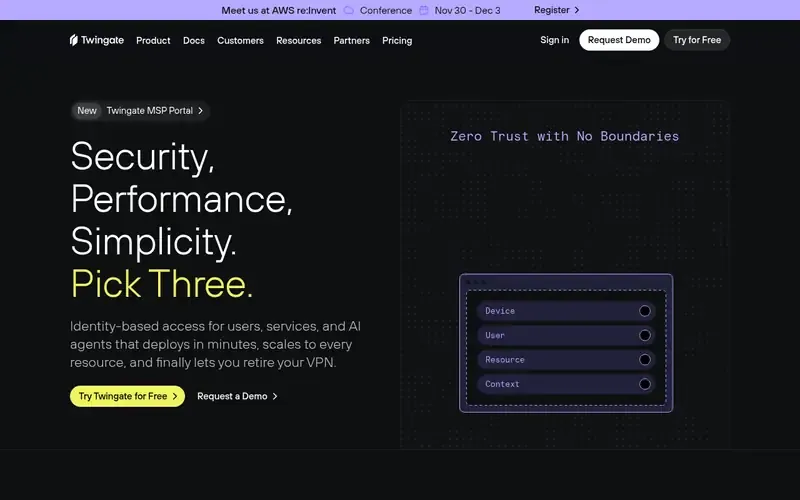
Twingate is an identity-based zero trust network access platform for users, services and AI agents, positioned as a way to retire VPNs. It is meant to replace VPNs, jump hosts and IP allowlists.
Documented strengths
- Resources can be private DNS names, private IPs or CIDR ranges, each isolated and hidden
- Outbound-only connections with no inbound ports open
- Device trust through MDM/EDR integrations and posture checks
- Access that expires automatically or locks after inactivity
- Managed as code via Terraform provider, Kubernetes Operator or GraphQL
Documented limits
Documented as a remote access platform for private resources, with secure internet access features alongside it. Teams that need deep web or SaaS inspection should check the vendor documentation for scope.
- Who it is for
- Per-resource access for distributed workforces
- Platforms
- Deployment via Docker scripts, Terraform and Helm Charts; other platforms not stated on official pages
- Pricing
- See the vendor's own pricing page for current plans and costs. twingate.com
- Facts checked
- 21 November 2026
Why it is placed here: It comes first because its documentation centers on per-resource access, with each resource isolated and hidden, which is the closest match to per-application access in place of flat network connectivity.
#2 · Zscaler
Zscaler Internet Access
Enterprises replacing firewall-centric web security
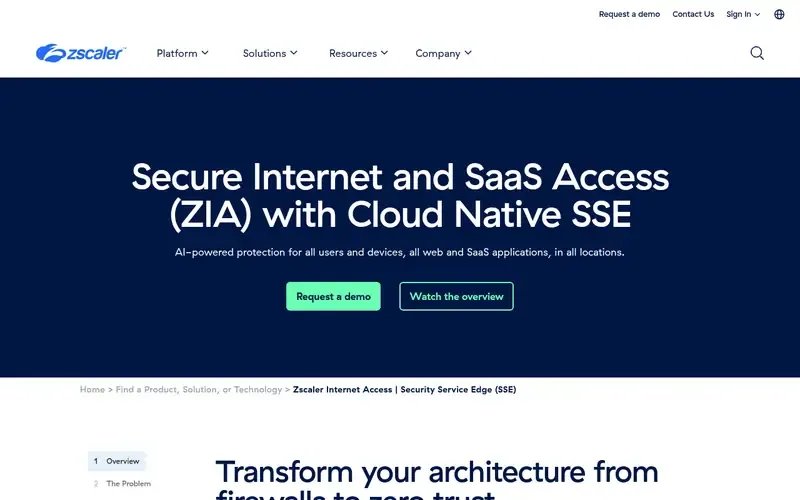
Zscaler Internet Access (ZIA) is a cloud native secure web gateway and security service edge (SSE) offering for secure internet and SaaS access. It is meant to replace legacy network security with zero trust connectivity.
Documented strengths
- TLS/SSL inspection of all traffic through a Single Scan, Multi-Action engine
- Intrusion Prevention System (IPS) and AI-based inline phishing detection
- Cloud Access Security Broker (CASB) for SaaS and IaaS environments
- Cloud DLP with Exact Data Match and Indexed Document Matching
- Dynamic access controls based on continuous risk analysis
Documented limits
Documented for secure internet and SaaS access, not for connecting users to private internal applications. Teams that need that should check the vendor documentation for how it is covered.
- Who it is for
- Enterprises replacing firewall-centric web security
- Platforms
- Not stated on official pages
- Pricing
- See the vendor's own pricing page for current plans and costs. zscaler.com
- Facts checked
- 21 November 2026
Why it is placed here: It sits second because it suits teams whose VPN replacement is driven by web and SaaS security and retiring firewall-centric architectures, rather than by access to private internal applications.
#3 · Tailscale Inc.
Tailscale
Engineering teams connecting devices and clouds
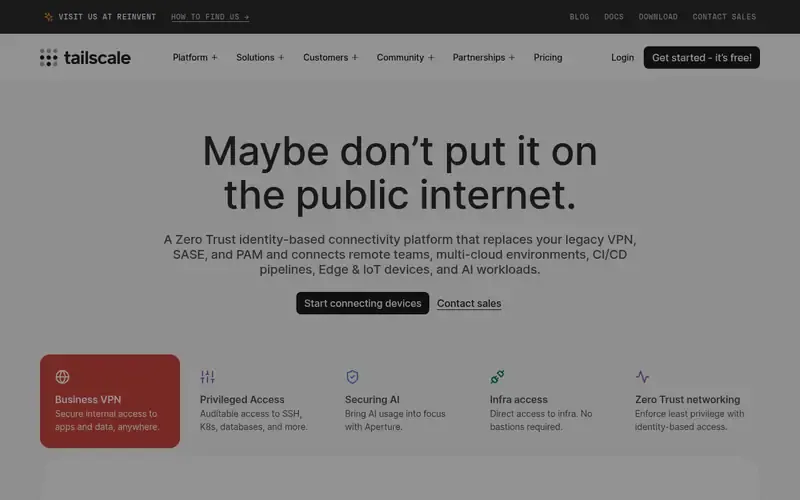
Tailscale is a zero trust, identity-based connectivity platform built on WireGuard. It replaces legacy VPN, SASE and PAM tools across many environments using a mesh overlay network.
Documented strengths
- Mesh overlay network connecting cloud and on-prem environments
- ACLs for users, roles and groups, manageable through GitOps with GitHub or GitLab
- Tailscale SSH without SSH key management, with session recordings stored in S3-compatible services or on local disk
- SCIM provisioning and sign-in through providers such as Google, Microsoft AD, GitHub, Okta and OneLogin
- MagicDNS for human-readable DNS names
Documented limits
Documented as a connectivity platform covering many environments, so teams that want strictly per-application access should check the vendor documentation on how ACLs map to that goal. The pages do not list supported operating systems.
- Who it is for
- Engineering teams connecting devices and clouds
- Platforms
- Not stated on official pages; can be embedded in Go programs
- Pricing
- See the vendor's own pricing page for current plans and costs. tailscale.com
- Facts checked
- 21 November 2026
Why it is placed here: It follows because its access model is identity-based and policy-driven with role-based ACLs, but it is built around a mesh network connecting devices, clouds and on-prem environments rather than a per-application gateway.
#4 · NetBird GmbH
Netbird
Teams wanting open-source, self-hostable ZTNA
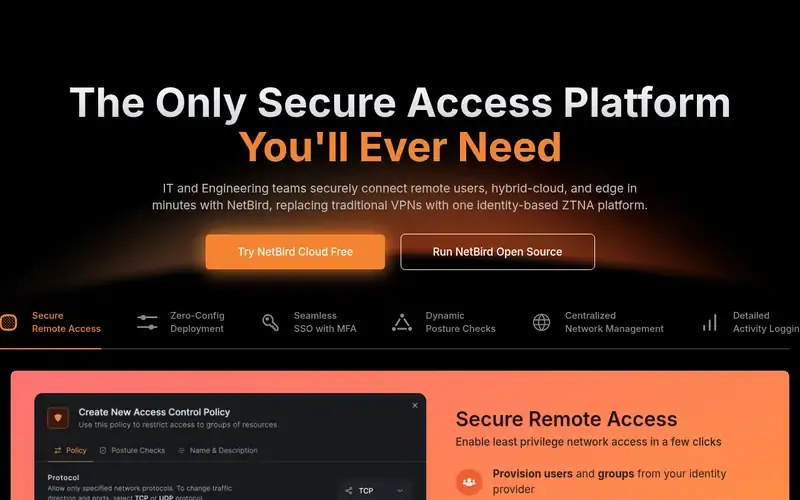
NetBird is an open-source, WireGuard-based overlay network and Zero Trust Network Access platform. It replaces traditional VPNs with identity-based secure access.
Documented strengths
- SSO login with providers such as Okta, Microsoft and Google, plus MFA enforcement
- Device posture checks that integrate with MDM and EDR solutions
- Connection traffic events logged and streamable to SIEM platforms
- Site-to-site connections between VPCs and on-premises sites
- BSD-3 licensed and self-hostable, alongside the NetBird Cloud offering
Documented limits
Documented as an overlay network with identity-based access. Teams that need web or SaaS inspection should check the vendor documentation, as it is not described on the official pages.
- Who it is for
- Teams wanting open-source, self-hostable ZTNA
- Platforms
- Desktop, mobile, containers and routers
- Pricing
- See the vendor's own pricing page for current plans and costs. netbird.io
- Facts checked
- 21 November 2026
Why it is placed here: It sits here because it pairs a peer-to-peer WireGuard network with identity-based ZTNA controls such as MFA and posture checks, and it adds a self-hosting option for teams that want to run it themselves.
#5 · Firezone Inc.
Firezone
Teams wanting self-run gateways and open source
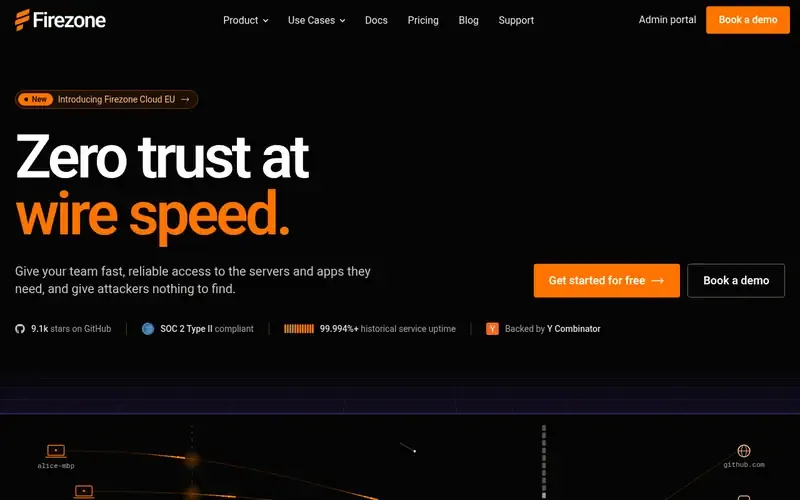
Firezone is an open-source zero trust access platform built on WireGuard, offered as a VPN replacement. It pairs WireGuard with a Rust data plane tuned for each operating system.
Documented strengths
- Gateways make only outbound connections, so no inbound ports are exposed
- Users and groups synced from Okta, Entra ID and Google Workspace
- MDM-issued device certificates with non-exportable keys, and custom posture rules from MDM and EDR data
- Logs of sign-ins, admin changes, API calls and network flows
- Managed as code with Terraform or the REST API
Documented limits
Documented for access to servers and apps, with the Gateway run by your own team. Teams that need web filtering or data loss prevention should check the vendor documentation.
- Who it is for
- Teams wanting self-run gateways and open source
- Platforms
- Gateway is a small Linux binary run on servers, VMs or containers; client platforms not stated on official pages
- Pricing
- See the vendor's own pricing page for current plans and costs. firezone.dev
- Facts checked
- 21 November 2026
Why it is placed here: It closes the list because its documentation focuses on giving teams access to servers and apps through self-run gateways, a good fit for teams that want to operate the infrastructure themselves, with fewer documented capabilities beyond access and logging.
Sources
- Twingate: twingate.com, twingate.com/about, twingate.com/product/ztna (21 Nov 2026)
- Zscaler Internet Access: zscaler.com/products-and-solutions/zscaler-internet-access, zscaler.com/custom-product-demo, zscaler.com/security-advisories (21 Nov 2026)
- Tailscale: tailscale.com, tailscale.com/features, tailscale.com/security (21 Nov 2026)
- Netbird: netbird.io, netbird.io/about (21 Nov 2026)
- Firezone: firezone.dev, firezone.dev/about (21 Nov 2026)
Related guides
How we compiled this
We looked at how well each tool fits the job of replacing a flat, network-wide VPN with per-application, identity-aware access. We also weighed how clearly each vendor documents its capabilities, such as identity provider integration, device posture checks, access policies and logging, and how clearly it documents deployment and platform support. We dropped one tool from the planned set because its documented scope is a consumer connectivity app, which does not match this use case.
All facts come from official vendor pages, and each page carries a check date. The order reflects editorial fit for this use case, and each entry explains its position in words. It does not say one tool is better overall. The list is built from vendor documentation rather than product trials, so verify details with the vendor before you commit to a rollout.
Order used: Ordered by fit for per-application, identity-aware access rather than flat network connectivity.
Common questions
What is zero trust network access and how does it differ from a VPN?
The vendors here position ZTNA as identity-based access to specific resources. Twingate, for example, isolates and hides each resource, and NetBird uses identity-based ZTNA in place of a traditional VPN. A legacy VPN is typically described as broader network connectivity.
Do these tools require opening inbound firewall ports?
Several vendors document that they do not. Twingate uses outbound-only connections with no inbound ports open, Firezone Gateways only make outbound connections, and NetBird states it removes the need for firewall configuration and open ports.
Which tools can enforce device posture checks?
Twingate, NetBird and Firezone all document device posture or trust checks tied to MDM and EDR integrations. Zscaler Internet Access documents dynamic access controls based on continuous risk analysis instead.
Are there open-source options for replacing a VPN?
Yes. NetBird is BSD-3 licensed and can be self-hosted, and Firezone's clients, gateways and control plane are public on GitHub. Both are built on WireGuard.
Can I manage zero trust access policies as code?
Several documented options exist. Twingate supports a Terraform provider, a Kubernetes Operator and GraphQL, Firezone supports Terraform and a REST API, NetBird offers an API for automation, and Tailscale ACLs can be managed through GitOps with GitHub or GitLab.
The editorial order is unpaid. A vendor can buy one labelled featured slot per guide, but it gets the same fact check as everyone else and cannot alter or remove a competitor's entry. Guidehurst is independent. Product names and logos belong to their respective owners.