For AppSec teams that want to find vulnerabilities in source code while developers are still writing it, this shortlist starts with Semgrep, CodeQL and Checkmarx One, followed by SonarQube and PMD. It is written for security teams shifting left who need to know where each tool runs, which security analysis it documents and what its scope boundaries are.
The shortlist
Side-by-side comparison
| Tool | Who it is for | Platforms | Pricing |
|---|---|---|---|
 SemgrepSemgrep | AppSec teams that want SAST, SCA and secrets scanning running in developer workflows | CLI, CI/CD, VS Code, JetBrains; PR checks on GitHub, GitLab, Bitbucket and Azure | Pricing on semgrep.dev |
 CodeQLGitHub | Security researchers and open source maintainers hunting vulnerability variants | CodeQL CLI and Visual Studio Code extension | Pricing on codeql.github.com |
 Checkmarx OneCheckmarx | Enterprise security teams that want SAST plus wider application risk in one platform | IDE, CI/CD and ticketing integrations; SCM integration for SBOM generation | Pricing on checkmarx.com |
 SonarQubeSonar | Teams that want security checks and quality gates on every pull request | Managed cloud (SonarQube Cloud) or self-hosted (SonarQube Server); major Git platforms and common editors | Pricing on sonarsource.com |
 PMDPMD | Java and Apex teams that want an open, extensible rule-based analyzer | Command line; IDE and CI plugins including Eclipse; Windows install via Chocolatey | Pricing on pmd.github.io |
Quick verdict by need
- Semgrep if you need appSec teams that want SAST, SCA and secrets scanning running in developer workflows.
- CodeQL if you need security researchers and open source maintainers hunting vulnerability variants.
- Checkmarx One if you need enterprise security teams that want SAST plus wider application risk in one platform.
- SonarQube if you need teams that want security checks and quality gates on every pull request.
- PMD if you need java and Apex teams that want an open, extensible rule-based analyzer.
Tool details
#1 · Semgrep
Semgrep
AppSec teams that want SAST, SCA and secrets scanning running in developer workflows
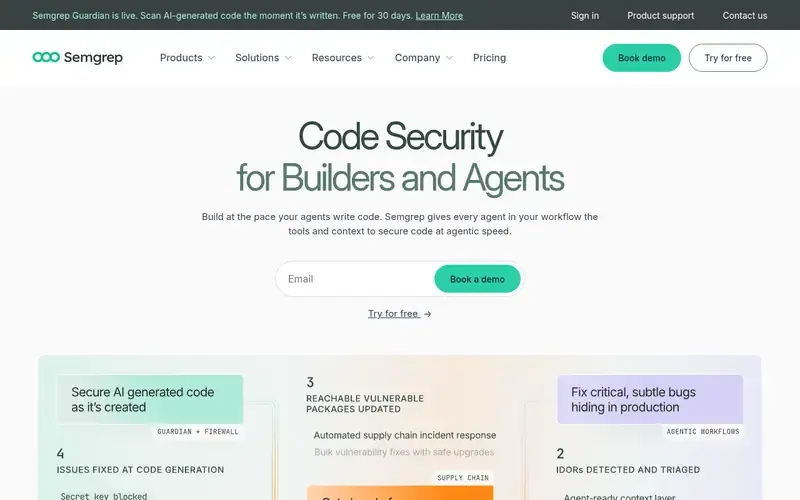
Semgrep is an application security platform that scans source code with SAST, SCA and secrets scanning in one product. It pairs deterministic static analysis with AI reasoning.
Documented strengths
- SAST, SCA and secrets scanning in one platform
- Detects IDORs, broken authorization and multi-step logic flaws
- Runs from the CLI, in CI/CD and in VS Code and JetBrains
- PR checks on GitHub, GitLab, Bitbucket and Azure
- MCP server for AI agents, with a read-only token option
Documented limits
The official pages describe capabilities in general terms. Teams that need a specific language or framework covered should check the vendor documentation.
- Who it is for
- AppSec teams that want SAST, SCA and secrets scanning running in developer workflows
- Platforms
- CLI, CI/CD, VS Code, JetBrains; PR checks on GitHub, GitLab, Bitbucket and Azure
- Pricing
- See the vendor's own pricing page for current plans and costs. semgrep.dev
- Facts checked
- 21 November 2026
Why it is placed here: It sits first because its documentation combines security-specific detection, such as IDORs and broken authorization, with CLI, CI/CD, IDE and pull request checks on four Git platforms.
#2 · GitHub
CodeQL
Security researchers and open source maintainers hunting vulnerability variants
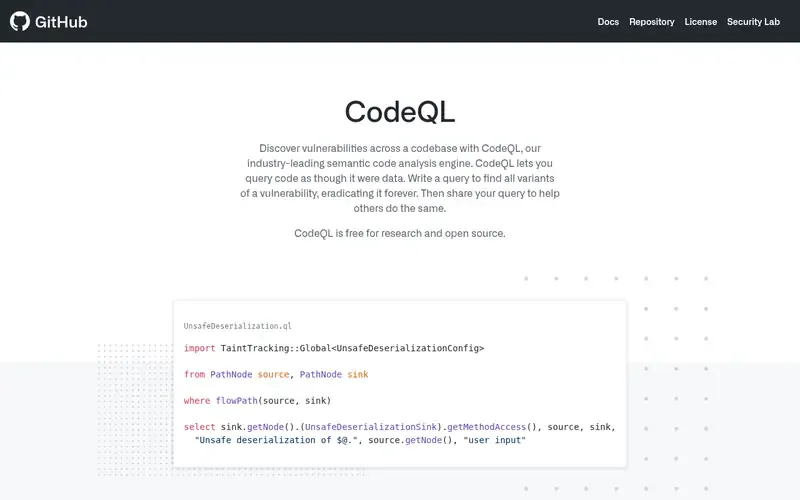
CodeQL is GitHub's semantic code analysis engine. It lets users query code as if it were data to find vulnerabilities across a codebase.
Documented strengths
- Query code as data to find all variants of a vulnerability
- Queries can be shared with others
- Taint tracking support
- Queries run from a Visual Studio Code extension
- Databases built with the CodeQL CLI or downloaded for open source projects
Documented limits
Documented use is restricted to OSI-approved open source codebases, academic research or specific automated-analysis cases. Other CI/CD use requires contacting the vendor's sales team.
- Who it is for
- Security researchers and open source maintainers hunting vulnerability variants
- Platforms
- CodeQL CLI and Visual Studio Code extension
- Pricing
- See the vendor's own pricing page for current plans and costs. codeql.github.com
- Facts checked
- 21 November 2026
Why it is placed here: It sits second because its query-based approach suits deep, variant-finding vulnerability work, while its documented licensing terms narrow which teams can use it in CI/CD.
#3 · Checkmarx
Checkmarx One
Enterprise security teams that want SAST plus wider application risk in one platform
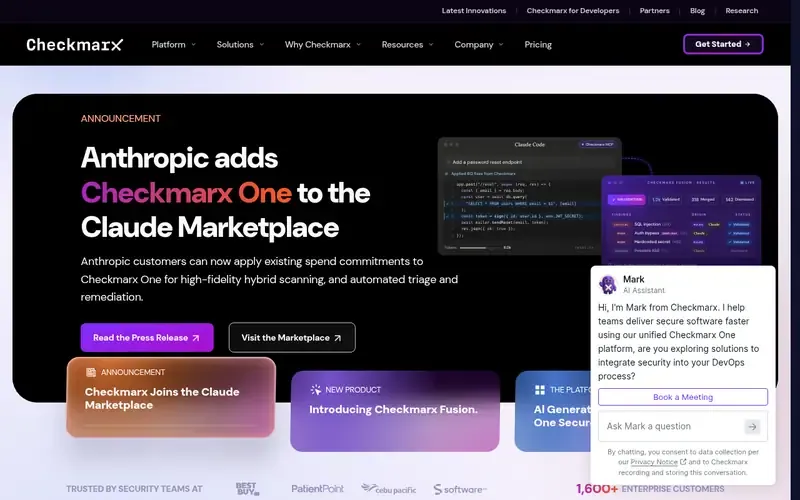
Checkmarx One is an agentic application security platform that combines hybrid scanning, AI agents and unified risk intelligence. Its hybrid engine pairs rules-based precision with Anthropic's AI.
Documented strengths
- SAST and IaC scanning in the IDE as code is written
- Secrets Detection that blocks credentials before they enter Git
- SCA and Malicious Package Protection before merge
- DAST to validate exploitability against running applications and APIs
- ASPM that accepts SARIF-based results from other AppSec tools
Documented limits
The documented scope is a full platform, so teams that only need source code scanning should check which modules they would use. Language coverage is not listed in the facts we collected.
- Who it is for
- Enterprise security teams that want SAST plus wider application risk in one platform
- Platforms
- IDE, CI/CD and ticketing integrations; SCM integration for SBOM generation
- Pricing
- See the vendor's own pricing page for current plans and costs. checkmarx.com
- Facts checked
- 21 November 2026
Why it is placed here: It sits third because SAST runs in the IDE as code is written and the platform adds secrets, dependency and runtime checks, but it is a broader platform than a focused code scanner.
#4 · Sonar
SonarQube
Teams that want security checks and quality gates on every pull request
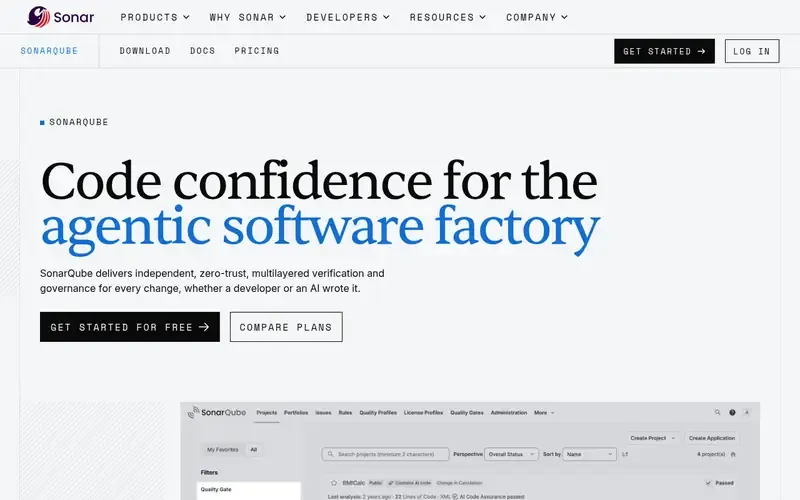
SonarQube is a code quality and security platform that automates reviews and verification of human-written and AI-generated code. It is available as managed cloud or self-hosted server.
Documented strengths
- SAST and taint analysis that trace untrusted input to injection flaws
- Quality gates that decide what merges and record every check
- Branch and pull request analysis across 45+ languages
- Secrets detection in the IDE, commits and pull requests
- Server edition can run self-managed, including air-gapped
Documented limits
SCA requires SonarQube Advanced Security. Teams that need dependency scanning should check the vendor documentation for what that involves.
- Who it is for
- Teams that want security checks and quality gates on every pull request
- Platforms
- Managed cloud (SonarQube Cloud) or self-hosted (SonarQube Server); major Git platforms and common editors
- Pricing
- See the vendor's own pricing page for current plans and costs. sonarsource.com
- Facts checked
- 21 November 2026
Why it is placed here: It sits fourth because its security analysis, including SAST and taint analysis, is delivered alongside code quality checks and quality gates, so security is one part of a wider scope.
#5 · PMD
PMD
Java and Apex teams that want an open, extensible rule-based analyzer
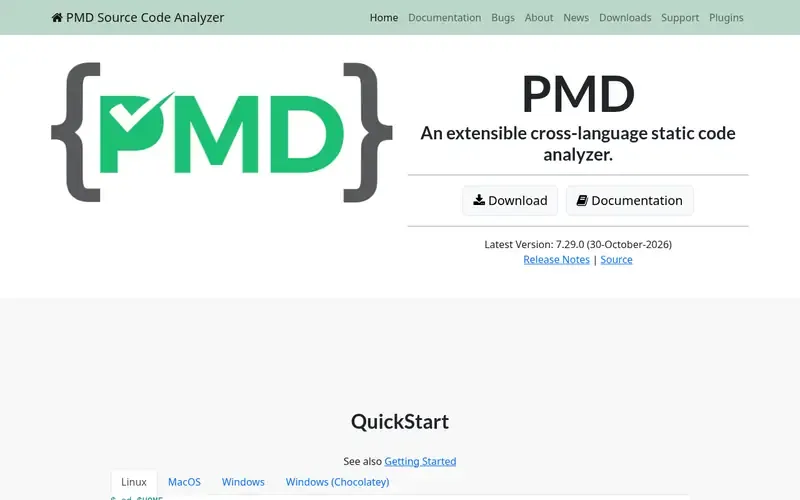
PMD is an extensible, cross-language static source code analyzer that finds common programming flaws such as unused variables, empty catch blocks and unnecessary object creation.
Documented strengths
- 400+ built-in rules, extendable with custom rules
- Custom rules written in Java or as XPath queries
- Focuses mainly on Java and Apex, with 16 other languages supported
- CPD copy-paste detector for duplicated code
- Eclipse plugin plus IDE and CI plugins
Documented limits
The documentation describes common flaws, not security vulnerability detection. Scala is supported, but no Scala rules are currently available.
- Who it is for
- Java and Apex teams that want an open, extensible rule-based analyzer
- Platforms
- Command line; IDE and CI plugins including Eclipse; Windows install via Chocolatey
- Pricing
- See the vendor's own pricing page for current plans and costs. pmd.github.io
- Facts checked
- 21 November 2026
Why it is placed here: It sits last because its documented rules target general code flaws rather than security vulnerabilities, so it works as a supplement to a security-focused scanner.
Sources
- Semgrep: semgrep.dev, semgrep.dev/about, semgrep.dev/solutions/mcp (21 Nov 2026)
- CodeQL: codeql.github.com (21 Nov 2026)
- Checkmarx One: checkmarx.com, checkmarx.com/product/aspm, checkmarx.com/product/sbom (21 Nov 2026)
- SonarQube: sonarsource.com/products/sonarqube (21 Nov 2026)
- PMD: pmd.github.io (21 Nov 2026)
Related guides
How we compiled this
We looked at three things: fit with finding security vulnerabilities in source code during development, the capabilities each vendor documents, and the deployment and platform documentation (CLI, CI/CD, IDE and pull request integration). Every fact in this list comes from official vendor pages, each recorded with a check date. We left out tools whose documentation does not describe a security-relevant use for this audience.
The order reflects editorial fit for this use case, explained in the "why it sits here" line on each entry: depth of security-focused analysis and how directly the tool plugs into CI and developer workflows. It does not say any tool is better overall. The list is built from documentation rather than product trials, so teams should confirm language coverage, rule depth and licensing against the vendor documentation before committing.
Order used: Ordered by security-focused rule depth and CI integration, closest fit first.
Common questions
What is static analysis in application security?
Static analysis scans source code without running it to find flaws. The tools here range from security-focused scanners such as Semgrep and SonarQube's taint analysis to general code-flaw analyzers such as PMD.
Which static analysis tools run in CI/CD and IDEs?
Semgrep runs from the CLI, in CI/CD and in VS Code and JetBrains. Checkmarx One runs SAST in the IDE and integrates with CI/CD, and SonarQube covers common editors and shows quality gate results in pull requests.
Can I use CodeQL on a private commercial codebase?
CodeQL's documented use is restricted to OSI-approved open source codebases, academic research or specific automated-analysis cases. Other CI/CD use requires contacting the vendor's sales team.
Does SonarQube include dependency scanning?
SonarQube documents SCA that detects known vulnerabilities and malicious packages, but it requires SonarQube Advanced Security. Semgrep and Checkmarx One list SCA as part of their platforms.
Is PMD a security scanner?
PMD's documentation describes finding common programming flaws such as unused variables and empty catch blocks. It does not describe itself as a vulnerability scanner, so AppSec teams usually pair it with a security-focused tool.
The editorial order is unpaid. A vendor can buy one labelled featured slot per guide, but it gets the same fact check as everyone else and cannot alter or remove a competitor's entry. Guidehurst is independent. Product names and logos belong to their respective owners.