For teams shipping Python, Ruby on Rails and PHP, this shortlist starts with Semgrep, Bandit and Brakeman, then covers Psalm, Opengrep, Horusec and Snyk Code. It is written for developers and AppSec teams who want to catch injection, cross-site scripting and similar flaws in source code before release. The tools differ in scope: some target one language or framework, others cover many languages.
The shortlist
Side-by-side comparison
| Tool | Who it is for | Platforms | Pricing |
|---|---|---|---|
 SemgrepSemgrep | Teams wanting one platform for code, dependency and secrets scanning | CLI, CI/CD, VS Code and JetBrains IDEs, GitHub, GitLab, Bitbucket and Azure PR checks, MCP integrations | Pricing on semgrep.dev |
 BanditPyCQA | Python developers adding a security linter | Container image on ghcr.io; otherwise not stated on official pages | Pricing on github.com |
 BrakemanBrakeman | Ruby on Rails developers | Installed as a gem and run with the brakeman command | Pricing on brakemanscanner.org |
 PsalmVimeo | PHP teams that want type checking and taint analysis together | Configured through psalm.xml; other platforms not stated on official pages | Pricing on psalm.dev |
 OpengrepOpengrep | Teams that write their own rules and run SAST in CI | Supports 30+ languages; CI mode and a desktop playground; Cosign-signed release binaries | Pricing on opengrep.dev |
| HorusecZupIT | DevSecOps teams who want several scanners behind one CLI | CLI, CI/CD, Docker image, Visual Studio Code extension, release binaries | Pricing on github.com |
 Snyk CodeSnyk | Developers who want scanning and one-click fixes inside the IDE and PRs | IDEs, pull requests and CI/CD tools | Pricing on snyk.io |
Quick verdict by need
- Semgrep if you need teams wanting one platform for code, dependency and secrets scanning.
- Bandit if you need python developers adding a security linter.
- Brakeman if you need ruby on Rails developers.
- Psalm if you need pHP teams that want type checking and taint analysis together.
- Opengrep if you need teams that write their own rules and run SAST in CI.
- Horusec if you need devSecOps teams who want several scanners behind one CLI.
Tool details
#1 · Semgrep
Semgrep
Teams wanting one platform for code, dependency and secrets scanning
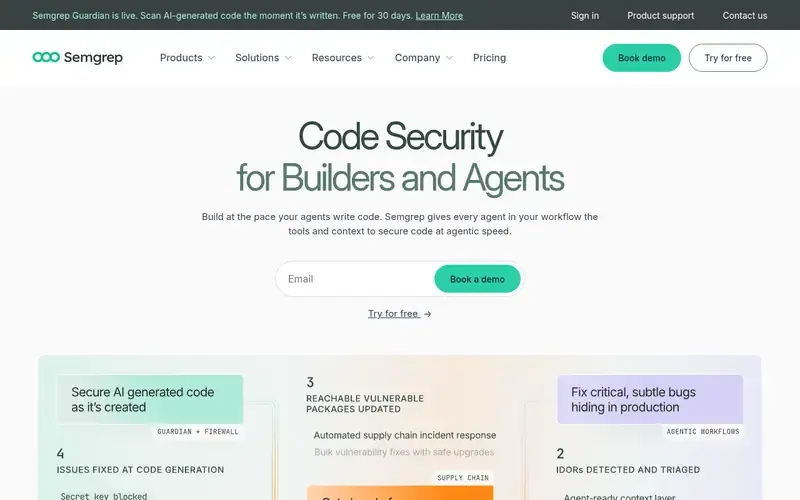
Semgrep is an extensible application security platform that scans source code, combining SAST, SCA and secrets scanning with deterministic static analysis and AI reasoning.
Documented strengths
- SAST, SCA and secrets scanning in one platform
- Detects complex issues such as IDORs and broken authorization
- PR checks on GitHub, GitLab, Bitbucket and Azure
- Triage decisions become reusable memories that suppress repeat false positives
- Remediation guidance in PRs and IDEs
Documented limits
The official pages summarized here do not list per-language rule coverage for Python, Ruby or PHP. Check the vendor documentation and the Semgrep Registry for your stack.
- Who it is for
- Teams wanting one platform for code, dependency and secrets scanning
- Platforms
- CLI, CI/CD, VS Code and JetBrains IDEs, GitHub, GitLab, Bitbucket and Azure PR checks, MCP integrations
- Pricing
- See the vendor's own pricing page for current plans and costs. semgrep.dev
- Facts checked
- 21 November 2026
Why it is placed here: It leads because it targets the flaw classes this audience worries about, including IDORs and broken authorization, and it plugs into the CLI, CI/CD and IDE workflows web teams already use.
#2 · PyCQA
Bandit
Python developers adding a security linter
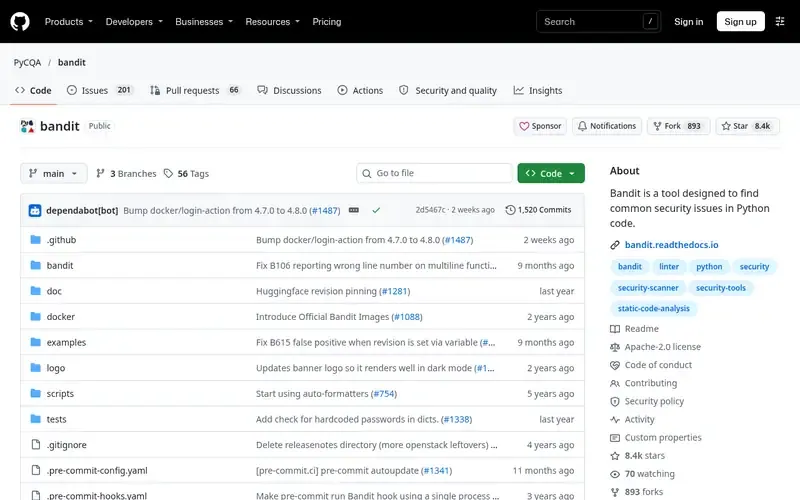
Bandit is an open-source security linter from PyCQA that finds common security issues in Python code. It parses each file into an AST and runs plugins against the nodes.
Documented strengths
- Parses each file into an AST and runs plugins on the nodes
- Generates a report after scanning all files
- Extensible AST node coverage
- Container image on ghcr.io signed with sigstore cosign
- README badge for projects
Documented limits
Documented for Python only; teams with Ruby or PHP code need other tools. The official pages do not describe taint tracking across files.
- Who it is for
- Python developers adding a security linter
- Platforms
- Container image on ghcr.io; otherwise not stated on official pages
- Pricing
- See the vendor's own pricing page for current plans and costs. github.com
- Facts checked
- 21 November 2026
Why it is placed here: It sits second because it is purpose-built for Python security, which makes it a natural first scanner for the Python part of a mixed stack.
#3 · Brakeman
Brakeman
Ruby on Rails developers
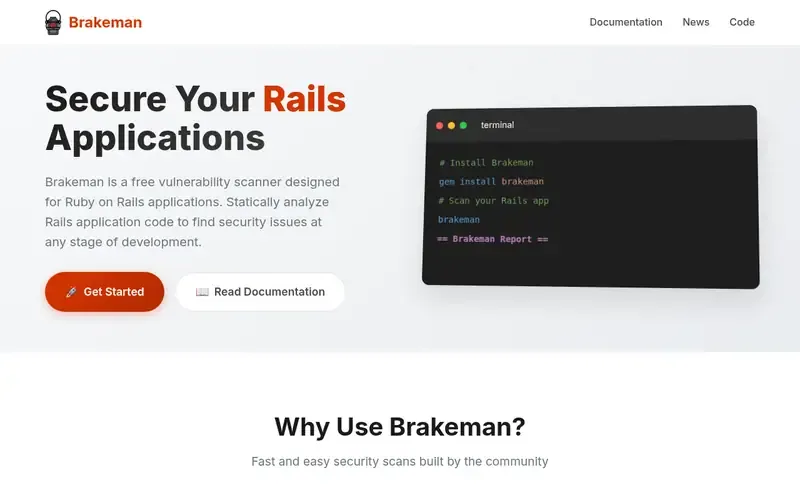
Brakeman is a static analysis security vulnerability scanner built specifically for Ruby on Rails applications and developed by the community.
Documented strengths
- Understands Rails conventions
- Detects SQL injection, cross-site scripting and command injection
- Works with sensible defaults out of the box
- Checks validation regexes, including in non-ActiveRecord models
- SonarQube report in the generic issue format
Documented limits
Documented for Rails applications only. Teams that also ship Python or PHP services need a separate tool for those.
- Who it is for
- Ruby on Rails developers
- Platforms
- Installed as a gem and run with the brakeman command
- Pricing
- See the vendor's own pricing page for current plans and costs. brakemanscanner.org
- Facts checked
- 21 November 2026
Why it is placed here: It is the Rails-specific option here: it understands Rails conventions and detects SQL injection, cross-site scripting and command injection.
#4 · Vimeo
Psalm
PHP teams that want type checking and taint analysis together
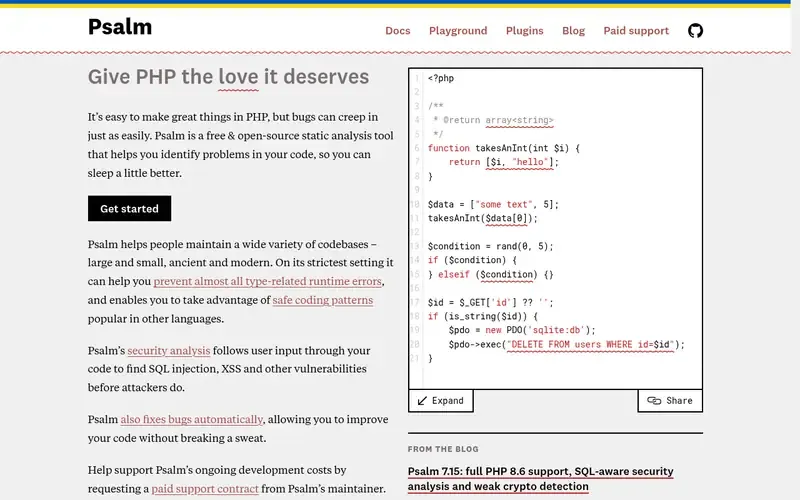
Psalm is an open-source static analysis tool for PHP that finds code problems and performs taint-based security analysis.
Documented strengths
- Taint analysis traces data through assignments, calls and array/property access
- Finds SQL injection, XSS and other vulnerabilities
- Default sources include PHP superglobals and data read from servers and the network
- Custom taint types and sources
- Taint analysis runs by default alongside type checking
Documented limits
Documented for PHP only. The official pages do not name specific PHP frameworks, so teams should check the vendor documentation for their framework.
- Who it is for
- PHP teams that want type checking and taint analysis together
- Platforms
- Configured through psalm.xml; other platforms not stated on official pages
- Pricing
- See the vendor's own pricing page for current plans and costs. psalm.dev
- Facts checked
- 21 November 2026
Why it is placed here: It is the PHP-specific entry, and its taint analysis follows user input to sinks, which maps directly to injection hunting.
#5 · Opengrep
Opengrep
Teams that write their own rules and run SAST in CI
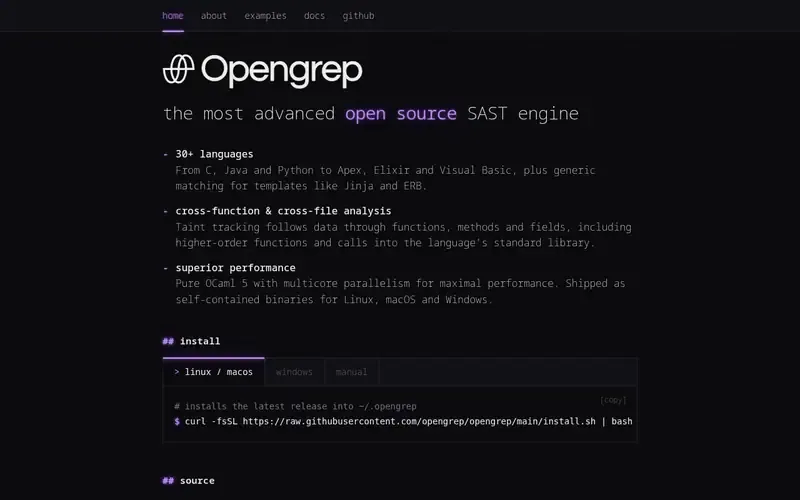
Opengrep is an open-source SAST engine, a fork of Semgrep under LGPL 2.1, that analyzes source code against rules without executing it.
Documented strengths
- Cross-function and cross-file taint analysis, with the interfile option
- User-declared taint sources, sinks and sanitizers
- CI mode reports only findings a pull request introduces
- Outputs SARIF, JSON, JUnit XML and GitLab formats
- Autofixes that can be previewed with a dry run
Documented limits
It is documented as an engine that checks code against rules, so teams should confirm that rules for their Python, Ruby and PHP frameworks are available. The official pages do not say which rule sets ship with it.
- Who it is for
- Teams that write their own rules and run SAST in CI
- Platforms
- Supports 30+ languages; CI mode and a desktop playground; Cosign-signed release binaries
- Pricing
- See the vendor's own pricing page for current plans and costs. opengrep.dev
- Facts checked
- 22 November 2026
Why it is placed here: It follows Semgrep because it offers a similar rule-based approach with cross-function and cross-file taint analysis, but it is a general engine rather than a set of Python, Ruby or PHP security rules.
#6 · ZupIT
Horusec
DevSecOps teams who want several scanners behind one CLI
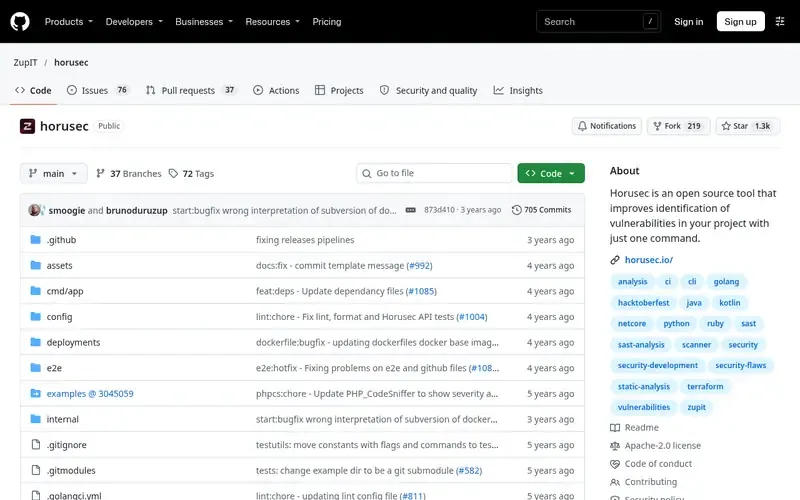
Horusec is an open-source tool that performs static code analysis to find security flaws during development. It runs multiple security tools across languages at once.
Documented strengths
- Searches for key leaks in project files and Git history
- Runs multiple security tools across languages for accuracy
- Web dashboard with false-positive control and authorization tokens
- Visual Studio Code extension
- Fully configurable through CLI options
Documented limits
The official pages say it supports many languages but do not list Python, Ruby or PHP rules in detail. Full analysis needs Docker; a flag disables that dependency at the cost of analysis power.
- Who it is for
- DevSecOps teams who want several scanners behind one CLI
- Platforms
- CLI, CI/CD, Docker image, Visual Studio Code extension, release binaries
- Pricing
- See the vendor's own pricing page for current plans and costs. github.com
- Facts checked
- 22 November 2026
Why it is placed here: It is placed after the language-specific tools because its strength is breadth: multi-tool orchestration, Git history search and a vulnerability dashboard.
#7 · Snyk
Snyk Code
Developers who want scanning and one-click fixes inside the IDE and PRs
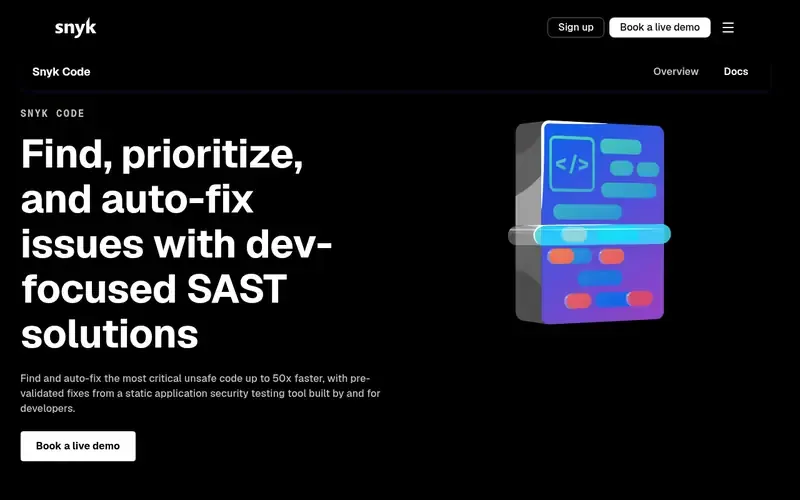
Snyk Code is a developer-focused SAST tool that scans source code for vulnerabilities and offers auto-fixes in the IDE and in pull requests.
Documented strengths
- Scans without a build, in the IDE and in pull requests
- Context-specific explanations and one-click auto-fixes
- Uses application context to prioritize riskier issues and reduce noise
- Snyk Agent Fix for automatically fixing vulnerabilities
- Scans every pull request and repository for a status report
Documented limits
The official pages say it works with most popular languages but do not list specific Python, Ruby or PHP coverage. Check the vendor documentation for your languages and frameworks.
- Who it is for
- Developers who want scanning and one-click fixes inside the IDE and PRs
- Platforms
- IDEs, pull requests and CI/CD tools
- Pricing
- See the vendor's own pricing page for current plans and costs. snyk.io
- Facts checked
- 22 November 2026
Why it is placed here: It closes the list because it is a general-purpose SAST tool for most popular languages, and its main distinction is auto-fix rather than depth of rules for these three languages.
Sources
- Semgrep: semgrep.dev, semgrep.dev/about, semgrep.dev/solutions/mcp (21 Nov 2026)
- Bandit: github.com/PyCQA/bandit, github.com/about, github.com/features (21 Nov 2026)
- Brakeman: brakemanscanner.org (21 Nov 2026)
- Psalm: psalm.dev, psalm.dev/docs/security_analysis (21 Nov 2026)
- Opengrep: opengrep.dev, opengrep.dev/about.html (22 Nov 2026)
- Horusec: github.com/ZupIT/horusec, github.com/about, github.com/features (22 Nov 2026)
- Snyk Code: snyk.io/product/snyk-code, snyk.io/about, snyk.io/platform (22 Nov 2026)
Related guides
How we compiled this
We looked at how well each tool fits the job of scanning dynamic-language web apps for injection and other security flaws. The criteria were documented capabilities for Python, Rails and PHP, the depth of the security analysis described (for example taint tracking or framework-aware checks), and the deployment and platform documentation: CLI, CI/CD, IDE and container options. Tools with dedicated rules for a specific language or framework are placed ahead of broader multi-language scanners.
All facts come from each vendor's official pages, with the date of each check recorded. The order reflects editorial fit for this use case, and the reasoning is given in each entry; it does not mean one tool is better overall. This list is built from documentation, not from product trials, so teams should confirm language and framework coverage in the vendor documentation before adopting a tool.
Order used: Ordered by depth of security rules for these specific languages and frameworks, then by general multi-language coverage.
Common questions
Which static analysis tool is built specifically for Ruby on Rails?
Brakeman is a static analysis security vulnerability scanner built for Rails applications. It understands Rails conventions and detects SQL injection, cross-site scripting and command injection.
How can I find SQL injection and XSS in PHP code with static analysis?
Psalm's taint analysis tracks user input from sources such as PHP superglobals to sinks, and it is documented to find SQL injection, XSS and other vulnerabilities. Taint analysis runs by default alongside type checking.
Is there a security linter for Python code?
Bandit, from PyCQA, is a security linter that finds common security issues in Python code. It parses each file into an AST, runs plugins against the nodes and produces a report after scanning all files.
Can one tool cover Python, Ruby and PHP together?
Semgrep, Opengrep, Horusec and Snyk Code are documented as multi-language tools. Their official pages do not give per-language rule coverage for all three languages, so check the vendor documentation for your frameworks.
What is the difference between Semgrep and Opengrep?
Opengrep is a fork of Semgrep under the LGPL 2.1 license. It was created after Semgrep moved critical features behind a commercial license, and it supports cross-function and cross-file taint analysis. Semgrep is a broader platform that also covers SCA and secrets scanning.
The editorial order is unpaid. A vendor can buy one labelled featured slot per guide, but it gets the same fact check as everyone else and cannot alter or remove a competitor's entry. Guidehurst is independent. Product names and logos belong to their respective owners.