If you release to Azure and Google Cloud and need approvals and rollbacks, start with Azure DevOps Release Pipelines, Google Cloud Deploy and Octopus Deploy. This shortlist is for teams that run workloads on both clouds, or are choosing a delivery tool for one of them without locking out the other. Harness and Spinnaker follow as cloud-neutral options.
The shortlist
Side-by-side comparison
| Tool | Who it is for | Platforms | Pricing |
|---|---|---|---|
 Azure DevOps Release PipelinesMicrosoft | Teams that plan, build and deploy on Azure DevOps | Linux, macOS and Windows; deploys to any cloud or on-premises | Pricing on azure.microsoft.com |
 Google Cloud DeployGoogle Cloud | Teams delivering to GKE and Cloud Run with formal promotion | Managed service for GKE, Cloud Run and Anthos | Pricing on cloud.google.com |
 Octopus DeployOctopus Deploy | Teams that want one deployment process across several clouds | Multi-cloud, hybrid and on-premises environments | Pricing on octopus.com |
 HarnessHarness | Platform teams that want governed, auditable delivery | Not stated on official pages | Pricing on harness.io |
 SpinnakerSpinnaker Project | Teams standardizing release processes across clouds | Multi-cloud, including Kubernetes and Azure | Pricing on spinnaker.io |
Quick verdict by need
- Azure DevOps Release Pipelines if you need teams that plan, build and deploy on Azure DevOps.
- Google Cloud Deploy if you need teams delivering to GKE and Cloud Run with formal promotion.
- Octopus Deploy if you need teams that want one deployment process across several clouds.
- Harness if you need platform teams that want governed, auditable delivery.
- Spinnaker if you need teams standardizing release processes across clouds.
Tool details
#1 · Microsoft
Azure DevOps Release Pipelines
Teams that plan, build and deploy on Azure DevOps
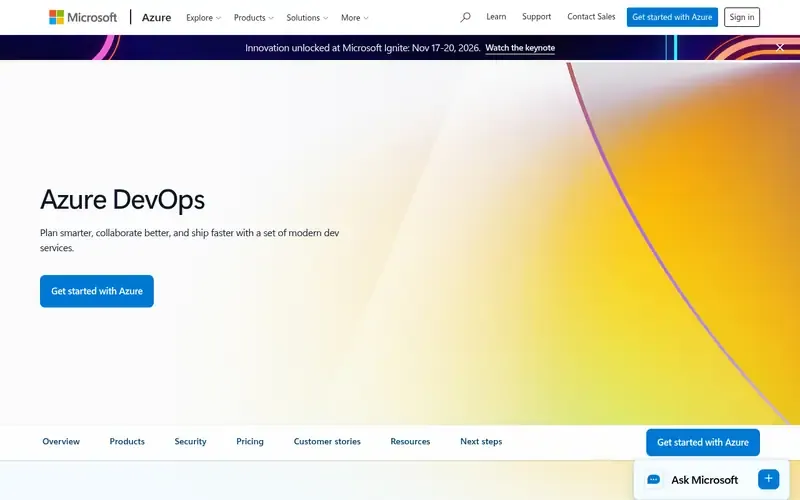
Azure DevOps is a Microsoft set of development services covering planning, CI/CD, testing, security and Git repositories. Azure Pipelines handles build and deployment.
Documented strengths
- CI/CD that builds, tests and deploys in any language, to any cloud or on-premises
- Parallel runs on Linux, macOS and Windows
- Connects to GitHub or any other Git provider
- Customizable agent pools
- Azure Artifacts package hosting integrated with Azure Pipelines
Documented limits
The verified pages describe CI/CD and continuous deployment but do not detail approval gates or rollback behavior. Teams that need those should check the vendor documentation.
- Who it is for
- Teams that plan, build and deploy on Azure DevOps
- Platforms
- Linux, macOS and Windows; deploys to any cloud or on-premises
- Pricing
- See the vendor's own pricing page for current plans and costs. azure.microsoft.com
- Facts checked
- 21 November 2026
Why it is placed here: It comes from Microsoft and is documented to deploy to any cloud or on-premises, so it fits teams whose Azure work already lives in Azure DevOps.
#2 · Google Cloud
Google Cloud Deploy
Teams delivering to GKE and Cloud Run with formal promotion
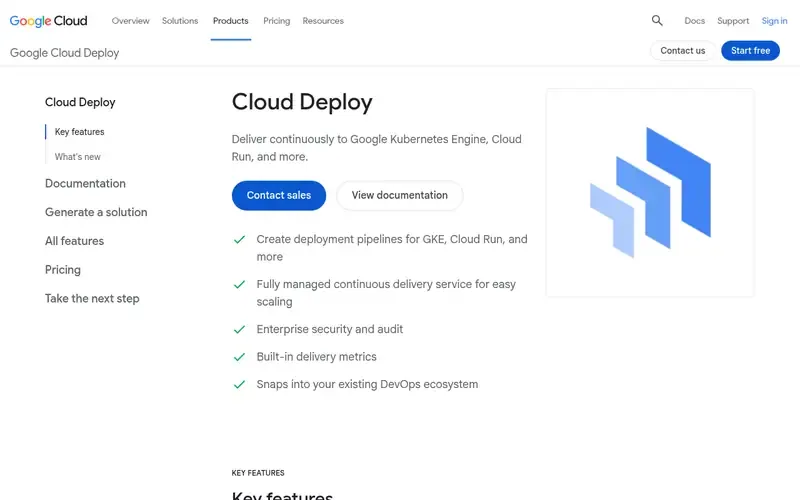
Google Cloud Deploy is a managed, opinionated continuous delivery service for GKE, Cloud Run and Anthos. Deployments are declarative and based on desired end states.
Documented strengths
- Releases progress through environments such as test, stage and production
- Promotion and rollback through the console, CLI or API
- Release promotion approvals integrated with IAM
- Canary deployments, plus pre-deployment and post-deployment actions
- Collective rollback when a multi-target deployment fails
Documented limits
It is documented for GKE, Cloud Run and Anthos. Teams that need to deploy to Azure should check the vendor documentation on custom target types.
- Who it is for
- Teams delivering to GKE and Cloud Run with formal promotion
- Platforms
- Managed service for GKE, Cloud Run and Anthos
- Pricing
- See the vendor's own pricing page for current plans and costs. cloud.google.com
- Facts checked
- 21 November 2026
Why it is placed here: It is Google Cloud's own delivery service and documents promotion approvals and rollback directly, so it sits first for Google Cloud targets.
#3 · Octopus Deploy
Octopus Deploy
Teams that want one deployment process across several clouds
Octopus Deploy is continuous deployment and delivery software for multi-cloud, hybrid and on-premises environments. It is built to take over from a CI tool and handle release, deployment and operations.
Documented strengths
- ITSM approvals, RBAC and OpenID Connect support
- Step timeouts, retries and a guided failure mode
- Runbooks for routine and emergency operations tasks
- Tenants that let one deployment process serve many customers
- Insights reporting based on the four DORA metrics
Documented limits
It is designed to follow a CI tool rather than replace one. The verified pages do not list specific Azure or Google Cloud targets, so check the vendor documentation for those.
- Who it is for
- Teams that want one deployment process across several clouds
- Platforms
- Multi-cloud, hybrid and on-premises environments
- Pricing
- See the vendor's own pricing page for current plans and costs. octopus.com
- Facts checked
- 21 November 2026
Why it is placed here: It is the first cloud-neutral option here, and it is documented as complementing CI tools including Azure DevOps while adding approvals and failure handling.
#4 · Harness
Harness
Platform teams that want governed, auditable delivery
Harness is a unified AI software delivery platform that manages the SDLC using purpose-built AI agents. It also covers risk detection and pipeline governance.
Documented strengths
- OPA-based guardrails on what Harness AI is allowed to do
- Logged and reviewable AI decisions
- Agents that run in the customer's infrastructure with an audit trail
- Worker Agents that execute remediations as governed pipeline steps
- Integrations with source control, issue tracking, infrastructure and secrets tools
Documented limits
The verified pages emphasize AI agents and governance and do not detail approval flows, rollback behavior or Azure and Google Cloud targets. Check the vendor documentation for those.
- Who it is for
- Platform teams that want governed, auditable delivery
- Platforms
- Not stated on official pages
- Pricing
- See the vendor's own pricing page for current plans and costs. harness.io
- Facts checked
- 21 November 2026
Why it is placed here: It suits teams that put governance and audit trails first, which matters when approvals span two clouds.
#5 · Spinnaker Project
Spinnaker
Teams standardizing release processes across clouds
Spinnaker is an open-source, multi-cloud continuous delivery platform with flexible pipeline management and integrations to major cloud providers. It was created at Netflix.
Documented strengths
- Manual judgment stage that can require approval before a release
- Blue/green and canary deployment strategies
- Immutable images for faster rollouts and easier rollbacks
- Stage execution restricted to specific time windows
- Notifications through email, Slack, HipChat or SMS
Documented limits
The documented provider list names AWS EC2, Kubernetes, Azure and Oracle Cloud Infrastructure. Teams targeting Google Cloud should check the vendor documentation.
- Who it is for
- Teams standardizing release processes across clouds
- Platforms
- Multi-cloud, including Kubernetes and Azure
- Pricing
- See the vendor's own pricing page for current plans and costs. spinnaker.io
- Facts checked
- 21 November 2026
Why it is placed here: It documents a manual approval stage, built-in deployment strategies and rollback-friendly immutable images, and it names Azure among its targets.
Sources
- Azure DevOps Release Pipelines: azure.microsoft.com/en-us/products/devops, azure.microsoft.com/en-us/products (21 Nov 2026)
- Google Cloud Deploy: cloud.google.com/deploy (21 Nov 2026)
- Octopus Deploy: octopus.com, octopus.com/use-case/platform-hub, octopus.com/publications/future-of-platform-engineering-report (21 Nov 2026)
- Harness: harness.io, harness.io/why-harness, harness.io/demo/platform (21 Nov 2026)
- Spinnaker: spinnaker.io (21 Nov 2026)
Related guides
How we compiled this
We looked at how well each tool fits the use case: releasing to Azure and Google Cloud environments with approvals and rollbacks. We also looked at the documented capabilities for promotion, approval and failure handling, and at what the official pages say about deployment targets and platforms. Facts come from official vendor pages, with the check date recorded for each.
The order reflects editorial fit for this use case. Tools with a native connection to Azure or Google Cloud come first, followed by cloud-neutral options. It is not a statement that one tool is better overall. The list is built from vendor documentation, not product trials, so where the documentation does not cover a point we say so in the Limits line and point you to the vendor.
Order used: Ordered by native fit with Azure and Google Cloud targets, then cloud-neutral options.
Common questions
Which of these tools support manual approvals before a release?
Google Cloud Deploy documents formal release promotion approvals integrated with IAM. Spinnaker has a manual judgment stage that can require approval before a release. Octopus Deploy provides ITSM approvals.
Which tools document rollback?
Google Cloud Deploy offers rollback through the console, CLI or API and rolls back collectively when a multi-target deployment fails. Spinnaker supports immutable images for easier rollbacks. Octopus Deploy documents retries and a guided failure mode.
Can Octopus Deploy be used with Azure DevOps?
Octopus is positioned as complementing CI tools such as GitHub Actions, Azure DevOps, Jenkins, GitLab CI and TeamCity. It is designed to take over from the CI tool for release, deployment and operations.
Can Azure DevOps deploy to Google Cloud?
Microsoft documents that Azure DevOps CI/CD builds, tests and deploys to any cloud or on-premises. For approval and rollback specifics on Google Cloud, check the vendor documentation.
The editorial order is unpaid. A vendor can buy one labelled featured slot per guide, but it gets the same fact check as everyone else and cannot alter or remove a competitor's entry. Guidehurst is independent. Product names and logos belong to their respective owners.