For permanent gateway-to-gateway tunnels, start with strongSwan, WireGuard and OpenVPN: an IPsec/IKE implementation, a minimal kernel-level VPN, and a business VPN that links offices and clouds. This shortlist is for network administrators and small IT teams who need to connect offices, data centers and cloud networks, and it also covers firewall platforms and a multi-protocol VPN program that can terminate tunnels.
The shortlist
Side-by-side comparison
| Tool | Who it is for | Platforms | Pricing |
|---|---|---|---|
 strongSwanstrongSwan Project | IPsec gateway tunnels that need certificate-based authentication | Linux, with ports to several other operating systems; NetworkManager plugin for Linux desktops | Pricing on strongswan.org |
 WireGuardJason A. Donenfeld | Simple, fast point-to-point tunnels between gateways | Linux, Windows, macOS, BSD, iOS and Android | Pricing on wireguard.com |
 OpenVPNOpenVPN Inc. | Teams that want a managed or self-hosted business VPN linking offices and clouds | Cloud-delivered (CloudConnexa) or self-hosted (Access Server) on several platforms and virtualization environments | Pricing on openvpn.net |
 pfSenseNetgate | Small IT teams that want the tunnel endpoint and firewall on one device | FreeBSD-based distribution; Netgate hardware appliances and virtual appliances on AWS and Azure | Pricing on pfsense.org |
 OPNsenseDeciso | Firewall-based tunnel termination with failover between sites | FreeBSD-based; official OPNsense hardware appliances are also sold | Pricing on opnsense.org |
 Fortinet FortiGateFortinet | Larger or distributed estates standardizing on one firewall platform across data centers, branches and clouds | Physical, virtualized and cloud environments | Pricing on fortinet.com |
 SoftEther VPNSoftEther VPN Project | Sites behind NAT or restrictive firewalls that need Layer 2 bridging or flexible tunneling protocols | Several desktop and server operating systems | Pricing on softether.org |
Quick verdict by need
- strongSwan if you need iPsec gateway tunnels that need certificate-based authentication.
- WireGuard if you need simple, fast point-to-point tunnels between gateways.
- OpenVPN if you need teams that want a managed or self-hosted business VPN linking offices and clouds.
- pfSense if you need small IT teams that want the tunnel endpoint and firewall on one device.
- OPNsense if you need firewall-based tunnel termination with failover between sites.
- Fortinet FortiGate if you need larger or distributed estates standardizing on one firewall platform across data centers, branches and clouds.
Tool details
#1 · strongSwan Project
strongSwan
IPsec gateway tunnels that need certificate-based authentication
strongSwan is an open-source, modular and portable IPsec-based VPN solution that implements the IKE protocols. It is extensible through a plugin system.
Documented strengths
- IKEv2 with IKEv1 also supported
- NAT traversal via UDP encapsulation and port floating
- X.509 certificates or pre-shared keys, with CRL and OCSP revocation checking
- Keys and certificates on a smartcard or protected by a TPM 2.0
- Post-quantum key exchanges including ML-KEM
Documented limits
It is a VPN software stack rather than a full firewall platform, so you assemble the surrounding routing and firewall setup yourself. Teams that need a specific topology or interoperability with a given vendor's gateway should check the strongSwan documentation.
- Who it is for
- IPsec gateway tunnels that need certificate-based authentication
- Platforms
- Linux, with ports to several other operating systems; NetworkManager plugin for Linux desktops
- Pricing
- See the vendor's own pricing page for current plans and costs. strongswan.org
- Facts checked
- 21 November 2026
Why it is placed here: It sits first because IPsec with IKEv2 is the standard approach to permanent gateway-to-gateway tunnels, and strongSwan documents the NAT traversal, certificate and key-handling features those tunnels rely on.
#2 · Jason A. Donenfeld
WireGuard
Simple, fast point-to-point tunnels between gateways
WireGuard is a simple, fast and modern VPN built on state-of-the-art cryptography. It adds a network interface such as wg0 and encapsulates IP packets over UDP.
Documented strengths
- Peers set up by exchanging public keys, as with SSH keys
- Cryptokey Routing ties public keys to the tunnel IP addresses allowed for each peer
- Runs inside the Linux kernel; userspace options such as wireguard-go
- IPv4 and IPv6 can be combined and encapsulated in each other
- Small design intended to be easy to audit
Documented limits
Key distribution and pushed configuration are out of scope, so you need your own process for managing keys and peer settings across many sites. Teams that need centralized management should check the vendor documentation and any tooling they plan to add.
- Who it is for
- Simple, fast point-to-point tunnels between gateways
- Platforms
- Linux, Windows, macOS, BSD, iOS and Android
- Pricing
- See the vendor's own pricing page for current plans and costs. wireguard.com
- Facts checked
- 21 November 2026
Why it is placed here: It follows strongSwan because its interface-per-tunnel design and Cryptokey Routing map neatly onto fixed gateway pairs, although key distribution and pushed configuration are deliberately out of scope.
#3 · OpenVPN Inc.
OpenVPN
Teams that want a managed or self-hosted business VPN linking offices and clouds

OpenVPN is a business VPN from the company behind the OpenVPN protocol. It comes as cloud-delivered CloudConnexa or self-hosted Access Server.
Documented strengths
- CloudConnexa links offices and clouds using OpenVPN or IPsec
- Access Server is self-hosted on several platforms and virtualization environments
- SSO and MFA integration in Access Server
- Access policies using identity, device posture and location in CloudConnexa
- Data Channel Offload processes VPN traffic in the operating system
Documented limits
The documented site-to-site capability is described for CloudConnexa; teams considering Access Server for gateway-to-gateway tunnels should check the vendor documentation. Both products are vendor offerings rather than a bare protocol implementation.
- Who it is for
- Teams that want a managed or self-hosted business VPN linking offices and clouds
- Platforms
- Cloud-delivered (CloudConnexa) or self-hosted (Access Server) on several platforms and virtualization environments
- Pricing
- See the vendor's own pricing page for current plans and costs. openvpn.net
- Facts checked
- 21 November 2026
Why it is placed here: It sits third because CloudConnexa is documented as linking offices and clouds over OpenVPN or IPsec, which fits the use case, but the vendor's stated focus also includes remote access for employees and contractors.
#4 · Netgate
pfSense
Small IT teams that want the tunnel endpoint and firewall on one device
pfSense is an open source firewall and router distribution based on FreeBSD. It also offers unified threat management, load balancing and multi-WAN, and is managed through a web interface.
Documented strengths
- Managed entirely through a web interface
- Multi-WAN and load balancing
- Netgate virtual appliances with pfSense Plus on AWS and Azure
- Package system for expansion
- Commercial support, training and professional services such as high-availability conversions
Documented limits
VPN use increases CPU requirements, and IPsec performance benefits from AES-NI acceleration, so size hardware accordingly. Hardware compatibility matches FreeBSD's, which is worth checking before you buy or repurpose a device.
- Who it is for
- Small IT teams that want the tunnel endpoint and firewall on one device
- Platforms
- FreeBSD-based distribution; Netgate hardware appliances and virtual appliances on AWS and Azure
- Pricing
- See the vendor's own pricing page for current plans and costs. pfsense.org
- Facts checked
- 21 November 2026
Why it is placed here: It comes next because it puts the VPN endpoint on a full firewall and router with a web interface, and Netgate documents cloud appliances that combine firewall, VPN and router functions.
#5 · Deciso
OPNsense
Firewall-based tunnel termination with failover between sites
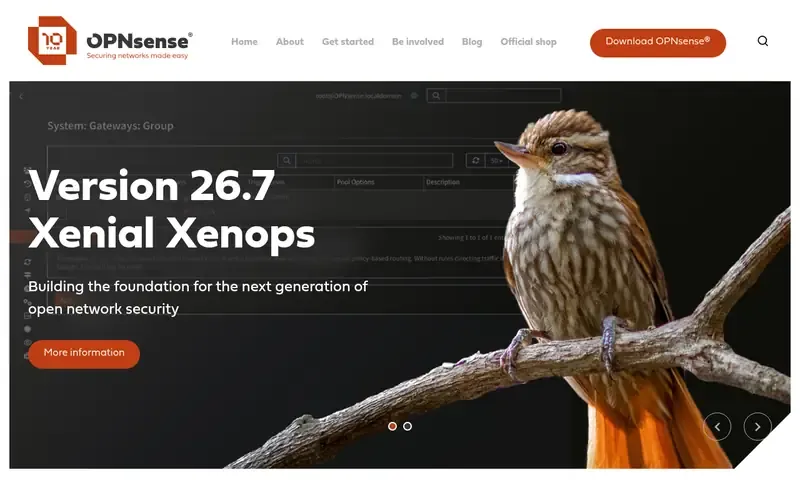
OPNsense is an open source firewall and routing platform from Deciso. It includes inline intrusion prevention and VPN support.
Documented strengths
- IPsec and OpenVPN natively, with pluggable Tinc and WireGuard support
- Multiple WAN connections with load balancing and failover
- Automatic hardware failover with state synchronization using CARP
- Stateful firewall for IPv4 and IPv6
- Inline intrusion prevention using Suricata
Documented limits
WireGuard and Tinc are pluggable rather than native, so teams standardizing on them should check the vendor documentation. A paid Business Edition exists alongside the open source version; check which one matches your support needs.
- Who it is for
- Firewall-based tunnel termination with failover between sites
- Platforms
- FreeBSD-based; official OPNsense hardware appliances are also sold
- Pricing
- See the vendor's own pricing page for current plans and costs. opnsense.org
- Facts checked
- 21 November 2026
Why it is placed here: It sits beside pfSense in fit because it supports IPsec and OpenVPN natively, adds failover features that suit always-on tunnels, and treats WireGuard as pluggable rather than built in.
#6 · Fortinet
Fortinet FortiGate
Larger or distributed estates standardizing on one firewall platform across data centers, branches and clouds
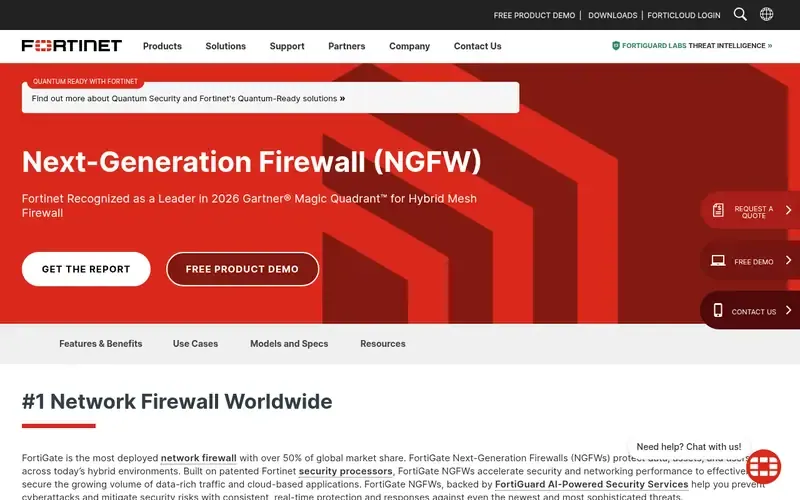
FortiGate is Fortinet's next-generation firewall line, built on patented Fortinet security processors and backed by FortiGuard AI-Powered Security Services.
Documented strengths
- Deployment across physical, virtualized and cloud environments on a single platform
- SD-WAN integrated into the platform
- Post-quantum cryptography for IPsec VPNs on FortiOS 7.6.1
- Models with Wi-Fi, LTE, PoE, DSL, bypass and ruggedized options
- Cloud-hosted FortiGates available
Documented limits
The official page is centered on next-generation firewall capabilities, so teams that only need simple tunnels between two sites should check the vendor documentation for the specific VPN features and models involved. Security bundles such as ATP, UTP and ENT add services beyond tunneling.
- Who it is for
- Larger or distributed estates standardizing on one firewall platform across data centers, branches and clouds
- Platforms
- Physical, virtualized and cloud environments
- Pricing
- See the vendor's own pricing page for current plans and costs. fortinet.com
- Facts checked
- 21 November 2026
Why it is placed here: It sits sixth for this use case because it is a broad next-generation firewall platform, with IPsec VPN, integrated SD-WAN and physical, virtual and cloud deployment, rather than a dedicated tunnel tool.
#7 · SoftEther VPN Project
SoftEther VPN
Sites behind NAT or restrictive firewalls that need Layer 2 bridging or flexible tunneling protocols
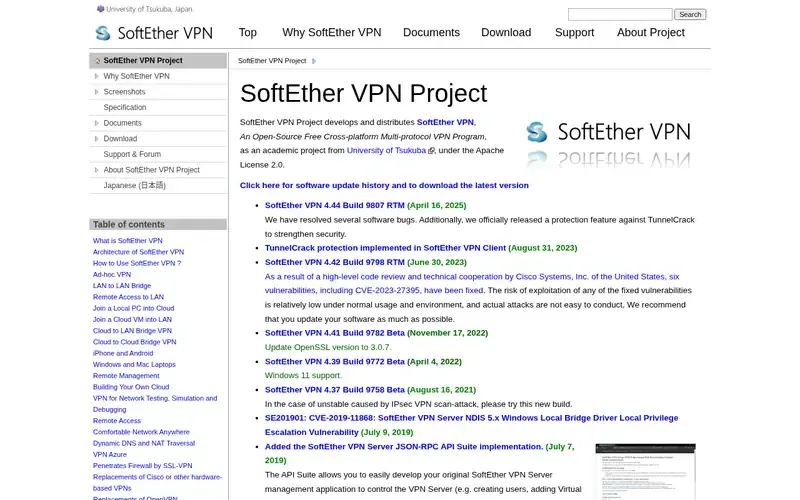
SoftEther VPN is an open-source, cross-platform, multi-protocol VPN program developed as an academic project at the University of Tsukuba.
Documented strengths
- Site-to-site and remote-access VPNs
- L2 Ethernet bridging and L3 IP routing over the VPN
- Tunnels over HTTPS to pass through NATs and firewalls
- Built-in dynamic DNS and NAT traversal, so no static IP is needed
- JSON-RPC API suite and an embedded HTML5-based admin console
Documented limits
The official pages describe the program and its protocols rather than managed deployments, so teams should check the vendor documentation for operational guidance on multi-site setups. It is a software project, not a firewall platform.
- Who it is for
- Sites behind NAT or restrictive firewalls that need Layer 2 bridging or flexible tunneling protocols
- Platforms
- Several desktop and server operating systems
- Pricing
- See the vendor's own pricing page for current plans and costs. softether.org
- Facts checked
- 21 November 2026
Why it is placed here: It sits last because it documents both remote-access and site-to-site VPNs with L2 bridging and L3 routing, but its stated audience leans toward BYOD and personal users rather than gateway fleets.
Sources
- strongSwan: strongswan.org, strongswan.org/security, strongswan.org/about.html (21 Nov 2026)
- WireGuard: wireguard.com, wireguard.com/xplatform (21 Nov 2026)
- OpenVPN: openvpn.net, openvpn.net/about, openvpn.net/cloud-vpn/features (21 Nov 2026)
- pfSense: pfsense.org, pfsense.org/products, pfsense.org/about-pfsense (21 Nov 2026)
- OPNsense: opnsense.org, opnsense.org/features (21 Nov 2026)
- Fortinet FortiGate: fortinet.com/products/next-generation-firewall (21 Nov 2026)
- SoftEther VPN: softether.org (21 Nov 2026)
Related guides
How we compiled this
We looked at how well each tool fits permanent site-to-site tunnels between gateways: documented tunnel and routing capabilities, authentication and key handling, NAT traversal, and the platforms or deployment models each vendor documents. Firewall and router platforms are included because many teams terminate tunnels on the same device that already protects the network edge.
All facts come from official vendor pages, each with a recorded check date. The order reflects editorial fit for this use case, closest fit first, and is explained in the 'why here' line for each tool. It does not mean any tool is better overall. This list is built from documentation, not product trials, so confirm details such as supported cipher suites, throughput and platform versions in the vendor documentation before you commit.
Order used: Ordered by how well each handles permanent gateway-to-gateway tunnels, closest fit first.
Common questions
What is a site-to-site VPN?
A site-to-site VPN connects whole networks, such as offices, data centers and cloud networks, through gateways that keep a tunnel up between them. This differs from remote access, where individual users connect with a client. strongSwan, WireGuard and SoftEther VPN all document ways to build gateway-to-gateway tunnels.
Is IPsec or WireGuard better for site-to-site tunnels?
Neither is better overall; it depends on your needs. strongSwan documents IKEv2 with certificate, OCSP and TPM 2.0 key-storage options. WireGuard aims to be simpler and faster than IPsec, but leaves key distribution and pushed configuration to you.
Can a firewall handle site-to-site VPN tunnels?
Yes. OPNsense supports IPsec and OpenVPN natively with pluggable WireGuard support, and pfSense and FortiGate document VPN functions on firewall platforms. Check hardware sizing: pfSense notes that VPN use increases CPU requirements and that IPsec benefits from AES-NI.
Which of these tools link cloud networks?
OpenVPN's CloudConnexa links offices and clouds using OpenVPN or IPsec. Netgate documents pfSense Plus virtual appliances on AWS and Azure, and Fortinet documents cloud-hosted FortiGates.
The editorial order is unpaid. A vendor can buy one labelled featured slot per guide, but it gets the same fact check as everyone else and cannot alter or remove a competitor's entry. Guidehurst is independent. Product names and logos belong to their respective owners.