Splunk Enterprise Security, IBM QRadar SIEM and Fortinet FortiSIEM are the first three tools on this shortlist for monitoring a mix of on-premises, legacy and cloud systems. The list is for enterprises with hybrid or on-prem infrastructure that need a SIEM able to take in many kinds of log sources. Securonix, Exabeam and Elastic Security follow, each with a different emphasis.
The shortlist
Side-by-side comparison
| Tool | Who it is for | Platforms | Pricing |
|---|---|---|---|
 Splunk Enterprise SecuritySplunk (Cisco) | SOC teams and current Splunk customers with data spread across many domains | Not stated on official pages | Pricing on splunk.com |
 IBM QRadar SIEMIBM | Security teams that need broad source coverage and compliance evidence | Not stated on official pages | Pricing on ibm.com |
 Fortinet FortiSIEMFortinet | Enterprises and MSSPs running mixed IT/OT and hybrid environments | Purpose-built hardware appliances for on-premises; software VM for on-prem or cloud; FortiSIEM Cloud (SaaS) hosted in 19 locations worldwide; hybrid combinations | Pricing on fortinet.com |
 SecuronixSecuronix | SOC teams that want behavioral analytics across cloud-heavy and hybrid data | Cloud-native platform; other platforms not stated on official pages | Pricing on securonix.com |
 ExabeamExabeam | Security operations teams that want behavioral analytics and network visibility | Cloud-native platform; NetMon as an appliance or virtual machine | Pricing on exabeam.com |
 Elastic SecurityElastic | SOC teams that want SIEM and endpoint protection on a unified data model | Cloud, self-managed and air-gapped deployments for model choice; other platforms not stated on official pages | Pricing on elastic.co |
Quick verdict by need
- Splunk Enterprise Security if you need sOC teams and current Splunk customers with data spread across many domains.
- IBM QRadar SIEM if you need security teams that need broad source coverage and compliance evidence.
- Fortinet FortiSIEM if you need enterprises and MSSPs running mixed IT/OT and hybrid environments.
- Securonix if you need sOC teams that want behavioral analytics across cloud-heavy and hybrid data.
- Exabeam if you need security operations teams that want behavioral analytics and network visibility.
- Elastic Security if you need sOC teams that want SIEM and endpoint protection on a unified data model.
Tool details
#1 · Splunk (Cisco)
Splunk Enterprise Security
SOC teams and current Splunk customers with data spread across many domains
Splunk Enterprise Security is a threat detection, investigation and response platform that integrates SIEM, SOAR, UEBA and agentic AI. It is made by Splunk, part of Cisco.
Documented strengths
- Federated Search and Federated Analytics for visibility across data sources
- Risk-Based Alerting to focus on the most important threats
- Detection Studio for testing, deploying and monitoring detections
- Detection coverage mapped against the MITRE ATT&CK Framework
- Machine learning and native UEBA for anomaly detection
Documented limits
The vendor's page describes data access across domains, clouds and devices but does not detail specific on-premises deployment models. Teams with legacy systems should check the vendor documentation for supported log sources.
- Who it is for
- SOC teams and current Splunk customers with data spread across many domains
- Platforms
- Not stated on official pages
- Pricing
- See the vendor's own pricing page for current plans and costs. splunk.com
- Facts checked
- 21 November 2026
Why it is placed here: It sits first because the vendor documents managing, searching and analyzing data across domains, clouds and devices wherever the data resides, which suits mixed estates.
#2 · IBM
IBM QRadar SIEM
Security teams that need broad source coverage and compliance evidence
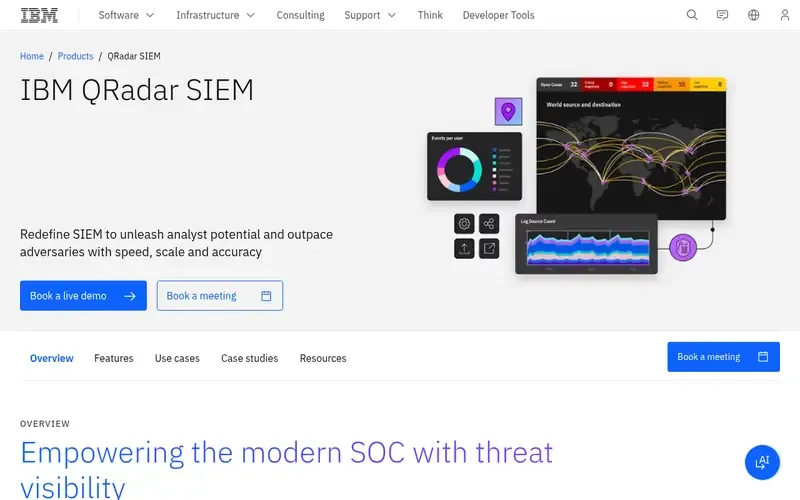
IBM QRadar SIEM is IBM's security information and event management product. It centralizes security visibility and real-time threat detection for SOCs.
Documented strengths
- Designed to work across all data source types and security tools
- Prebuilt integrations and partner extensions
- Import of thousands of open source Sigma Rules
- User behavior analytics for insider threats and risky users
- Support for showing compliance with regulatory statutes and internal audits
Documented limits
The cited pages do not state specific deployment options or platforms. Enterprises with on-premises estates should check the vendor documentation for how and where it can be deployed.
- Who it is for
- Security teams that need broad source coverage and compliance evidence
- Platforms
- Not stated on official pages
- Pricing
- See the vendor's own pricing page for current plans and costs. ibm.com
- Facts checked
- 21 November 2026
Why it is placed here: It follows Splunk because IBM documents a design that works across all data source types and security tools, with prebuilt integrations and partner extensions.
#3 · Fortinet
Fortinet FortiSIEM
Enterprises and MSSPs running mixed IT/OT and hybrid environments
FortiSIEM is Fortinet's SIEM. It combines IT/OT analytics, a built-in CMDB, native SOAR automation and GenAI assistance.
Documented strengths
- Over 2800 correlation rules plus UEBA and customer-controlled machine learning models
- Built-in CMDB with automatic asset discovery and Purdue model mapping
- Pre-built SOAR playbook library with FortiSOAR integrated
- Integrations with hundreds of third-party solutions
- Collectors and endpoint agents deployable across any environment
Documented limits
Its documented strength is in Fortinet's own ecosystem, and it adds capabilities for Fortinet products. Teams with many non-Fortinet sources should check the vendor documentation for the integrations they need.
- Who it is for
- Enterprises and MSSPs running mixed IT/OT and hybrid environments
- Platforms
- Purpose-built hardware appliances for on-premises; software VM for on-prem or cloud; FortiSIEM Cloud (SaaS) hosted in 19 locations worldwide; hybrid combinations
- Pricing
- See the vendor's own pricing page for current plans and costs. fortinet.com
- Facts checked
- 21 November 2026
Why it is placed here: It has the most explicit deployment documentation on this list: hardware appliances, a software VM, SaaS and cloud, which can be combined in a hybrid model.
#4 · Securonix
Securonix
SOC teams that want behavioral analytics across cloud-heavy and hybrid data

Securonix offers a cloud-native Unified Defense SIEM with behavioral analytics, threat intelligence and governed agentic AI for security operations.
Documented strengths
- Behavioral analytics for insider threats, account compromise and privilege misuse
- Data Pipeline Manager for ingestion, processing and retention
- Alerts and analytics aligned to the MITRE ATT&CK framework
- Threat intelligence through Securonix Threat Labs research and ThreatQ
- Governed AI actions with Agentic Guardrails, human oversight and auditability
Documented limits
The platform is documented as cloud-native, and the cited pages do not describe on-premises deployment. Enterprises that must keep a SIEM on-premises should check the vendor documentation.
- Who it is for
- SOC teams that want behavioral analytics across cloud-heavy and hybrid data
- Platforms
- Cloud-native platform; other platforms not stated on official pages
- Pricing
- See the vendor's own pricing page for current plans and costs. securonix.com
- Facts checked
- 21 November 2026
Why it is placed here: It sits mid-list because it documents ingesting data from cloud, identity, endpoint, network, SaaS and business systems, but is described as cloud-native rather than as an on-premises product.
#5 · Exabeam
Exabeam
Security operations teams that want behavioral analytics and network visibility

Exabeam is a cloud-native, AI-powered security operations platform for threat detection, investigation and response. Its behavioral analytics cover both employees and AI agents.
Documented strengths
- UEBA and Agent Behavior Analytics to baseline activity and expose anomalies
- AI agents that help build evidence-backed timelines
- Data pipeline management with search in place and low-cost storage
- NetMon deep packet inspection that categorizes traffic from nearly 5,000 applications
- Reporting against use cases, MITRE ATT&CK TTPs and compliance initiatives
Documented limits
The pages describe the main platform as cloud-native. On-premises deployment is documented only for NetMon, which is added to New-Scale or LogRhythm SIEM deployments. Teams with on-prem requirements should check the vendor documentation.
- Who it is for
- Security operations teams that want behavioral analytics and network visibility
- Platforms
- Cloud-native platform; NetMon as an appliance or virtual machine
- Pricing
- See the vendor's own pricing page for current plans and costs. exabeam.com
- Facts checked
- 21 November 2026
Why it is placed here: It sits fifth because the core platform is documented as cloud-native, though its NetMon network component is documented for appliance or virtual machine deployment.
#6 · Elastic
Elastic Security
SOC teams that want SIEM and endpoint protection on a unified data model
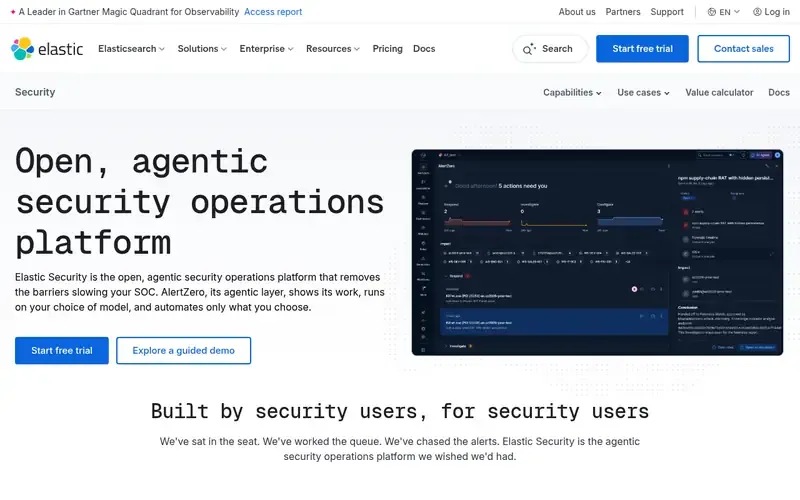
Elastic Security is an open, agentic security operations platform that combines SIEM, endpoint security and automation on one platform.
Documented strengths
- 400+ prebuilt integrations that normalize data and ship with dashboards
- Archived data that stays queryable in place without rehydration
- Detection rules published openly on GitHub
- Automatic Migration of detection rules and dashboards from another SIEM
- Attack Discovery that correlates scattered alerts into attack chains
Documented limits
Cloud, self-managed and air-gapped deployments are documented for AI model choice. The cited pages do not describe deployment of the full SIEM in those terms, so on-prem teams should check the vendor documentation.
- Who it is for
- SOC teams that want SIEM and endpoint protection on a unified data model
- Platforms
- Cloud, self-managed and air-gapped deployments for model choice; other platforms not stated on official pages
- Pricing
- See the vendor's own pricing page for current plans and costs. elastic.co
- Facts checked
- 21 November 2026
Why it is placed here: It closes the list because its documentation stresses openness and prebuilt integrations, and names cloud, self-managed and air-gapped options only for model choice.
Sources
- Splunk Enterprise Security: splunk.com/en_us/products/enterprise-security.html, splunk.com/en_us/products.html, splunk.com/en_us/about-splunk.html (21 Nov 2026)
- IBM QRadar SIEM: ibm.com/products/qradar-siem, ibm.com/products, ibm.com/products (21 Nov 2026)
- Fortinet FortiSIEM: fortinet.com/products/siem/fortisiem (21 Nov 2026)
- Securonix: securonix.com, securonix.com/company/about, securonix.com/products/ueba (21 Nov 2026)
- Exabeam: exabeam.com, exabeam.com/featured-blogs, exabeam.com/platform/netmon (21 Nov 2026)
- Elastic Security: elastic.co/security, elastic.co/about, elastic.co/about (21 Nov 2026)
Related guides
How we compiled this
We looked at three things: fit with the use case of monitoring on-premises and legacy systems alongside newer ones, the capabilities each vendor documents, and what the vendor's documentation says about deployment and platforms. Breadth of log source coverage and clarity about where the software can run carried the most weight. The order reflects editorial fit for hybrid and on-prem work, explained in the "why here" line for each tool. It does not say any tool is better overall.
All facts come from official vendor pages, and each tool's page carries the date it was checked. This shortlist is built from documentation, not from product trials, so we do not describe how any tool performs in practice. Where a vendor does not state something, such as a supported platform or deployment model, we say so and suggest checking the vendor documentation.
Order used: Ordered by fit for on-prem and hybrid deployment and breadth of log source coverage.
Common questions
Which SIEM tools document on-premises deployment?
Fortinet FortiSIEM documents hardware appliances and a software VM for on-premises use, plus SaaS and cloud options that can be combined in a hybrid model. Exabeam documents on-premises deployment for NetMon only, as an appliance or virtual machine. For the others, check the vendor documentation.
Can a SIEM monitor legacy systems?
IBM says QRadar SIEM is designed to work across all data source types and security tools, with prebuilt integrations and partner extensions. FortiSIEM documents collectors and endpoint agents that can be deployed across any environment. Confirm support for your specific legacy sources with the vendor.
Does FortiSIEM support hybrid deployments?
Yes. Fortinet states that SaaS, cloud and on-prem deployments can be combined in a hybrid model. Options include FortiSIEM Cloud, hosted in 19 locations worldwide, a software VM and hardware appliances.
Can I move detection rules from my current SIEM?
Elastic Security offers Automatic Migration to help move detection rules and dashboards from another SIEM. The other vendors' pages cited here do not describe a comparable migration feature.
How many integrations does Elastic Security have?
Elastic states it has 400+ prebuilt integrations. The integrations normalize data and ship with prebuilt dashboards.
The editorial order is unpaid. A vendor can buy one labelled featured slot per guide, but it gets the same fact check as everyone else and cannot alter or remove a competitor's entry. Guidehurst is independent. Product names and logos belong to their respective owners.