GitHub Actions, GitLab CI/CD and Bitbucket Pipelines come first on this shortlist because each is part of the code host itself. Azure Pipelines, Google Cloud Build and AWS CodeBuild follow as CI services tied to a cloud platform. It is for teams that want fewer tools to manage and would rather run CI where their code or infrastructure already lives.
The shortlist
Side-by-side comparison
| Tool | Who it is for | Platforms | Pricing |
|---|---|---|---|
 GitHub ActionsGitHub | Teams whose code already lives on GitHub | Hosted runners for several operating systems, ARM, GPU, and containers; self-run runners in the cloud or on-premises | Pricing on github.com |
 GitLab CI/CDGitLab | Teams that need CI and governance on one platform | Hosted runners; self-managed on any cloud or on premises, including air-gapped; FedRAMP Moderate authorized single-tenant SaaS on AWS GovCloud | Pricing on about.gitlab.com |
 Bitbucket PipelinesAtlassian | Software teams using Bitbucket Cloud | Any language, OS, and architecture, including x86 and ARM; Atlassian-hosted or customer runners | Pricing on bitbucket.org |
 Azure PipelinesMicrosoft | Teams in the Microsoft ecosystem, or using GitHub with Azure | Microsoft-hosted and self-hosted agents; Linux, macOS, and Windows; cloud or on-premises targets | Pricing on azure.microsoft.com |
 Google Cloud BuildGoogle Cloud | Teams building and deploying on Google Cloud | Deploys to VMs, serverless, Kubernetes, or Firebase; images pushed to Docker Hub and Artifact Registry | Pricing on cloud.google.com |
 AWS CodeBuildAmazon Web Services | Teams running their builds on AWS | Linux and Windows; three compute levels that vary by CPU and memory | Pricing on aws.amazon.com |
Quick verdict by need
- GitHub Actions if you need teams whose code already lives on GitHub.
- GitLab CI/CD if you need teams that need CI and governance on one platform.
- Bitbucket Pipelines if you need software teams using Bitbucket Cloud.
- Azure Pipelines if you need teams in the Microsoft ecosystem, or using GitHub with Azure.
- Google Cloud Build if you need teams building and deploying on Google Cloud.
- AWS CodeBuild if you need teams running their builds on AWS.
Tool details
#1 · GitHub
GitHub Actions
Teams whose code already lives on GitHub
GitHub Actions is GitHub's workflow automation and CI/CD feature for building, testing, and deploying code directly from GitHub.
Documented strengths
- Hosted build and test environments for multiple operating systems, ARM, GPU, and containers
- Matrix workflows across operating systems and runtime versions
- Encrypted secrets at repository, environment, or organization level
- Marketplace of actions and shared, preconfigured workflows
- Own runners in the cloud or on-premises
Documented limits
Documented for workflows tied to GitHub events and repositories. Teams that keep source code on another host should check the vendor documentation for how that works.
- Who it is for
- Teams whose code already lives on GitHub
- Platforms
- Hosted runners for several operating systems, ARM, GPU, and containers; self-run runners in the cloud or on-premises
- Pricing
- See the vendor's own pricing page for current plans and costs. github.com
- Facts checked
- 21 November 2026
Why it is placed here: It sits first because workflows run inside GitHub itself, can be triggered by any GitHub event, and can act as required checks before merge.
#2 · GitLab
GitLab CI/CD
Teams that need CI and governance on one platform
GitLab CI/CD is GitLab's CI/CD automation for building, testing, packaging, and deploying software on one platform with built-in governance.
Documented strengths
- CI/CD Catalog of versioned reusable pipeline components
- Merge trains, child pipelines with DAG execution, and cross-project pipelines
- Built-in SAST and compliance pipelines that enforce policy as code
- Canary deployments and progressive delivery
- AI root cause analysis for failed pipelines
Documented limits
The facts describe CI/CD inside the GitLab platform. Teams that want to keep source control elsewhere should check the vendor documentation.
- Who it is for
- Teams that need CI and governance on one platform
- Platforms
- Hosted runners; self-managed on any cloud or on premises, including air-gapped; FedRAMP Moderate authorized single-tenant SaaS on AWS GovCloud
- Pricing
- See the vendor's own pricing page for current plans and costs. about.gitlab.com
- Facts checked
- 21 November 2026
Why it is placed here: It follows GitHub Actions because it is just as closely tied to its code host, and its documentation puts more weight on governance, with compliance pipelines and policy as code.
#3 · Atlassian
Bitbucket Pipelines
Software teams using Bitbucket Cloud
bitbucket.orgBitbucket Pipelines is CI/CD built into Bitbucket Cloud for automating builds, tests, and deployments without managing infrastructure.
Documented strengths
- Atlassian-hosted runners and customer runners behind a firewall
- Pipes that extend pipelines with third-party tools without plugins
- Merge queues that validate pull requests before merging
- Organization-wide policies defined as code
- Built-in secret scanning for over 400 types of hardcoded secrets
Documented limits
Documented for Bitbucket Cloud. Teams using another code host or a self-hosted Bitbucket should check the vendor documentation.
- Who it is for
- Software teams using Bitbucket Cloud
- Platforms
- Any language, OS, and architecture, including x86 and ARM; Atlassian-hosted or customer runners
- Pricing
- See the vendor's own pricing page for current plans and costs. bitbucket.org
- Facts checked
- 21 November 2026
Why it is placed here: It is built into Bitbucket Cloud and aimed at teams already using it, so it fits the use case closely, but it is documented for that one host.
#4 · Microsoft
Azure Pipelines
Teams in the Microsoft ecosystem, or using GitHub with Azure
Azure Pipelines is Microsoft's cloud-hosted CI/CD service for building, testing, and deploying to any platform and cloud.
Documented strengths
- Microsoft-hosted agents for Linux, macOS, and Windows
- Parallel jobs and native container support
- Stages, gates, and approvals for deployment strategies
- YAML pipelines, build chaining, and multi-phased builds
- Marketplace of community tasks and extensions
Documented limits
Its documentation stresses deploying to any cloud, so it is not limited to Azure. Teams that want a single-vendor setup should check how much of the pipeline setup sits outside Azure.
- Who it is for
- Teams in the Microsoft ecosystem, or using GitHub with Azure
- Platforms
- Microsoft-hosted and self-hosted agents; Linux, macOS, and Windows; cloud or on-premises targets
- Pricing
- See the vendor's own pricing page for current plans and costs. azure.microsoft.com
- Facts checked
- 21 November 2026
Why it is placed here: It is the first cloud-platform entry because it fits Azure-centered teams and also integrates deeply with GitHub pull requests, checks, and statuses.
#5 · Google Cloud
Google Cloud Build
Teams building and deploying on Google Cloud
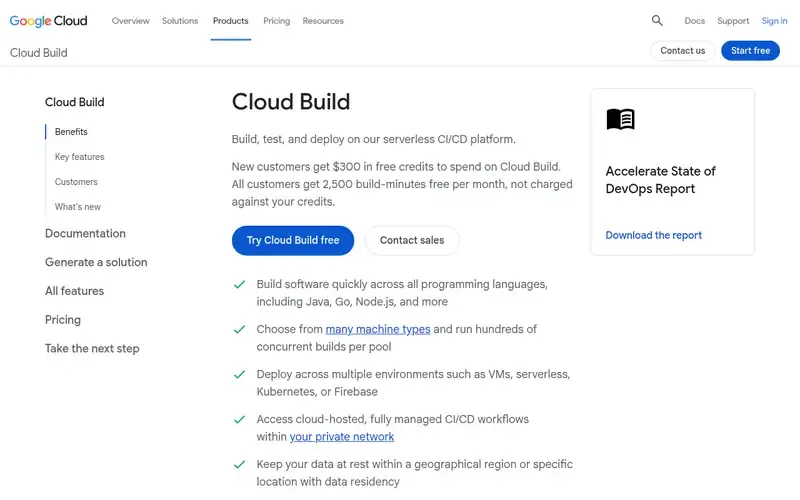
Google Cloud Build is a fully managed, serverless continuous integration, delivery and deployment platform on Google Cloud.
Documented strengths
- Serverless, with no infrastructure to manage
- Triggers that start builds on pushes to supported repositories
- SLSA level 3 build support, provenance metadata, and attestations
- Private pools with VPC Peering and VPC-SC for private networking
- Open source local builder for building and debugging locally
Documented limits
The facts describe source control support as out-of-the-box for enterprise source control systems. Teams should check the vendor documentation for their specific repository host.
- Who it is for
- Teams building and deploying on Google Cloud
- Platforms
- Deploys to VMs, serverless, Kubernetes, or Firebase; images pushed to Docker Hub and Artifact Registry
- Pricing
- See the vendor's own pricing page for current plans and costs. cloud.google.com
- Facts checked
- 21 November 2026
Why it is placed here: It suits teams whose infrastructure is on Google Cloud, with built-in deployment integrations to several Google Cloud services and security features such as provenance and Binary Authorization.
#6 · Amazon Web Services
AWS CodeBuild
Teams running their builds on AWS
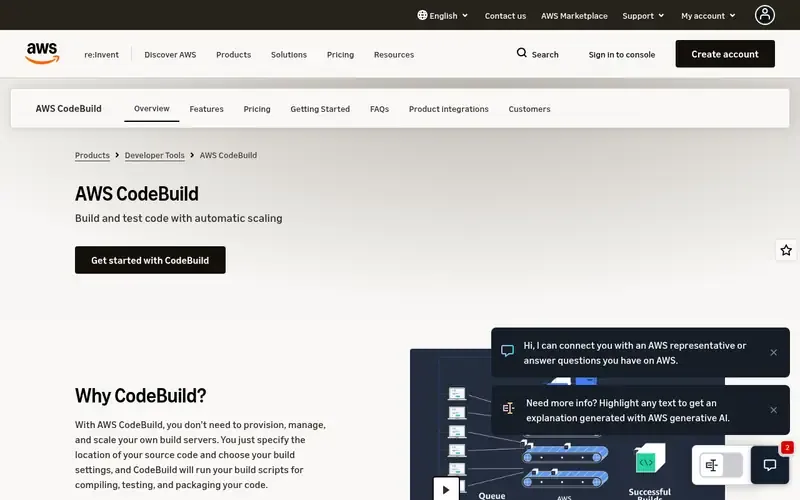
AWS CodeBuild is a fully managed continuous integration service that runs build scripts for compiling, testing, and packaging code without servers to provision.
Documented strengths
- Prebuilt build environments, or custom Docker images from Docker Hub or Amazon ECR
- Build commands for each phase defined in a YAML build specification file
- Artifacts stored in Amazon S3 and encrypted with AWS KMS keys
- Access control through AWS IAM; metrics and logs in Amazon CloudWatch
- Existing Jenkins build jobs can run on CodeBuild
Documented limits
Documented as a build service that integrates with CodePipeline to build and test on each commit. Teams that need full pipeline orchestration should check the vendor documentation.
- Who it is for
- Teams running their builds on AWS
- Platforms
- Linux and Windows; three compute levels that vary by CPU and memory
- Pricing
- See the vendor's own pricing page for current plans and costs. aws.amazon.com
- Facts checked
- 21 November 2026
Why it is placed here: It sits last because it is a build service rather than a full code-host workflow, though it fits AWS teams well through IAM, KMS, CloudWatch, S3, and CodePipeline.
Sources
- GitHub Actions: github.com/features/actions, github.com/about, github.com/features (21 Nov 2026)
- GitLab CI/CD: about.gitlab.com/solutions/continuous-integration, about.gitlab.com/platform, about.gitlab.com/security (21 Nov 2026)
- Bitbucket Pipelines: atlassian.com/software/bitbucket/features/pipelines, atlassian.com/software/bitbucket/features/packages, atlassian.com/software/bitbucket/features/devsecops (21 Nov 2026)
- Azure Pipelines: azure.microsoft.com/en-us/products/devops/pipelines, azure.microsoft.com/en-us/products, azure.microsoft.com/en-us/products (21 Nov 2026)
- Google Cloud Build: cloud.google.com/build (21 Nov 2026)
- AWS CodeBuild: aws.amazon.com/codebuild, aws.amazon.com/products, aws.amazon.com/solutions/ai (21 Nov 2026)
Related guides
How we compiled this
We looked at three things: how well each tool fits the job of running CI inside a platform you already use, what its documentation says it can do, and what deployment and platform options it documents (hosted, self-hosted, cloud targets). The order reflects editorial fit for this use case, from tools that are part of a code host to services attached to a cloud platform. It is not a statement that any tool is better overall.
Every fact comes from the tool's official vendor page, and we record the date each page was checked. The list is built from documentation, not product trials, so where a capability is not documented we say so in the limits and suggest checking the vendor documentation. Pricing is left out; each vendor's own pricing page is the place to look.
Order used: Ordered by depth of integration with the surrounding code or cloud platform, closest fit first.
Common questions
What is a platform-native CI tool?
It is a CI service that runs inside the code host or cloud platform you already use, such as GitHub Actions on GitHub or AWS CodeBuild on AWS. That means fewer separate systems to set up and manage.
Which CI tools run inside the code host itself?
GitHub Actions, GitLab CI/CD, and Bitbucket Pipelines are built into GitHub, GitLab, and Bitbucket Cloud respectively. GitLab and GitHub also document self-managed or self-run options.
Can I run my own runners instead of hosted ones?
GitHub Actions lets you run your own runners in the cloud or on-premises, and Bitbucket Pipelines supports customer runners behind a firewall. Azure Pipelines offers both Microsoft-hosted and self-hosted options, and GitLab offers self-managed deployment.
Do cloud CI services only deploy to their own cloud?
Not according to the documentation. Azure Pipelines says continuous delivery can target any cloud, including Azure, AWS, and GCP. Google Cloud Build and AWS CodeBuild describe integrations with their own cloud services, so check the vendor documentation for other targets.
The editorial order is unpaid. A vendor can buy one labelled featured slot per guide, but it gets the same fact check as everyone else and cannot alter or remove a competitor's entry. Guidehurst is independent. Product names and logos belong to their respective owners.