For teaching operations research with algebraic modeling languages, Pyomo, JuMP and GAMS are the strongest starting points on this shortlist, followed by AMPL, AIMMS and GLPK. It is written for university instructors choosing a course tool and for students who want to know what they will be working with. We dropped Google OR-Tools because it is a solver-library suite rather than an algebraic modeling language.
The shortlist
Side-by-side comparison
| Tool | Who it is for | Platforms | Pricing |
|---|---|---|---|
 PyomoPyomo (Sandia/community) | Courses that already use Python | Python; installed with pip | Pricing on pyomo.org |
 JuMPJuMP-dev | Instructors comfortable with Julia | Julia | Pricing on jump.dev |
 GAMSGAMS Software GmbH | Classes that want no local solver setup | Local, NEOS Server, GAMS Engine; Google Colab notebooks | Pricing on gams.com |
 AMPLAMPL Optimization | Courses that want book and notebook support | Python, R, C#, C++, Java and more via APIs; Google Colab notebooks | Pricing on ampl.com |
 AIMMSAIMMS | Courses with a supply chain focus | Not stated on official pages | Pricing on aimms.com |
 GLPKGNU Project | Introductory linear and integer programming | ANSI C library; distribution tarball from the GNU FTP site | Pricing on gnu.org |
Quick verdict by need
- Pyomo if you need courses that already use Python.
- JuMP if you need instructors comfortable with Julia.
- GAMS if you need classes that want no local solver setup.
- AMPL if you need courses that want book and notebook support.
- AIMMS if you need courses with a supply chain focus.
- GLPK if you need introductory linear and integer programming.
Tool details
#1 · Pyomo (Sandia/community)
Pyomo
Courses that already use Python
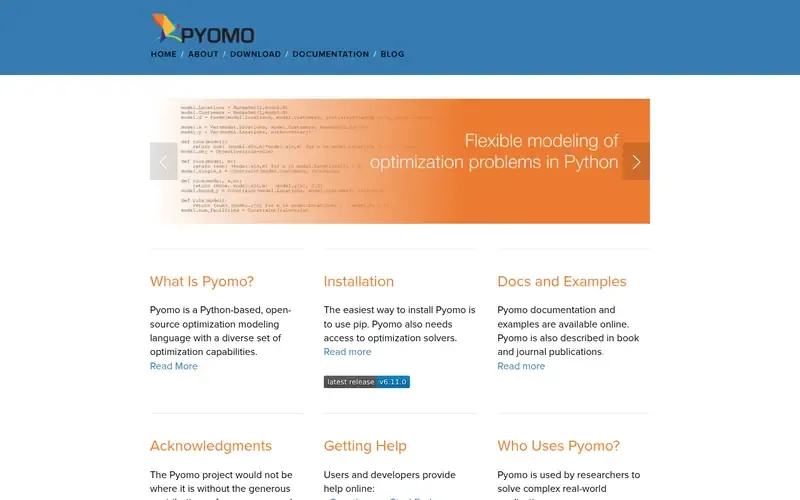
Pyomo is a Python-based, open-source optimization modeling language for formulating, solving and analyzing optimization models. It defines symbolic problems, creates instances and solves them with commercial and open-source solvers.
Documented strengths
- Linear, nonlinear and mixed-integer programming
- Covers MILP, MIQP, MINLP, generalized disjunctive programming, differential algebraic equations and MPECs
- Supports iterative analysis and scripting
- Online documentation and examples, plus books and journal publications
- Help through StackExchange and the Pyomo Forum
Documented limits
Pyomo needs access to separate optimization solvers, so a course must plan solver installation. The vendor names researchers and tool developers as its audience; instructors should check the documentation for introductory material at their level.
- Who it is for
- Courses that already use Python
- Platforms
- Python; installed with pip
- Pricing
- See the vendor's own pricing page for current plans and costs. pyomo.org
- Facts checked
- 21 November 2026
Why it is placed here: It sits first because it is open source, installs with pip, and embeds modeling objects in a full programming language that students may already know.
#2 · JuMP-dev
JuMP
Instructors comfortable with Julia
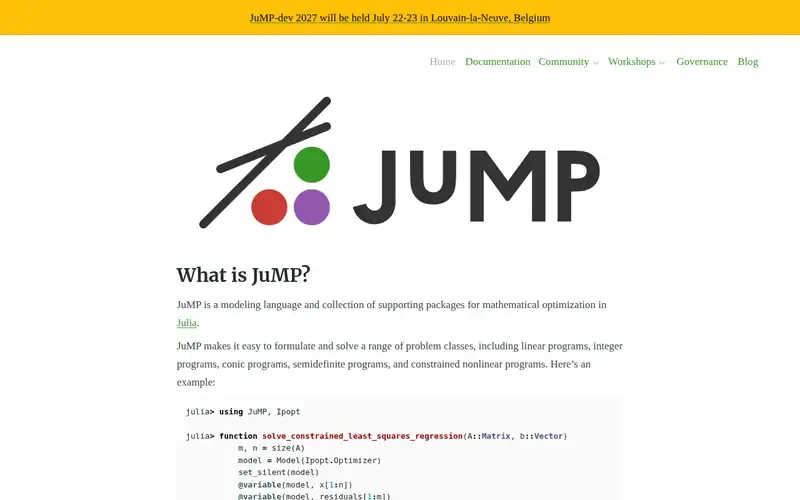
JuMP is a modeling language with supporting packages for mathematical optimization in Julia. It handles linear, integer, conic, semidefinite and constrained nonlinear programs.
Documented strengths
- Linear, integer, conic, semidefinite and constrained nonlinear programs
- Convex.jl for Disciplined Convex Programming
- Installation guide for JuMP and Julia
- Tutorial for solving a first JuMP model
- Third-party book on Julia and JuMP for operations research
Documented limits
JuMP is documented for Julia, so courses built around another language would need to adopt Julia. Teams that need other solver or deployment details should check the JuMP documentation.
- Who it is for
- Instructors comfortable with Julia
- Platforms
- Julia
- Pricing
- See the vendor's own pricing page for current plans and costs. jump.dev
- Facts checked
- 21 November 2026
Why it is placed here: It follows Pyomo because the official pages state it is used to teach optimization at universities and list university instructors among its audience, but it requires students to work in Julia.
#3 · GAMS Software GmbH
GAMS
Classes that want no local solver setup
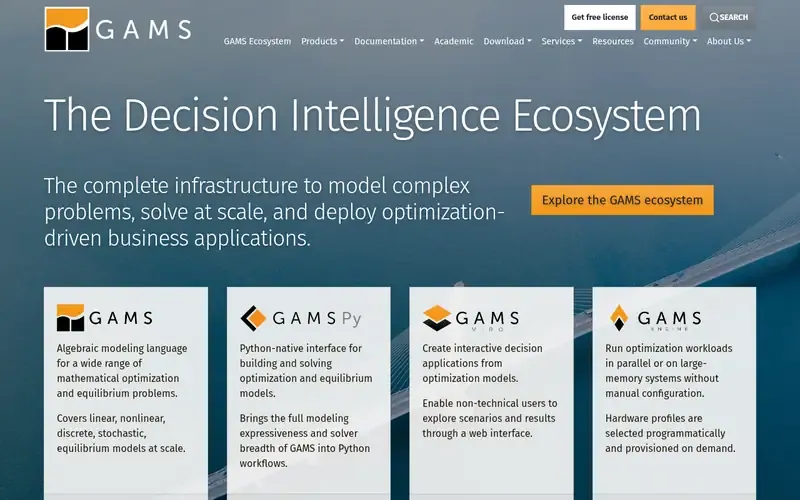
GAMS is an ecosystem for mathematical optimization that combines an algebraic modeling language, a Python interface (GAMSPy), scalable execution (GAMS Engine) and interactive decision apps (GAMS MIRO).
Documented strengths
- Algebraic modeling language for optimization and equilibrium problems
- GAMSPy models solved locally, on NEOS Server or on GAMS Engine
- Public model library with runnable examples
- Notebooks that open in Google Colab
- Solvers can be switched by model type, licensing and performance
Documented limits
The ecosystem is broad, and several components (Engine, MIRO) go beyond what a first course needs. Instructors should check the vendor documentation for which parts apply to classroom use.
- Who it is for
- Classes that want no local solver setup
- Platforms
- Local, NEOS Server, GAMS Engine; Google Colab notebooks
- Pricing
- See the vendor's own pricing page for current plans and costs. gams.com
- Facts checked
- 21 November 2026
Why it is placed here: It sits third because its pages explicitly address teaching: notebooks open in Google Colab without local setup, and remote solving avoids local solver installations.
#4 · AMPL Optimization
AMPL
Courses that want book and notebook support
ampl.comAMPL is an optimization platform for developing and deploying complex solutions. It connects to commercial and open-source solvers and automatically reformulates models.
Documented strengths
- Connects to commercial and open-source solvers
- Documentation covers all solvers available with AMPL
- MO-Book Jupyter Notebooks with various solvers
- Notebooks on Google Colab, with user contributions
- Books, tutorials and webinars
Documented limits
The vendor positions AMPL for mission-critical applications such as electric grids and supply chains. Instructors should check the vendor documentation for teaching-specific access details.
- Who it is for
- Courses that want book and notebook support
- Platforms
- Python, R, C#, C++, Java and more via APIs; Google Colab notebooks
- Pricing
- See the vendor's own pricing page for current plans and costs. ampl.com
- Facts checked
- 21 November 2026
Why it is placed here: It sits fourth because its learning resources are extensive, including books from beginner to advanced and MO-Book notebooks, but the vendor's stated audience is application developers and enterprise users rather than classrooms.
#5 · AIMMS
AIMMS
Courses with a supply chain focus
AIMMS is a modeling language and platform for optimization and decision support, with an AI layer called SENSAI. Models are built declaratively without low-level programming.
Documented strengths
- Declarative model building
- Community Edition with CBC, IPOPT and the AOA solver
- Models powered by solvers such as Gurobi and CPLEX
- Pre-built modules for production, transportation and carbon footprint optimization
- Custom applications that embed optimization in workflows
Documented limits
The official pages are oriented toward enterprise supply chain use. Instructors who want classroom exercises across general operations research topics should check the vendor documentation.
- Who it is for
- Courses with a supply chain focus
- Platforms
- Not stated on official pages
- Pricing
- See the vendor's own pricing page for current plans and costs. aimms.com
- Facts checked
- 21 November 2026
Why it is placed here: It sits fifth because it names academic users in its audience and its Community Edition includes open-source solvers, but its focus is supply chain decision intelligence rather than general course material.
#6 · GNU Project
GLPK
Introductory linear and integer programming
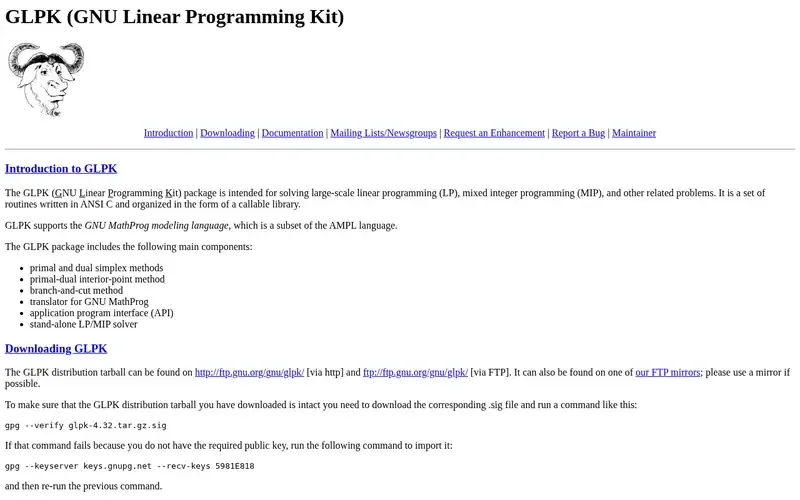
GLPK (GNU Linear Programming Kit) is a GNU package of ANSI C routines for solving large-scale linear and mixed integer programming problems. It supports the GNU MathProg modeling language, a subset of AMPL.
Documented strengths
- GNU MathProg modeling language, a subset of AMPL
- Simplex methods and an interior-point method
- MathProg translator, API and stand-alone solver
- Reference Manual and MathProg language description
- Separate mailing lists for discussion and bug reports
Documented limits
GLPK is documented for LP, MIP and related problems; courses covering other problem classes should check other tools. Documentation ships in LaTeX, DVI and PostScript formats, and the vendor page states no audience.
- Who it is for
- Introductory linear and integer programming
- Platforms
- ANSI C library; distribution tarball from the GNU FTP site
- Pricing
- See the vendor's own pricing page for current plans and costs. gnu.org
- Facts checked
- 21 November 2026
Why it is placed here: It sits last because MathProg gives students a compact algebraic syntax, but GLPK is a callable library and stand-alone solver rather than a full modeling environment.
Sources
- Pyomo: pyomo.org, pyomo.org/about, pyomo.org/documentation (21 Nov 2026)
- JuMP: jump.dev (21 Nov 2026)
- GAMS: gams.com, gams.com/products/gamspy (21 Nov 2026)
- AMPL: dev.ampl.com (21 Nov 2026)
- AIMMS: aimms.com, aimms.com/about, aimms.com/ai-capabilities (21 Nov 2026)
- GLPK: gnu.org/software/glpk (21 Nov 2026)
Related guides
How we compiled this
We looked at how well each tool fits a classroom: how readable its modeling approach is, how clearly the vendor documents learning resources, how it connects to solvers, and what the official pages say about platforms and deployment. Only documented capabilities count. Where a vendor page does not say something, we say so rather than fill the gap.
All facts come from official vendor pages, with check dates recorded. The order reflects editorial fit for teaching operations research, and the reasoning for each position is given in words next to each entry. This list is built from documentation, not from product trials, so instructors should still try a tool on a sample course exercise before committing.
Order used: Ordered by suitability for classroom use, weighing readable syntax, free access and solver connectivity.
Common questions
Which modeling language is easiest to start with for an operations research course?
The official pages do not rank ease. Pyomo suits courses already using Python, JuMP documents a tutorial for a first model and use in university teaching, and GAMS documents notebooks that open in Google Colab without local setup.
Can students run optimization models without installing solvers?
GAMS documents remote solving without local solver installations, noting it is useful for teaching and research. Pyomo, by contrast, needs access to separate optimization solvers.
Which tools work with Python?
Pyomo is Python-based, GAMS offers the Python-native GAMSPy interface, and AMPL offers Python integration through documented APIs. JuMP is documented for Julia.
Is there a lightweight option for basic linear programming?
GLPK is a set of ANSI C routines for large-scale LP and MIP problems. It supports the GNU MathProg modeling language, a subset of AMPL.
The editorial order is unpaid. A vendor can buy one labelled featured slot per guide, but it gets the same fact check as everyone else and cannot alter or remove a competitor's entry. Guidehurst is independent. Product names and logos belong to their respective owners.