For threat hunting that starts from network traffic and metadata, the shortlist opens with Zeek, Suricata and Security Onion. Zeek produces structured logs from deep protocol inspection, Suricata works directly on network traffic, and Security Onion bundles both with full packet capture and hunting interfaces. It is written for security analysts and threat hunters who want to inspect traffic and investigate suspicious activity.
The shortlist
Side-by-side comparison
| Tool | Who it is for | Platforms | Pricing |
|---|---|---|---|
 ZeekZeek Project | Analysts who hunt through rich network metadata and logs | Sensor: hardware, software, virtual or cloud-based | Pricing on zeek.org |
 SuricataOpen Information Security Foundation | Teams that want a packet-level engine deployed on the network path | Linux and Windows (IPS/inline guides); Docker and Podman containers | Pricing on suricata.io |
 Security OnionSecurity Onion Solutions | SOC analysts who want network engines and hunting tools in one platform | Single appliance to distributed grid; Linux desktop install option | Pricing on securityonionsolutions.com |
 SnortCisco Talos | Analysts who want rule-based packet detection and packet logging | Linux and Windows | Pricing on snort.org |
 WazuhWazuh | Analysts who want endpoint and cloud telemetry alongside ingested network data | Public cloud, private cloud and on-premises; agent on common operating systems | Pricing on wazuh.com |
 Elastic SecurityElastic | SOC teams that want hunting, SIEM and automation in one platform | Cloud, self-managed and air-gapped deployments (stated for model choice) | Pricing on elastic.co |
Quick verdict by need
- Zeek if you need analysts who hunt through rich network metadata and logs.
- Suricata if you need teams that want a packet-level engine deployed on the network path.
- Security Onion if you need sOC analysts who want network engines and hunting tools in one platform.
- Snort if you need analysts who want rule-based packet detection and packet logging.
- Wazuh if you need analysts who want endpoint and cloud telemetry alongside ingested network data.
- Elastic Security if you need sOC teams that want hunting, SIEM and automation in one platform.
Tool details
#1 · Zeek Project
Zeek
Analysts who hunt through rich network metadata and logs
zeek.orgZeek is an open-source, scriptable network security monitor that passively analyzes traffic and produces structured logs for analysts and SIEMs. It was originally developed by Vern Paxson in the 1990s under the name Bro.
Documented strengths
- Deep inspection of application-layer protocols such as HTTP, DNS, SSL/TLS and SSH
- Transaction logs, file contents and customizable outputs
- Structured logs suited to forensics, compliance and SIEM integration
- Own scripting language, extended by community-contributed scripts and packages
Documented limits
Zeek is documented as a monitor, not an active defense tool like a firewall or IPS, so blocking has to come from other tools. It runs on a sensor, so teams need to plan sensor placement.
- Who it is for
- Analysts who hunt through rich network metadata and logs
- Platforms
- Sensor: hardware, software, virtual or cloud-based
- Pricing
- See the vendor's own pricing page for current plans and costs. zeek.org
- Facts checked
- 21 November 2026
Why it is placed here: It comes first because it centers on deep application-layer inspection and structured transaction logs, which is the raw material of network-metadata hunting.
#2 · Open Information Security Foundation
Suricata
Teams that want a packet-level engine deployed on the network path

Suricata is a security tool that processes untrusted network data. Its documentation covers IPS/inline mode setup and the privileges and isolation it needs.
Documented strengths
- Low-level read access to network traffic, plus write access when run as an IPS
- IPS/inline mode guides for Linux and Windows
- Can drop to a non-root user after startup (Linux only)
- Docker and Podman containers can isolate it from the host
Documented limits
The documentation we checked focuses on privileges, deployment and isolation, not on detection content or log outputs, so hunting teams should check the vendor documentation for those. It does not work with rootless Podman because it must start with root privileges.
- Who it is for
- Teams that want a packet-level engine deployed on the network path
- Platforms
- Linux and Windows (IPS/inline guides); Docker and Podman containers
- Pricing
- See the vendor's own pricing page for current plans and costs. suricata.io
- Facts checked
- 21 November 2026
Why it is placed here: It sits second because it works directly on network traffic, with low-level read access to it and documented inline (IPS) deployment.
#3 · Security Onion Solutions
Security Onion
SOC analysts who want network engines and hunting tools in one platform
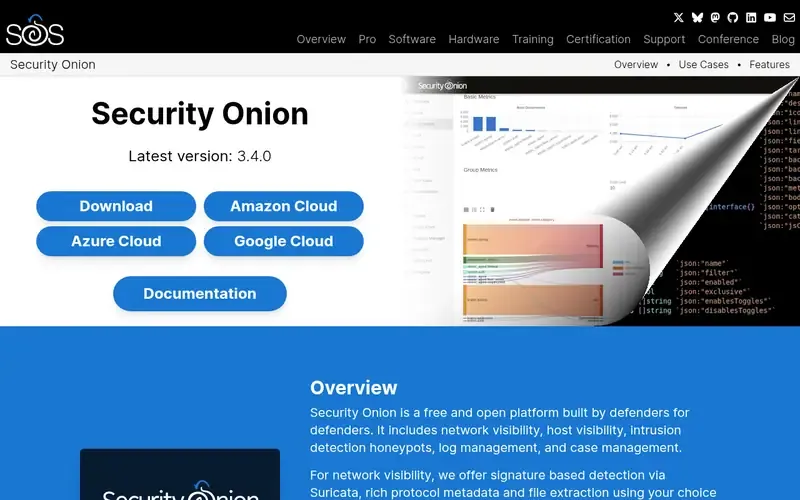
Security Onion is an open platform for network and host visibility, intrusion detection, log management and case management. It is built for defenders and SOC analysts.
Documented strengths
- Network visibility using Suricata, Zeek, full packet capture and Strelka file analysis
- Elastic stack with custom interfaces for alerting, hunting, dashboards and cases
- PCAP and Windows EVTX file import for static analysis
- Setup wizard builds a distributed grid; scales from a single appliance to a grid of a thousand nodes
Documented limits
It is a full platform, so it covers more than traffic inspection and suits teams ready to run a grid. The vendor offers to handle hardware and setup, and teams should check the vendor documentation for what that involves.
- Who it is for
- SOC analysts who want network engines and hunting tools in one platform
- Platforms
- Single appliance to distributed grid; Linux desktop install option
- Pricing
- See the vendor's own pricing page for current plans and costs. securityonionsolutions.com
- Facts checked
- 21 November 2026
Why it is placed here: It sits third because it packages Suricata, Zeek and full packet capture with hunting interfaces, so analysts get the network engines and a workflow in one deployment.
#4 · Cisco Talos
Snort
Analysts who want rule-based packet detection and packet logging
Snort is an open-source network intrusion detection and prevention system that uses rules to match packets indicating malicious activity and generate alerts. Its rulesets are developed by Cisco Talos.
Documented strengths
- Packet sniffer, packet logger or full network intrusion prevention system
- Real-time traffic analysis and packet logging
- Subscriber Ruleset from Cisco Talos and a community-developed Community Ruleset
- Snort 3 source code on GitHub, with an instruction manual and setup guides
Documented limits
The facts describe a lightweight NIDS centered on rules, so teams that need broad metadata logging or case management should check the vendor documentation. It can be deployed inline to stop malicious packets, which adds placement considerations.
- Who it is for
- Analysts who want rule-based packet detection and packet logging
- Platforms
- Linux and Windows
- Pricing
- See the vendor's own pricing page for current plans and costs. snort.org
- Facts checked
- 21 November 2026
Why it is placed here: It sits fourth because it is a rule-driven packet matcher that can sniff, log and alert on traffic, with less emphasis on network metadata than Zeek.
#5 · Wazuh
Wazuh
Analysts who want endpoint and cloud telemetry alongside ingested network data
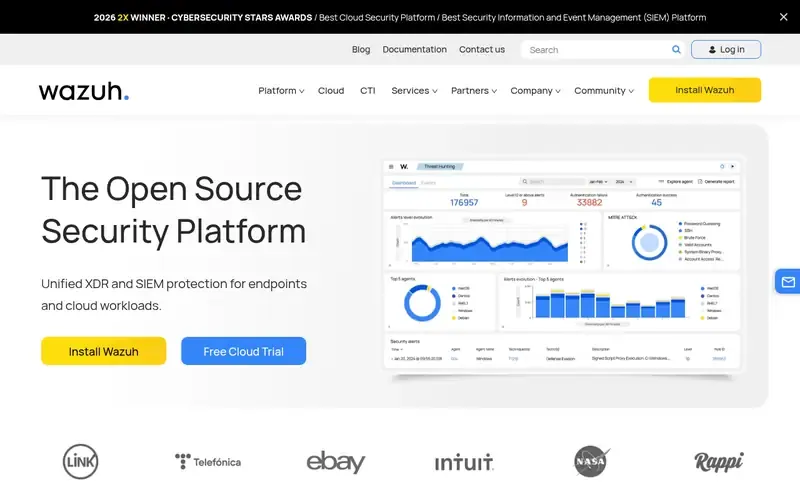
Wazuh is an open source security platform that unifies XDR and SIEM protection for endpoints and cloud workloads. It uses a single agent and platform architecture.
Documented strengths
- Agent performs malware detection, FIM, vulnerability assessment and configuration scanning
- Detected events mapped to adversary tactics and techniques
- Threat intelligence from OSINT, commercial and user-contributed sources
- Ingests third-party telemetry via syslog or APIs
- Integrations with VirusTotal, TheHive and PagerDuty
Documented limits
The facts do not describe packet capture or protocol-level traffic inspection, so teams focused on network traffic should check the vendor documentation. Network data would come from other tools through syslog or APIs.
- Who it is for
- Analysts who want endpoint and cloud telemetry alongside ingested network data
- Platforms
- Public cloud, private cloud and on-premises; agent on common operating systems
- Pricing
- See the vendor's own pricing page for current plans and costs. wazuh.com
- Facts checked
- 21 November 2026
Why it is placed here: It sits fifth because its documented strength is endpoint and cloud telemetry, with network data arriving as third-party input through syslog or APIs.
#6 · Elastic
Elastic Security
SOC teams that want hunting, SIEM and automation in one platform
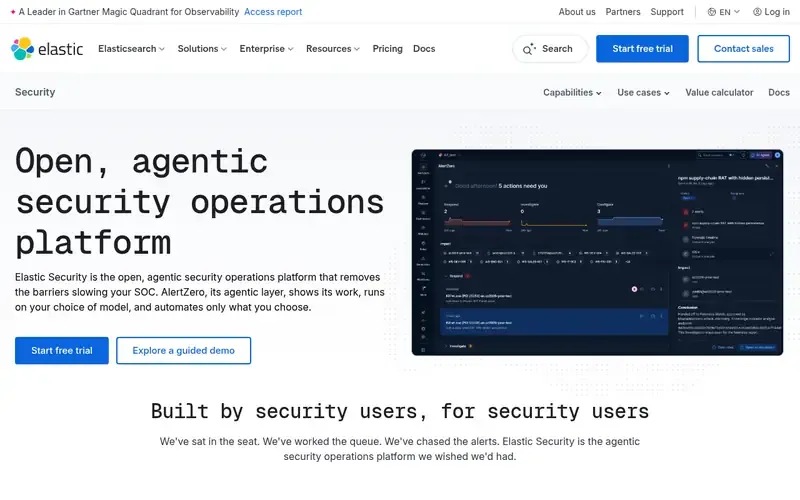
Elastic Security is an open, agentic security operations platform that combines SIEM, endpoint security and automation on one platform. It uses a unified data model and a single query language.
Documented strengths
- Attack Discovery correlates scattered alerts into attack chains
- Agentic layer covers triage, investigation, hunting, detection engineering and forensics
- 400+ prebuilt integrations that normalize data and ship with prebuilt dashboards
- Archived data stays queryable in place without rehydration
- Detection rules written by Elastic's research team and published on GitHub
Documented limits
The facts do not describe direct packet capture or protocol inspection, so network visibility depends on the integrations you connect. Teams should check the vendor documentation for the network data sources they need.
- Who it is for
- SOC teams that want hunting, SIEM and automation in one platform
- Platforms
- Cloud, self-managed and air-gapped deployments (stated for model choice)
- Pricing
- See the vendor's own pricing page for current plans and costs. elastic.co
- Facts checked
- 21 November 2026
Why it is placed here: It closes the list because it is documented as a broad operations platform for triage, hunting and investigation, with network traffic reaching it through integrations rather than direct packet analysis.
Sources
- Zeek: zeek.org, zeek.org/about, zeek.org/security-reporting (21 Nov 2026)
- Suricata: suricata.io, docs.suricata.io/en/suricata-8.0.8, docs.suricata.io/en/suricata-8.0.8/security.html (21 Nov 2026)
- Security Onion: securityonionsolutions.com/software (21 Nov 2026)
- Snort: snort.org, snort.org/products (21 Nov 2026)
- Wazuh: wazuh.com, wazuh.com/about-us, wazuh.com/platform/xdr (21 Nov 2026)
- Elastic Security: elastic.co/security, elastic.co/about, elastic.co/about (21 Nov 2026)
Related guides
How we compiled this
We looked at how well each tool fits inspecting network traffic and metadata to detect and investigate threats, which capabilities the vendor documents, and which deployment and platform options the vendor documents. Tools that analyze packets and network metadata directly sit higher, while platforms that treat network data as one input among many sit lower.
All facts come from official vendor pages, each checked on a recorded date. The order reflects editorial fit for this use case, and each entry explains its position in words. The list is built from documentation rather than from running the products ourselves, so where a vendor page does not cover a topic, we say so and point you to the vendor documentation.
Order used: Ordered by depth of packet and network-metadata analysis, strongest first.
Common questions
Which tool is best for inspecting network metadata?
Zeek is documented as performing deep inspection of application-layer protocols such as HTTP, DNS, SSL/TLS and SSH. It produces structured logs suited to forensics and SIEM integration.
Can I use Zeek and Suricata together?
Security Onion's network visibility uses Suricata, Zeek, full packet capture and Strelka file analysis, and it collects network events from Zeek, Suricata and other tools. It is one documented way to run them in the same deployment.
Do these tools block traffic or only detect it?
Zeek is documented as not an active defense tool like a firewall or IPS. Snort can be deployed inline to stop malicious packets, and Suricata's documentation includes IPS/inline mode guides for Linux and Windows.
Can I analyze a packet capture file after an incident?
Security Onion can import PCAP and Windows EVTX files for static analysis. Zeek also produces structured logs suited to forensics.
Do Wazuh and Elastic Security replace network sensors?
The facts we checked describe both as broader platforms, with Wazuh ingesting third-party telemetry via syslog or APIs and Elastic Security offering 400+ prebuilt integrations. Neither is documented there as a packet-level sensor, so check the vendor documentation for network coverage.
The editorial order is unpaid. A vendor can buy one labelled featured slot per guide, but it gets the same fact check as everyone else and cannot alter or remove a competitor's entry. Guidehurst is independent. Product names and logos belong to their respective owners.