For enterprise platform teams running API gateways on-premises, in hybrid setups or across clouds, this shortlist starts with Kong Gateway, Apigee and Gravitee, followed by Tyk, WSO2 API Manager and Azure API Management. The order follows how clearly each vendor documents self-hosted and hybrid gateway deployment. Each entry also states where the documentation stops.
The shortlist
Side-by-side comparison
| Tool | Who it is for | Platforms | Pricing |
|---|---|---|---|
 Kong GatewayKong Inc. | Platform teams that need one gateway across on-prem and multi-cloud | On-prem, cloud, Kubernetes and serverless | Pricing on konghq.com |
 ApigeeGoogle Cloud | Organizations managing high-value or high-volume APIs with a Kubernetes runtime | Google Cloud; Apigee hybrid on your own Kubernetes cluster | Pricing on cloud.google.com |
 GraviteeGravitee.io | Enterprises governing APIs, Kafka streams and AI agents together | Not stated on official pages | Pricing on gravitee.io |
 TykTyk Technologies | Platform engineers who want a self-managed, air-gap-capable gateway | On-prem, any cloud, air-gapped; hybrid across cloud and on-prem | Pricing on tyk.io |
 WSO2 API ManagerWSO2 | Organizations running API management on their own infrastructure | Kubernetes, VMs, bare metal, air-gapped networks; cloud, on-premises and hybrid | Pricing on wso2.com |
 Azure API ManagementMicrosoft | Teams centered on Azure that need gateways on-prem or in other clouds | Azure control plane; self-hosted gateways in Azure, on-premises or other clouds | Pricing on azure.microsoft.com |
Quick verdict by need
- Kong Gateway if you need platform teams that need one gateway across on-prem and multi-cloud.
- Apigee if you need organizations managing high-value or high-volume APIs with a Kubernetes runtime.
- Gravitee if you need enterprises governing APIs, Kafka streams and AI agents together.
- Tyk if you need platform engineers who want a self-managed, air-gap-capable gateway.
- WSO2 API Manager if you need organizations running API management on their own infrastructure.
- Azure API Management if you need teams centered on Azure that need gateways on-prem or in other clouds.
Tool details
#1 · Kong Inc.
Kong Gateway
Platform teams that need one gateway across on-prem and multi-cloud
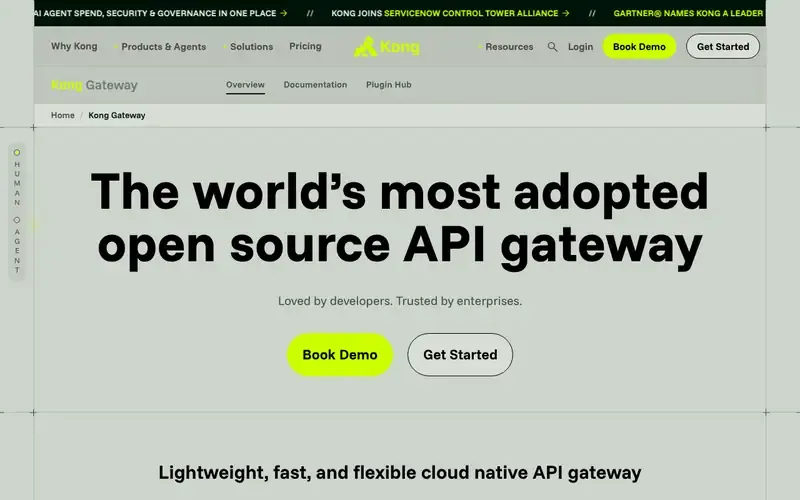
Kong Gateway is a lightweight, cloud-native API gateway built on NGINX that provides security, authentication, transformation and analytics through plugins.
Documented strengths
- Runs from on-prem to cloud, Kubernetes and serverless
- Configurable with or without a database, in hybrid or cloud-hosted modes
- Declarative configuration for CI/CD pipelines
- OAuth 2.0, OpenID Connect, mutual TLS and SAML 2.0 authentication
- FIPS 140-2 compliant mode for the gateway core
Documented limits
Documented as a gateway extended through plugins; teams should check the vendor documentation for which capabilities sit in open source, Enterprise or Kong Konnect.
- Who it is for
- Platform teams that need one gateway across on-prem and multi-cloud
- Platforms
- On-prem, cloud, Kubernetes and serverless
- Pricing
- See the vendor's own pricing page for current plans and costs. konghq.com
- Facts checked
- 21 November 2026
Why it is placed here: It sits first because its documentation says it runs in any environment from on-prem to cloud, Kubernetes and serverless, with hybrid and database-less modes.
#2 · Google Cloud
Apigee
Organizations managing high-value or high-volume APIs with a Kubernetes runtime
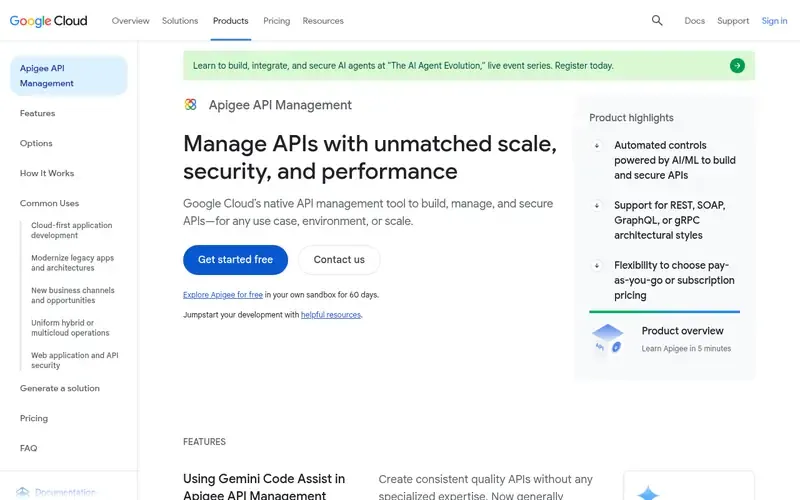
Apigee is Google Cloud's native API management tool for building, managing, and securing APIs at any scale and in any environment.
Documented strengths
- Apigee hybrid runs runtime services in your own Kubernetes cluster
- More than 50 policies covering behavior, traffic, security and QoS
- REST, SOAP, GraphQL and gRPC support
- Built-in traffic dashboards and anomalous-traffic notifications
- Integrated or Drupal-based developer portals
Documented limits
It is Google Cloud's native tool, and the hybrid option is documented for Kubernetes. Teams without Kubernetes should check the vendor documentation for other on-prem options.
- Who it is for
- Organizations managing high-value or high-volume APIs with a Kubernetes runtime
- Platforms
- Google Cloud; Apigee hybrid on your own Kubernetes cluster
- Pricing
- See the vendor's own pricing page for current plans and costs. cloud.google.com
- Facts checked
- 21 November 2026
Why it is placed here: It sits second because Apigee hybrid lets teams run containerized runtime services in their own Kubernetes cluster, with a full management layer around it.
#3 · Gravitee.io
Gravitee
Enterprises governing APIs, Kafka streams and AI agents together
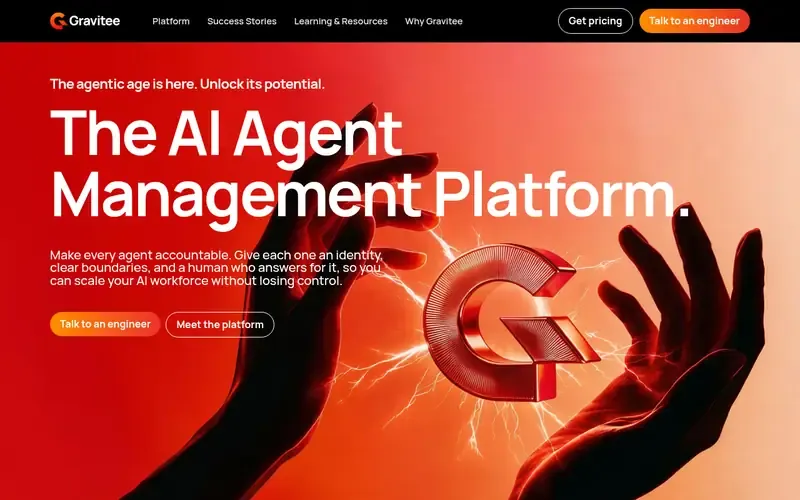
Gravitee is an AI Agent Management platform that secures, observes and governs AI agents, APIs and event streams at enterprise scale.
Documented strengths
- API management across gateways, teams and consumers
- Event management for Kafka streams
- Zero-trust, fine-grained authorization
- PII filtering and agent identity
- REST APIs and Kafka topics convertible into MCP Tools
Documented limits
The facts we hold do not state on-premises or hybrid deployment options. Teams with those requirements should check the vendor documentation.
- Who it is for
- Enterprises governing APIs, Kafka streams and AI agents together
- Platforms
- Not stated on official pages
- Pricing
- See the vendor's own pricing page for current plans and costs. gravitee.io
- Facts checked
- 21 November 2026
Why it is placed here: It sits third because it covers API management across gateways and Kafka event streams, though its documentation centers on governing AI agents.
#4 · Tyk Technologies
Tyk
Platform engineers who want a self-managed, air-gap-capable gateway
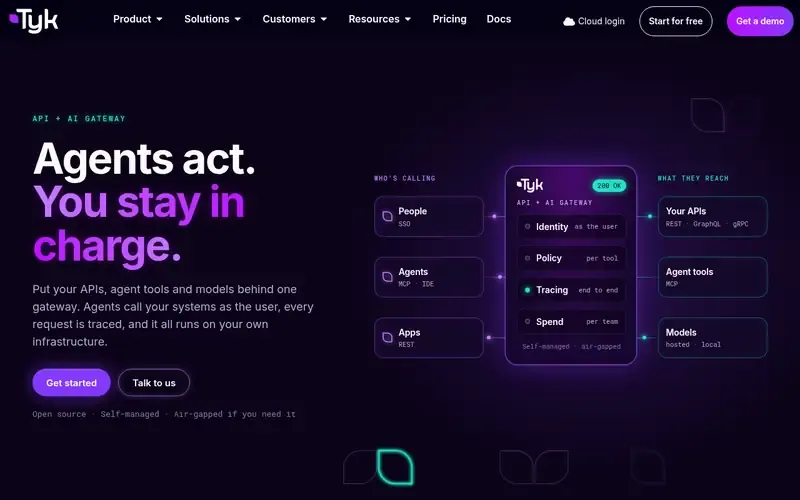
Tyk is an API management platform with an open source API gateway, analytics, developer portal and dashboard, extended to govern agent tools and models.
Documented strengths
- Open source, self-managed and able to run air-gapped
- Hybrid deployment across cloud and on-prem
- Tyk Operator manages APIs as Kubernetes resources
- Tyk Sync moves configuration between dev, test and production
- Rate limiting, quotas, load balancing and circuit breakers
Documented limits
Documentation is oriented to self-run gateways and platform teams. Teams that want a vendor-hosted option should check the vendor documentation.
- Who it is for
- Platform engineers who want a self-managed, air-gap-capable gateway
- Platforms
- On-prem, any cloud, air-gapped; hybrid across cloud and on-prem
- Pricing
- See the vendor's own pricing page for current plans and costs. tyk.io
- Facts checked
- 21 November 2026
Why it is placed here: It sits here because its documentation states that one gateway runs on-prem, in any cloud or fully air-gapped, and supports hybrid deployment.
#5 · WSO2
WSO2 API Manager
Organizations running API management on their own infrastructure
wso2.comWSO2 API Manager, now presented as Choreo API Manager by Choreo Labs (formerly WSO2), is an open platform for full-lifecycle management of APIs, AI, and agents.
Documented strengths
- Deploys on Kubernetes, VMs or bare metal, including air-gapped networks
- From version 4.7, Classic and Platform Gateways run from one control plane
- Can federate Kong, AWS and Azure gateways
- Centralized policy enforcement with XACML, OPA and scope-based authorization
- Audit logging of every API and policy change
Documented limits
The product is now presented under a new name, and AI traffic is routed through a separate AI Gateway and Agent Control Plane. Teams should check the vendor documentation for how current versions are packaged.
- Who it is for
- Organizations running API management on their own infrastructure
- Platforms
- Kubernetes, VMs, bare metal, air-gapped networks; cloud, on-premises and hybrid
- Pricing
- See the vendor's own pricing page for current plans and costs. wso2.com
- Facts checked
- 21 November 2026
Why it is placed here: It sits fifth because it documents Kubernetes, VM, bare metal and air-gapped deployment, with the gateway options tied to specific versions.
#6 · Microsoft
Azure API Management
Teams centered on Azure that need gateways on-prem or in other clouds
Azure API Management is Microsoft's Azure-native platform for securing, scaling, and monitoring APIs, including AI model, MCP server, and agent APIs, across environments.
Documented strengths
- Self-hosted containerized gateways in Azure, on-premises or other clouds
- Unified control plane in Azure
- API Center as a single registry for APIs in any environment
- Microsoft Defender for Cloud for security posture
- Real-time dashboards, metrics and logs
Documented limits
The control plane lives in Azure. Teams that need a control plane outside Azure should check the vendor documentation.
- Who it is for
- Teams centered on Azure that need gateways on-prem or in other clouds
- Platforms
- Azure control plane; self-hosted gateways in Azure, on-premises or other clouds
- Pricing
- See the vendor's own pricing page for current plans and costs. azure.microsoft.com
- Facts checked
- 21 November 2026
Why it is placed here: It sits last because self-hosted gateways are documented, but they are managed from a control plane in Azure, which suits teams already centered on Azure.
Sources
- Kong Gateway: konghq.com/products/kong-gateway, konghq.com/product-updates (21 Nov 2026)
- Apigee: cloud.google.com/apigee (21 Nov 2026)
- Gravitee: gravitee.io, gravitee.io/platform (21 Nov 2026)
- Tyk: tyk.io, tyk.io/about-us, tyk.io/api-security (21 Nov 2026)
- WSO2 API Manager: choreolabs.com/api-manager, choreolabs.com/about, choreolabs.com/security (21 Nov 2026)
- Azure API Management: azure.microsoft.com/en-us/products/api-management (21 Nov 2026)
Related guides
How we compiled this
We looked at fit with running gateways outside a single public cloud, the capabilities each vendor documents, and the deployment and platform details on its official pages. Tools that state where the gateway can run, such as on-prem, Kubernetes, hybrid modes or air-gapped networks, sit earlier. Tools whose deployment documentation is thinner or tied to one platform sit later, with the boundary noted in the limits.
All facts come from official vendor pages, and each fact carries a check date. The order reflects editorial fit for this use case, explained in words for each tool, and does not say any tool is better overall. The list is built from documentation, not product trials, so teams should confirm details with the vendor before committing.
Order used: Ordered by strength of self-hosted and hybrid gateway deployment options, closest fit first.
Common questions
Which API gateways here can run air-gapped?
Tyk documents that it can run fully air-gapped. WSO2 API Manager documents deployment on Kubernetes, VMs or bare metal, including air-gapped networks.
Can I run an API gateway on-premises while managing it from the cloud?
Azure API Management documents self-hosted containerized gateways that run in Azure, on-premises or on other clouds, managed from a unified control plane in Azure. Apigee hybrid runs runtime services in your own Kubernetes cluster.
Which tool runs without a database?
Kong Gateway documents configuration with or without a database, in hybrid or cloud-hosted modes.
Do any of these tools manage several gateways together?
WSO2 API Manager documents federating Kong, AWS and Azure gateways. From version 4.7 it also runs a Classic Gateway and a Platform Gateway from one control plane.
Are there open source options in this list?
Kong Gateway lists open source among its offerings, Tyk documents an open source gateway, and WSO2 API Manager is documented as open source.
The editorial order is unpaid. A vendor can buy one labelled featured slot per guide, but it gets the same fact check as everyone else and cannot alter or remove a competitor's entry. Guidehurst is independent. Product names and logos belong to their respective owners.