For governed, large-scale app development, Mendix, Microsoft Power Apps and Appian are the first platforms to look at, followed by Pega Platform, Quickbase and Zoho Creator. This shortlist is for IT leaders and enterprise citizen-developer programs that need low-code speed without giving up audit trails, policy control and administrative oversight.
The shortlist
Side-by-side comparison
| Tool | Who it is for | Platforms | Pricing |
|---|---|---|---|
 MendixMendix (Siemens) | Enterprises that want governed apps, agents and workflows on one platform | Public cloud, private cloud or air-gapped environments | Pricing on mendix.com |
 Microsoft Power AppsMicrosoft | Microsoft-centred organisations with mixed citizen and professional developers | Web and mobile apps, running on Microsoft Cloud as part of Power Platform | Pricing on microsoft.com |
 AppianAppian Corporation | Regulated enterprises orchestrating processes across people, bots and systems | Not stated on official pages | Pricing on appian.com |
 Pega PlatformPegasystems | Large organisations tying workflow automation to customer decisioning | Cloud-native platform; specific deployment options not stated on official pages | Pricing on pega.com |
 QuickbaseQuickbase Inc. | IT-supervised departmental apps and field operations | Web platform with mobile capabilities for field operations | Pricing on quickbase.com |
 Zoho CreatorZoho Corporation | Teams that want flexible deployment and many prebuilt connectors | Zoho Cloud, AWS, Azure, GCP, on-premise or hybrid; native iOS and Android apps generated automatically | Pricing on zoho.com |
Quick verdict by need
- Mendix if you need enterprises that want governed apps, agents and workflows on one platform.
- Microsoft Power Apps if you need microsoft-centred organisations with mixed citizen and professional developers.
- Appian if you need regulated enterprises orchestrating processes across people, bots and systems.
- Pega Platform if you need large organisations tying workflow automation to customer decisioning.
- Quickbase if you need iT-supervised departmental apps and field operations.
- Zoho Creator if you need teams that want flexible deployment and many prebuilt connectors.
Tool details
#1 · Mendix (Siemens)
Mendix
Enterprises that want governed apps, agents and workflows on one platform
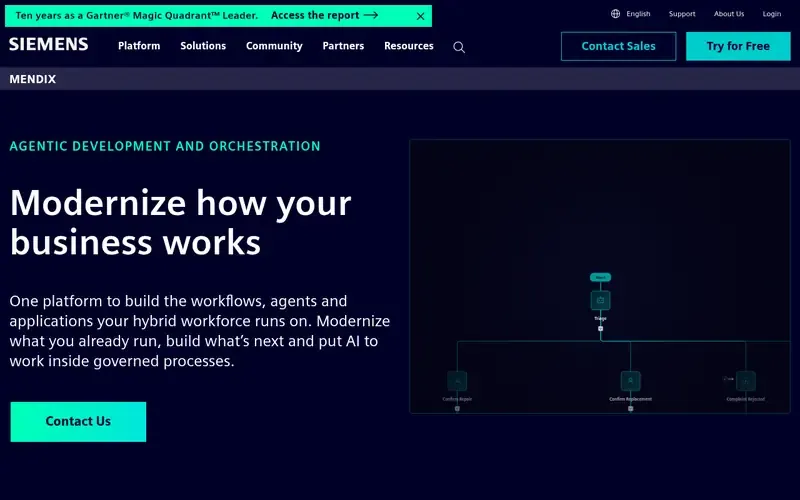
Mendix is a Siemens low-code platform for building the workflows, agents and applications that a hybrid workforce runs on. It is a single platform for all three.
Documented strengths
- Trust layer with built-in audit trails and policy control across apps, agents and workflows
- Permissions, guardrails, approvals and escalation paths for apps and agents
- Deployment to public cloud, private cloud or air-gapped environments
- Studio Pro, a governed, open and extensible IDE
- Graph Studio builds an enterprise knowledge graph without copying or moving records
Documented limits
Documented for product owners, developers, architects and domain experts. Teams that expect to hand the platform to a wide group of non-technical builders should check the vendor documentation on how roles are split.
- Who it is for
- Enterprises that want governed apps, agents and workflows on one platform
- Platforms
- Public cloud, private cloud or air-gapped environments
- Pricing
- See the vendor's own pricing page for current plans and costs. mendix.com
- Facts checked
- 21 November 2026
Why it is placed here: It sits first because its documentation puts governance at the centre, with a trust layer, audit trails, policy control and a choice of deployment environments.
#2 · Microsoft
Microsoft Power Apps
Microsoft-centred organisations with mixed citizen and professional developers
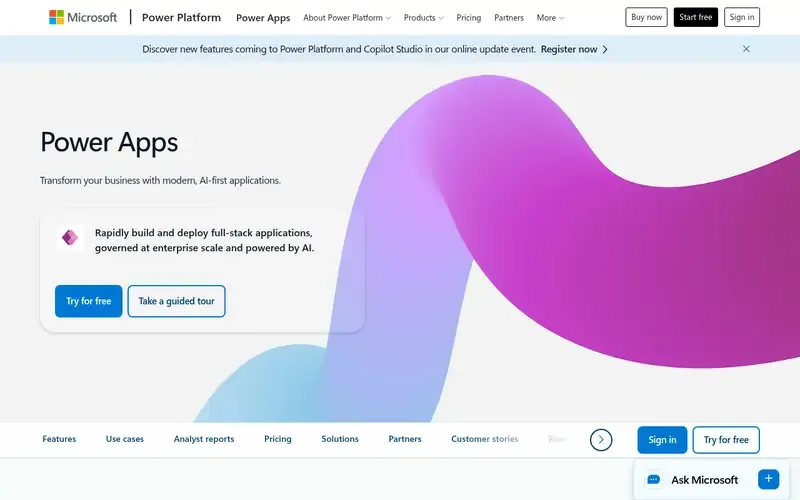
Microsoft Power Apps is a low-code app builder for custom business apps. Apps can be built by drag and drop, with generative AI, or with custom code.
Documented strengths
- Admins can centralize policies for environments, data loss prevention, access and auditing
- Business users can generate apps by describing needs in natural language
- Professional developers can extend apps with custom code and connectors
- Integrates with Microsoft Teams and works with Dynamics 365 and Azure
- Power Platform can connect to SAP data and workflows
Documented limits
Governance is documented as part of Power Platform on Microsoft Cloud. Teams that need other hosting models should check the vendor documentation.
- Who it is for
- Microsoft-centred organisations with mixed citizen and professional developers
- Platforms
- Web and mobile apps, running on Microsoft Cloud as part of Power Platform
- Pricing
- See the vendor's own pricing page for current plans and costs. microsoft.com
- Facts checked
- 21 November 2026
Why it is placed here: It comes second because its central admin policies and Microsoft Cloud foundation suit organisations that already run on Microsoft services and want business users and developers on one governed platform.
#3 · Appian Corporation
Appian
Regulated enterprises orchestrating processes across people, bots and systems
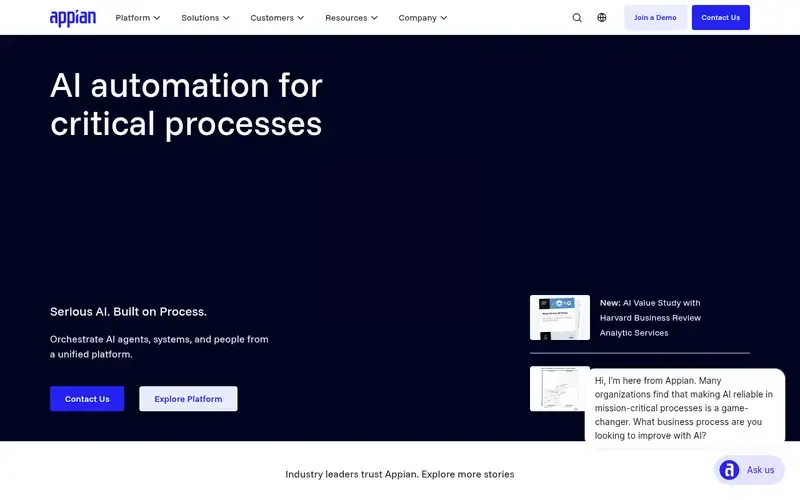
Appian is an enterprise process orchestration platform that unites AI agents, systems, people, data and automation. It is aimed at large enterprises and governments.
Documented strengths
- Built-in audit trails log every action for compliance and audit workflows
- Compliance certifications including HIPAA and FedRAMP
- Data fabric connects data without moving it and treats external data as local data with secure read-write access
- Process intelligence, intelligent document processing (IDP) and RPA capabilities
- No-code apps with embedded AI agents
Documented limits
Documented as a process orchestration platform. Teams looking mainly for a lightweight form or app builder should check the vendor documentation on scope. Hosting and platform options are not stated on the official pages we used.
- Who it is for
- Regulated enterprises orchestrating processes across people, bots and systems
- Platforms
- Not stated on official pages
- Pricing
- See the vendor's own pricing page for current plans and costs. appian.com
- Facts checked
- 21 November 2026
Why it is placed here: It fits third because its documentation stresses compliance certifications, audit trails and high availability for critical processes, which matter in regulated enterprise programs.
#4 · Pegasystems
Pega Platform
Large organisations tying workflow automation to customer decisioning
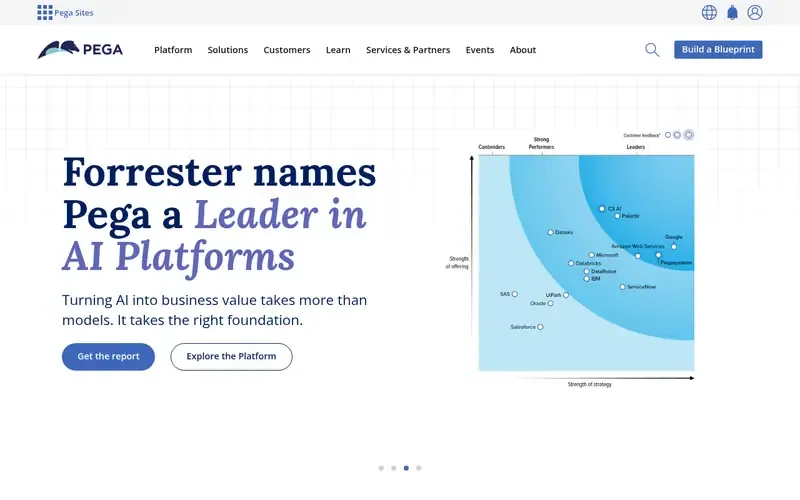
Pega Platform is an AI-powered, low-code enterprise platform for workflow automation, decisioning and customer engagement, from Pegasystems. Its products are grouped in the Pega Infinity portfolio.
Documented strengths
- Responsible AI governance named as an architectural principle
- AI agents run with context, compliance and human oversight
- Situational Layer Cake approach to build once and reuse everywhere
- Pega Blueprint brings business and IT together for design and go-live
- Works with multiple third-party AI models, including Claude, GPT and Gemini
Documented limits
Documented mainly for workflow automation, decisioning and customer engagement. Teams building general internal apps should check the vendor documentation for fit.
- Who it is for
- Large organisations tying workflow automation to customer decisioning
- Platforms
- Cloud-native platform; specific deployment options not stated on official pages
- Pricing
- See the vendor's own pricing page for current plans and costs. pega.com
- Facts checked
- 21 November 2026
Why it is placed here: It sits fourth because its governance and reuse documentation is strong, but its emphasis on decisioning and customer engagement makes it a closer fit for programs with those goals than for general-purpose app building.
#5 · Quickbase Inc.
Quickbase
IT-supervised departmental apps and field operations
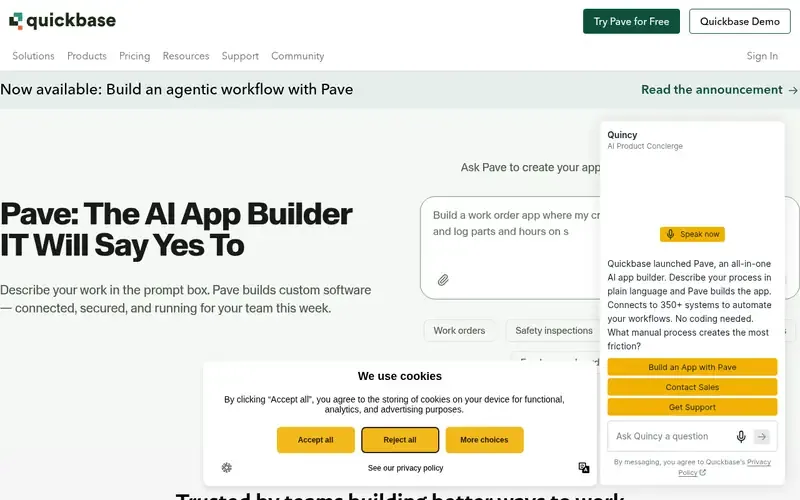
Quickbase is an application platform for dynamic work that brings data and teams into one centralized place. It has a no-code visual builder and Pave, an AI app builder.
Documented strengths
- Permissions by role, down to the field level
- SAML single sign-on and SCIM group provisioning
- Data encrypted at rest with AES-256 and in transit with TLS
- Separate dev, test and prod environments through application lifecycle management
- IP filtering to restrict network access
Documented limits
Documented around no-code building for business users and app builders. Teams that need deep process orchestration or custom-code extension should check the vendor documentation.
- Who it is for
- IT-supervised departmental apps and field operations
- Platforms
- Web platform with mobile capabilities for field operations
- Pricing
- See the vendor's own pricing page for current plans and costs. quickbase.com
- Facts checked
- 21 November 2026
Why it is placed here: It sits fifth because its administrative controls are well documented for departmental and operational apps, though its documentation is less focused on enterprise-wide orchestration.
#6 · Zoho Corporation
Zoho Creator
Teams that want flexible deployment and many prebuilt connectors
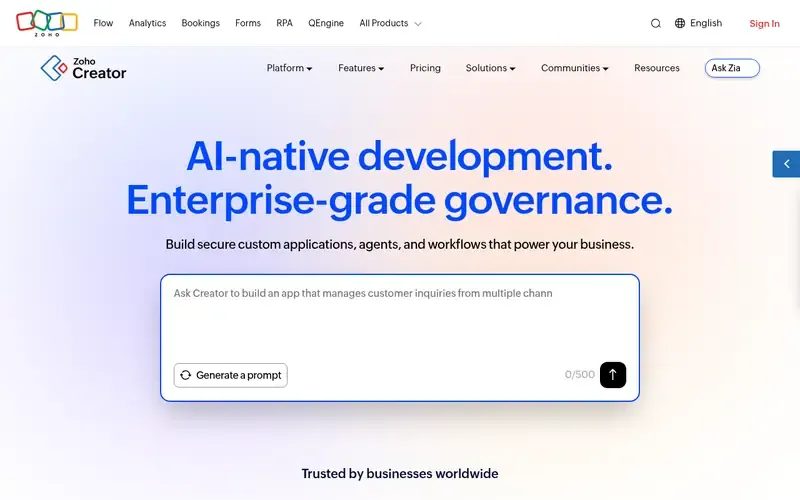
Zoho Creator is an AI app builder for custom applications, agents and workflows. Apps can be built by prompting, assembling components, or coding with Deluge and VS Code.
Documented strengths
- Certified against SOC 2, GDPR, HIPAA and HDS
- Deployment on Zoho Cloud, AWS, Azure, GCP, on-premise or hybrid
- Over 1,000 prebuilt connectors, including SAP and Oracle
- Staging and production environments with monitoring, backups and disaster recovery
- Test Agent generates and runs test cases and can self-heal broken tests
Documented limits
Documented for businesses, IT admins and operations teams generally. Enterprises that need detailed approval and policy workflows for AI agents should check the vendor documentation.
- Who it is for
- Teams that want flexible deployment and many prebuilt connectors
- Platforms
- Zoho Cloud, AWS, Azure, GCP, on-premise or hybrid; native iOS and Android apps generated automatically
- Pricing
- See the vendor's own pricing page for current plans and costs. zoho.com
- Facts checked
- 21 November 2026
Why it is placed here: It sits last on this list because it is aimed at a broad range of businesses and its documentation is lighter on enterprise governance, although its security certifications and deployment choices are extensive.
Sources
- Mendix: mendix.com, mendix.com/platform, mendix.com/products (21 Nov 2026)
- Microsoft Power Apps: microsoft.com/en-us/power-platform/products/power-apps, microsoft.com/en-us/about (21 Nov 2026)
- Appian: appian.com, appian.com/pre-built-solutions, appian.com/platform/capabilities (21 Nov 2026)
- Pega Platform: pega.com, pega.com/about, pega.com/products (21 Nov 2026)
- Quickbase: quickbase.com, quickbase.com/product, quickbase.com/solutions (21 Nov 2026)
- Zoho Creator: zoho.com/creator, zoho.com/creator/solutions, zoho.com/creator/solutions/asset-management (21 Nov 2026)
Related guides
- Top 5 RPA tools for automating legacy desktop applications without APIs
- Top 5 workflow automation tools for Microsoft 365 and Zoho users
- Top 5 workflow engines for durable, fault-tolerant execution in code
- Top 6 workflow automation tools for non-technical small business owners
- More in Workflow automation
How we compiled this
We looked at how well each platform fits governed, enterprise-scale app development: documented governance and audit capabilities, administrative controls, options for connecting existing systems, AI-assisted development, and deployment or platform documentation. Each entry draws only on facts from the vendor's official pages, which we record with check dates. Where a page does not state something, we say so instead of filling the gap.
The order reflects editorial fit for this use case, and we explain it in words under each entry. Platforms with the most explicit governance and scalability documentation come first, and lighter departmental platforms come last. No entry is better overall than another, and a lower position does not mean a weaker product. The list is built from documentation, not from product trials, so teams should confirm details with each vendor before committing.
Order used: Ordered by enterprise governance and scalability for app development, with lighter departmental platforms last.
Common questions
What is a governed low-code platform?
It is a low-code platform with controls over who can build, change and run apps. On this shortlist, examples include Mendix's audit trails and policy control, Power Apps' central admin policies for data loss prevention and auditing, and Appian's audit trail of every action.
Which of these platforms can run in air-gapped or private environments?
Mendix documents deployment to public cloud, private cloud or air-gapped environments. Zoho Creator documents Zoho Cloud, AWS, Azure, GCP, on-premise or hybrid deployment. For the others, check the vendor documentation.
Which platforms document compliance certifications?
Appian lists compliance certifications including HIPAA and FedRAMP. Zoho Creator lists SOC 2, GDPR, HIPAA and HDS. Confirm current certification scope with each vendor.
Can these platforms work with existing systems instead of replacing them?
Mendix and Appian both document building on or orchestrating existing systems without replacing them. Power Apps can connect to SAP data and workflows, and Zoho Creator offers prebuilt connectors for SAP and Oracle.
Which platforms help non-developers build apps?
Power Apps lets business users describe an app in natural language, and Quickbase offers a no-code visual builder and the Pave AI app builder. Zoho Creator supports prompting through its Zia assistant, and Mendix generates visual models rather than raw code so non-specialists can contribute.
The editorial order is unpaid. A vendor can buy one labelled featured slot per guide, but it gets the same fact check as everyone else and cannot alter or remove a competitor's entry. Guidehurst is independent. Product names and logos belong to their respective owners.