For backend engineers who need long-lived workflows that survive failures, Temporal, Zeebe and Camunda are the closest fits, followed by Prefect and Pipedream. Temporal comes first because it is a durable execution platform where business logic is written as code. This shortlist is for teams building reliable distributed systems who want to understand what each engine documents before they commit.
The shortlist
Side-by-side comparison
| Tool | Who it is for | Platforms | Pricing |
|---|---|---|---|
 TemporalTemporal Technologies | Backend teams writing long-running business logic in code | Self-hosted open source (MIT-licensed) or managed Temporal Cloud; local dev server via CLI on macOS, Windows and Linux | Pricing on temporal.io |
 ZeebeCamunda | Teams that want fault-tolerant, horizontally scalable process orchestration | Docker and Kubernetes | Pricing on github.com |
 CamundaCamunda Services GmbH | Organizations orchestrating long-running processes across people, systems and AI agents | Self-Managed deployments with multi-zone, dual-region or three-region setups | Pricing on camunda.com |
 PrefectPrefect Technologies | Python teams running durable data and AI workflows | Serverless platforms such as Cloud Run, ECS and Modal, or workers on Kubernetes, ECS, Docker or serverless | Pricing on prefect.io |
 PipedreamPipedream Inc. | Developers adding API connectors and managed auth to agents and apps | Managed runtime; no customer hosting required | Pricing on pipedream.com |
Quick verdict by need
- Temporal if you need backend teams writing long-running business logic in code.
- Zeebe if you need teams that want fault-tolerant, horizontally scalable process orchestration.
- Camunda if you need organizations orchestrating long-running processes across people, systems and AI agents.
- Prefect if you need python teams running durable data and AI workflows.
- Pipedream if you need developers adding API connectors and managed auth to agents and apps.
Tool details
#1 · Temporal Technologies
Temporal
Backend teams writing long-running business logic in code
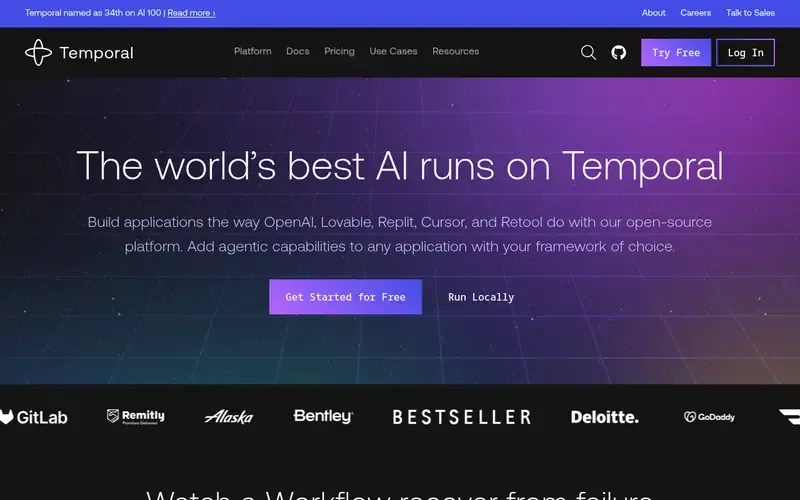
Temporal is an open-source durable execution platform for writing business logic as code in Workflows that automatically recover from failure. Workflows capture state at every step and resume where they left off.
Documented strengths
- Workflows resume exactly where they left off after a failure
- Activities model failure-prone interactions and retry automatically
- Configured retry policies that can last months
- Timers that wait days, weeks or months and survive outages or restarts
- Native SDKs for Go, Java, TypeScript, Python and .NET
Documented limits
Documented as a platform for developers writing workflows in code through its SDKs; teams that want to define processes visually should look at the BPMN-based options below. Self-hosting versus managed Temporal Cloud is a choice to evaluate in the vendor documentation.
- Who it is for
- Backend teams writing long-running business logic in code
- Platforms
- Self-hosted open source (MIT-licensed) or managed Temporal Cloud; local dev server via CLI on macOS, Windows and Linux
- Pricing
- See the vendor's own pricing page for current plans and costs. temporal.io
- Facts checked
- 21 November 2026
Why it is placed here: It sits first because durable execution is its core design and workflows are written directly in code, which matches the use case most directly.
#2 · Camunda
Zeebe
Teams that want fault-tolerant, horizontally scalable process orchestration
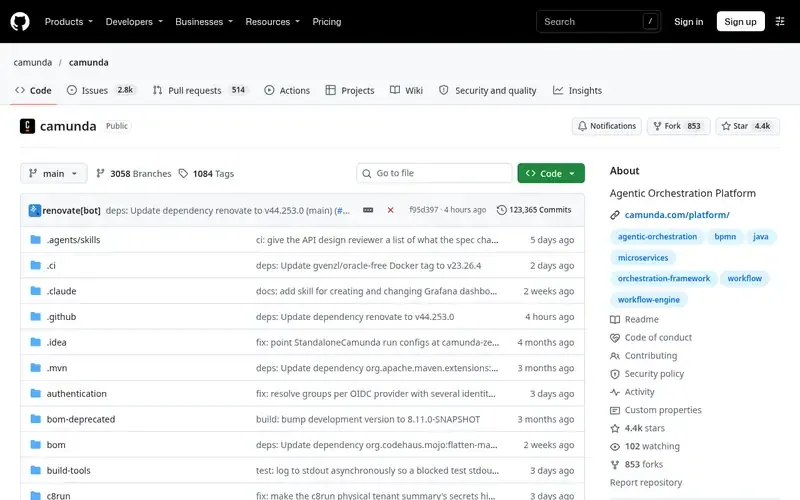
Zeebe is the cloud-native process engine of Camunda 8. It runs processes defined visually in BPMN 2.0 and is fault tolerant without requiring a relational database.
Documented strengths
- Fault tolerant and does not require a relational database
- Scales horizontally for very high throughput
- Processes defined visually in BPMN 2.0
- Reacts to messages from Kafka and other message queues
- Choice of programming language
Documented limits
Workflow logic is defined in BPMN and DMN rather than purely in code, so it suits teams comfortable with visual process modeling. Zeebe source files are under the Camunda License 1.0, except some parts under Apache 2.0, so check the license terms for your use.
- Who it is for
- Teams that want fault-tolerant, horizontally scalable process orchestration
- Platforms
- Docker and Kubernetes
- Pricing
- See the vendor's own pricing page for current plans and costs. github.com
- Facts checked
- 21 November 2026
Why it is placed here: It follows Temporal because it documents fault tolerance and horizontal scale for long-running processes, but its processes are modeled in BPMN rather than written as code.
#3 · Camunda Services GmbH
Camunda
Organizations orchestrating long-running processes across people, systems and AI agents
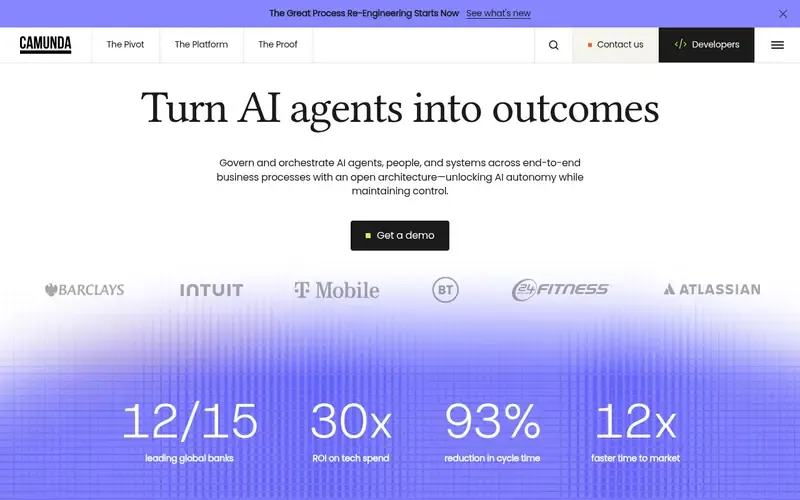
Camunda is an open platform for agentic orchestration that coordinates AI agents, people and systems across end-to-end business processes using BPMN. Zeebe is its orchestration engine for high-volume, long-running processes.
Documented strengths
- Zeebe engine handling retries, compensation, timeouts and escalations
- Operate with live execution traces, incident resolution and an audit trail
- Pre-built connectors for ERP, CRM, ITSM and major LLM providers
- RBAC, SSO and SCIM
- Self-Managed multi-zone, dual-region or three-region setups with replicated data
Documented limits
Documented as a process-orchestration platform built on BPMN and DMN, with a broad scope beyond workflow code. Engineers who only need a code-level execution engine should compare how much of the platform they would use.
- Who it is for
- Organizations orchestrating long-running processes across people, systems and AI agents
- Platforms
- Self-Managed deployments with multi-zone, dual-region or three-region setups
- Pricing
- See the vendor's own pricing page for current plans and costs. camunda.com
- Facts checked
- 21 November 2026
Why it is placed here: It sits after Zeebe because it wraps the same engine, which handles retries, compensation, timeouts and escalations, in a broader platform aimed at business and IT teams as well as developers.
#4 · Prefect Technologies
Prefect
Python teams running durable data and AI workflows
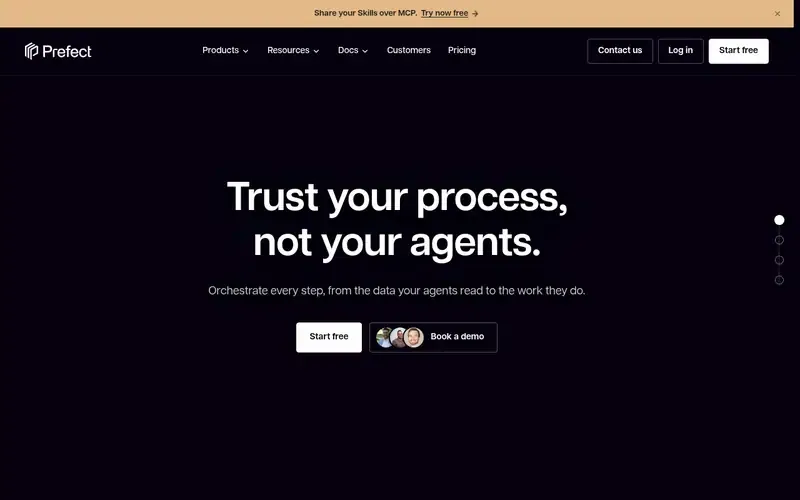
Prefect is a Python workflow orchestration product, built on the open source Prefect framework, for data pipelines and AI agents. Any Python function can become a durable, observable workflow with a decorator.
Documented strengths
- Workflows defined with the @flow decorator, with no YAML or DSL
- Durable execution reuses completed work after a failure
- No code replay, so no determinism rules
- Pause for human input in the UI, such as approvals or forms
- Workers poll over outbound-only connections, so no inbound network access is needed
Documented limits
Documented for Python workflows; teams working in other languages should check the vendor documentation. Managed and push execution are not part of the open-source Prefect server.
- Who it is for
- Python teams running durable data and AI workflows
- Platforms
- Serverless platforms such as Cloud Run, ECS and Modal, or workers on Kubernetes, ECS, Docker or serverless
- Pricing
- See the vendor's own pricing page for current plans and costs. prefect.io
- Facts checked
- 21 November 2026
Why it is placed here: It sits fourth because it is code-first and documents durable execution that reuses completed work after a failure, but it is centered on Python and data and AI pipelines.
#5 · Pipedream Inc.
Pipedream
Developers adding API connectors and managed auth to agents and apps
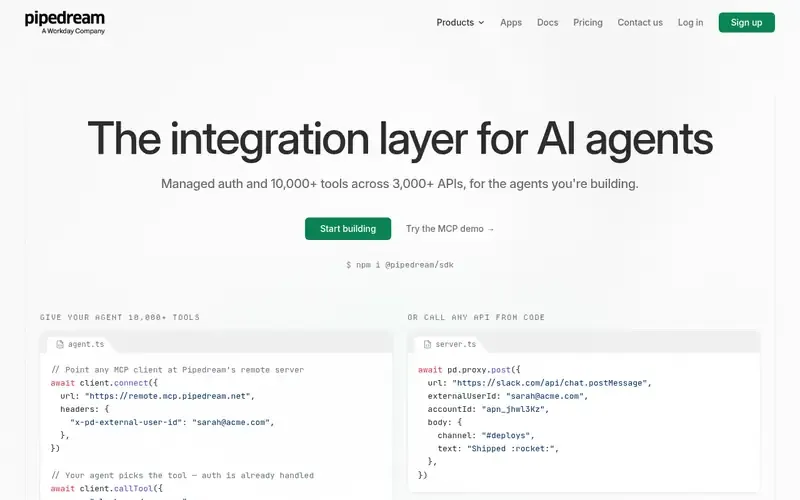
Pipedream is an integration layer for AI agents that offers managed auth, prebuilt tools and triggers across thousands of APIs. It also provides a gateway for company AI tool use.
Documented strengths
- Full OAuth authorization flow with token storage and refresh
- Actions and real-time event triggers from a public registry
- Single MCP endpoint with tool discovery and per-user auth
- Proxy that calls supported APIs with the user's credentials attached
- Managed runtime that needs no hosting or scaling by the customer
Documented limits
The official pages document integrations and auth rather than durable execution or retry guarantees for long-lived workflows. Teams that need those guarantees should check the vendor documentation. Audit trails in the company-facing gateway are listed as early access.
- Who it is for
- Developers adding API connectors and managed auth to agents and apps
- Platforms
- Managed runtime; no customer hosting required
- Pricing
- See the vendor's own pricing page for current plans and costs. pipedream.com
- Facts checked
- 21 November 2026
Why it is placed here: It sits last because its documented scope is agent and app integrations rather than durable workflow state, so it complements an engine rather than replacing one.
Sources
- Temporal: temporal.io, temporal.io/about, temporal.io/product (21 Nov 2026)
- Zeebe: github.com/camunda/camunda, github.com/about, github.com/features (21 Nov 2026)
- Camunda: camunda.com, camunda.com/about, camunda.com/platform (21 Nov 2026)
- Prefect: prefect.io, prefect.io/security, prefect.io/how-it-works (21 Nov 2026)
- Pipedream: pipedream.com (21 Nov 2026)
Related guides
How we compiled this
We looked at three things: how closely each tool fits running long-lived, fault-tolerant workflows in code, which durability and recovery capabilities the vendor documents, and which deployment and platform options are documented. Tools that define workflows in a visual model rather than in code, or that focus on a neighboring problem such as agent integrations, are included where the documentation shows a relevant link to the use case, and their scope boundaries are stated plainly.
All facts come from official vendor pages and were checked on the dates we recorded them. The order reflects editorial fit for this use case, which is durable guarantees and a code-first developer experience. We explain each position in words, and no tool is claimed to be better overall. This list is built from documentation, not from product trials, so teams should confirm details in the vendor documentation before choosing.
Order used: Ordered by strength of durable-execution guarantees and developer-code-first design.
Common questions
What is durable execution in a workflow engine?
In Temporal's documentation, it means Workflows capture state at every step and resume exactly where they left off after a failure. Prefect describes a similar idea, where completed work is reused after a failure instead of repeated.
Which workflow engines let you write workflows in code?
Temporal documents native SDKs for Go, Java, TypeScript, Python and .NET. Prefect workflows are plain Python, defined by adding the @flow decorator. Zeebe and Camunda define processes visually in BPMN, with a choice of programming language for working with them.
Can these engines handle retries and long waits?
Temporal documents configured retry policies that can last months, and timers that wait days, weeks or months and survive outages or restarts. Camunda documents that Zeebe handles retries, compensation, timeouts and escalations for long-running processes.
Can I self-host a durable workflow engine?
Temporal can be self-hosted as open source or run as the managed Temporal Cloud. Zeebe supports deployment with Docker and Kubernetes, and Camunda documents Self-Managed deployments. Prefect workers can run in your own environment, though managed and push execution are not part of the open-source Prefect server.
Does Prefect require deterministic workflow code?
Prefect states that it does not replay code, so there are no determinism rules. Teams should compare this with the replay-based model described in Temporal's documentation, where executions can be replayed and rewound step by step.
The editorial order is unpaid. A vendor can buy one labelled featured slot per guide, but it gets the same fact check as everyone else and cannot alter or remove a competitor's entry. Guidehurst is independent. Product names and logos belong to their respective owners.