CrowdStrike Falcon Insight XDR, Microsoft Defender for Endpoint and Palo Alto Networks Cortex XDR open this shortlist of EDR and XDR tools for detecting and responding to advanced endpoint threats. It is written for enterprise security operations teams that run large fleets and need investigation and response capabilities, not only prevention.
The shortlist
Side-by-side comparison
| Tool | Who it is for | Platforms | Pricing |
|---|---|---|---|
 CrowdStrike Falcon Insight XDRCrowdStrike | SOC teams wanting EDR extended with identity, cloud and mobile telemetry | Single lightweight sensor across domains; related Falcon for Mobile covers Android and iOS; package blocking on Windows, macOS and Linux | Pricing on crowdstrike.com |
 Microsoft Defender for EndpointMicrosoft | Security teams managing mixed device fleets that want granular policy control | Windows, Linux, macOS, iOS, Android and IoT | Pricing on microsoft.com |
 Palo Alto Networks Cortex XDRPalo Alto Networks | SOC teams that want to write custom detections and investigate across data sources | Not stated on official pages; integrates with Google Security Operations | Pricing on paloaltonetworks.com |
 Trend Micro Vision OneTrend Micro | Enterprises consolidating endpoint, email, cloud and risk tooling in one platform | Endpoints, laptops, PCs, mobile devices, servers and workloads; cloud and hybrid cloud environments | Pricing on trendmicro.com |
 Cybereason Defense PlatformCybereason | Teams with private or isolated networks or those wanting vendor SOC support | Cloud-connected, private or offline deployments; on-premises EDR version for private and isolated networks | Pricing on cybereason.com |
 Cisco Secure EndpointCisco | Teams in Cisco environments that want threat hunting and Cisco XDR integration | Not stated on official pages; cloud-native | Pricing on cisco.com |
 Elastic DefendElastic | Teams that want an open platform and can ingest third-party endpoint data | Windows, macOS and Linux; hybrid environments, including offline and cloud-connected ones | Pricing on elastic.co |
Quick verdict by need
- CrowdStrike Falcon Insight XDR if you need sOC teams wanting EDR extended with identity, cloud and mobile telemetry.
- Microsoft Defender for Endpoint if you need security teams managing mixed device fleets that want granular policy control.
- Palo Alto Networks Cortex XDR if you need sOC teams that want to write custom detections and investigate across data sources.
- Trend Micro Vision One if you need enterprises consolidating endpoint, email, cloud and risk tooling in one platform.
- Cybereason Defense Platform if you need teams with private or isolated networks or those wanting vendor SOC support.
- Cisco Secure Endpoint if you need teams in Cisco environments that want threat hunting and Cisco XDR integration.
Tool details
#1 · CrowdStrike
CrowdStrike Falcon Insight XDR
SOC teams wanting EDR extended with identity, cloud and mobile telemetry
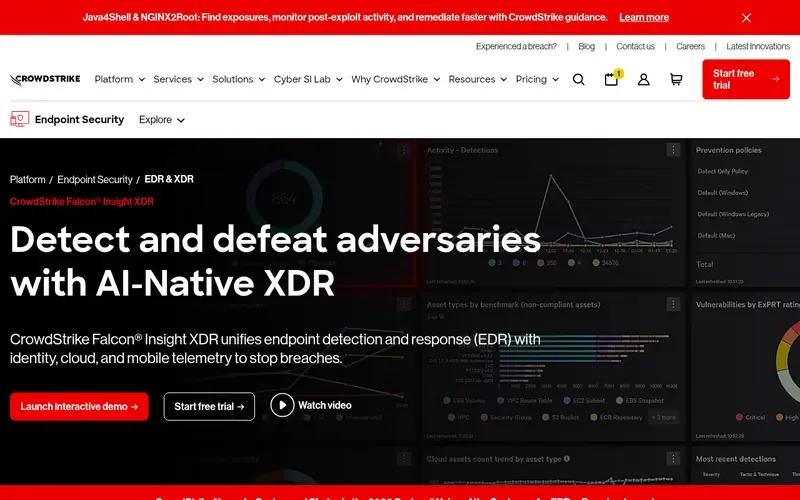
Falcon Insight XDR is an AI-native XDR and EDR solution that unifies endpoint detection and response with identity, cloud and mobile telemetry.
Documented strengths
- EDR unified with identity, cloud and mobile telemetry
- Attack path visibility, adversary context and MITRE ATT&CK mappings
- Real Time Response (RTR) for direct remote access to systems
- Native Falcon Fusion SOAR for automating complex tasks
- 24/7 managed threat hunting
Documented limits
Managed detection and response is described as the related Falcon Complete service. Teams that want managed coverage should check the vendor documentation for how it is delivered.
- Who it is for
- SOC teams wanting EDR extended with identity, cloud and mobile telemetry
- Platforms
- Single lightweight sensor across domains; related Falcon for Mobile covers Android and iOS; package blocking on Windows, macOS and Linux
- Pricing
- See the vendor's own pricing page for current plans and costs. crowdstrike.com
- Facts checked
- 21 November 2026
Why it is placed here: It comes first because the documentation covers the full chain of detection, investigation and response, from automated leads and attack path visibility to Real Time Response, SOAR and managed hunting.
#2 · Microsoft
Microsoft Defender for Endpoint
Security teams managing mixed device fleets that want granular policy control
Microsoft Defender for Endpoint is Microsoft's endpoint security product that helps stop cyberattacks and secure devices using AI-powered protection.
Documented strengths
- Autonomous protection that acts during active attacks
- Single view of attack surface, adversaries and attack paths
- Granular controls over settings, policies, access, detections and automated workflows
- Telemetry data collection that can be optimized in the portal
- Unified endpoint management for security and IT collaboration
Documented limits
The product page centers on endpoint security, with email, identity and SaaS protection offered through the Defender Suite. Teams that need those should check the vendor documentation.
- Who it is for
- Security teams managing mixed device fleets that want granular policy control
- Platforms
- Windows, Linux, macOS, iOS, Android and IoT
- Pricing
- See the vendor's own pricing page for current plans and costs. microsoft.com
- Facts checked
- 21 November 2026
Why it is placed here: It sits second for its documented operating system breadth, granular controls and attack path view, with the option to sit inside the wider Defender Suite.
#3 · Palo Alto Networks
Palo Alto Networks Cortex XDR
SOC teams that want to write custom detections and investigate across data sources

Cortex XDR is Palo Alto Networks' XDR product that connects endpoint, network, cloud, identity and email data and applies AI to detect and prioritize attacks.
Documented strengths
- Attack timelines and root causes from correlated sensor data
- Customizable detection rules including BIOCs, IOCs and Correlation Rules
- Cortex AgentiX Assistant with AI agents for investigation and response
- Logs retrievable through the Cortex XDR REST API in JSON format
- Unit 42 MDR running natively in the customer's Cortex XDR tenant
Documented limits
Extensions such as NG-SIEM, endpoint DLP and exposure management are described as additions on a single sensor. Teams should check the vendor documentation for how they are packaged.
- Who it is for
- SOC teams that want to write custom detections and investigate across data sources
- Platforms
- Not stated on official pages; integrates with Google Security Operations
- Pricing
- See the vendor's own pricing page for current plans and costs. paloaltonetworks.com
- Facts checked
- 21 November 2026
Why it is placed here: It sits third because its pages emphasize investigation depth, with attack timelines, root cause analysis and customizable detection rules, plus a managed service.
#4 · Trend Micro
Trend Micro Vision One
Enterprises consolidating endpoint, email, cloud and risk tooling in one platform
trendmicro.comTrendAI Vision One is an enterprise cybersecurity platform that combines cyber risk exposure management, security operations (XDR, SIEM, SOAR) and layered protection.
Documented strengths
- Security operations with XDR, Agentic SIEM and Agentic SOAR
- Protection for endpoints, laptops, PCs, mobile devices, servers and workloads
- Prioritization of security issues by business impact and urgency
- Zero Day Initiative intelligence for vulnerability mitigation ahead of patches
- Managed detection and response services
Documented limits
The scope is broad, and endpoint detection is one part of it. Teams that need endpoint-specific investigation details should check the vendor documentation.
- Who it is for
- Enterprises consolidating endpoint, email, cloud and risk tooling in one platform
- Platforms
- Endpoints, laptops, PCs, mobile devices, servers and workloads; cloud and hybrid cloud environments
- Pricing
- See the vendor's own pricing page for current plans and costs. trendmicro.com
- Facts checked
- 21 November 2026
Why it is placed here: It sits fourth because it is documented as a broad platform that spans endpoints, email, identity, network, cloud and data, which suits teams consolidating tools more than teams focused only on endpoint depth.
#5 · Cybereason
Cybereason Defense Platform
Teams with private or isolated networks or those wanting vendor SOC support
cybereason.comThe Cybereason Defense Platform is an EDR platform with multi-layered prevention and MalOp attack correlation that, per LevelBlue's pages, is now owned and evolved by LevelBlue after its acquisition of Cybereason.
Documented strengths
- MalOp engine connecting related pieces of an attack into one story
- Investigation showing root cause, spread and affected endpoints and users
- Containment automated or done in one click from an investigation
- Remediation including machine isolation, process killing and removal of persistence mechanisms
- Self-run, co-managed or vendor SOC operation
Documented limits
The product is documented as being evolved under LevelBlue after the acquisition. Existing and prospective users should check the vendor documentation for current packaging and support.
- Who it is for
- Teams with private or isolated networks or those wanting vendor SOC support
- Platforms
- Cloud-connected, private or offline deployments; on-premises EDR version for private and isolated networks
- Pricing
- See the vendor's own pricing page for current plans and costs. cybereason.com
- Facts checked
- 21 November 2026
Why it is placed here: It sits fifth for its MalOp approach to correlating alerts into one attack story, and for private and offline deployment options that suit isolated networks.
#6 · Cisco
Cisco Secure Endpoint
Teams in Cisco environments that want threat hunting and Cisco XDR integration
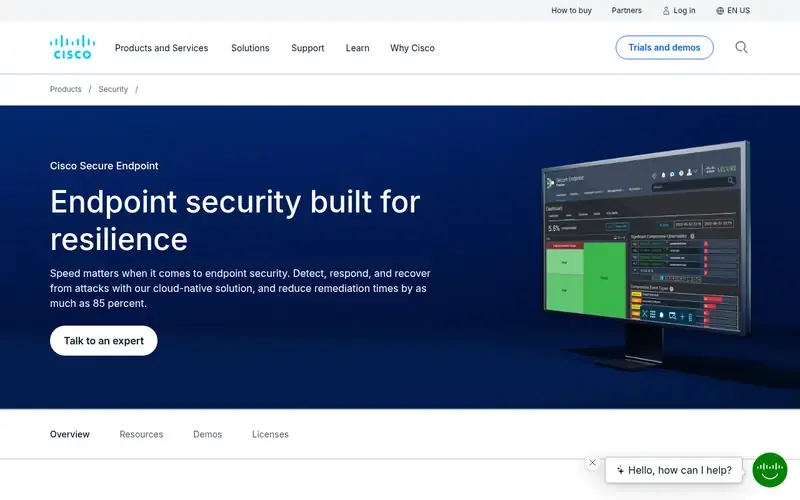
Cisco Secure Endpoint (formerly AMP for Endpoints) offers cloud-delivered next-generation antivirus and advanced endpoint detection and response.
Documented strengths
- Cloud-delivered next-generation antivirus and advanced EDR
- Talos Threat Hunting mapped to the MITRE ATT&CK framework
- Integration with Cisco XDR for unified view, incident management and automated playbooks
- One-click isolation of infected hosts
- USB device rules so only approved devices are used
Documented limits
Several capabilities are described alongside other Cisco products, such as Umbrella, Duo and Cisco XDR. Teams outside the Cisco ecosystem should check the vendor documentation.
- Who it is for
- Teams in Cisco environments that want threat hunting and Cisco XDR integration
- Platforms
- Not stated on official pages; cloud-native
- Pricing
- See the vendor's own pricing page for current plans and costs. cisco.com
- Facts checked
- 21 November 2026
Why it is placed here: It sits sixth because its documented strengths are human-driven hunting from Cisco Talos and tie-ins to other Cisco products, which suit teams already using that portfolio.
#7 · Elastic
Elastic Defend
Teams that want an open platform and can ingest third-party endpoint data
Elastic's endpoint security (Elastic Security for Endpoint) stops ransomware and malware, detects advanced threats and streamlines investigation and response with a single agent.
Documented strengths
- Single agent for prevention, host data collection, investigation and response
- Attack Discovery that prioritizes real attacks over individual alerts
- Native response actions to kill, suspend or isolate threats
- Ingestion of third-party endpoint data for visibility and threat hunting
- Built on Elastic Agent and Elastic Common Schema
Documented limits
The official page does not describe a managed detection and response service. Teams that want one should check the vendor documentation.
- Who it is for
- Teams that want an open platform and can ingest third-party endpoint data
- Platforms
- Windows, macOS and Linux; hybrid environments, including offline and cloud-connected ones
- Pricing
- See the vendor's own pricing page for current plans and costs. elastic.co
- Facts checked
- 21 November 2026
Why it is placed here: It sits last because it suits teams that favor an open platform and ingestion of third-party endpoint data, rather than a packaged managed service.
Sources
- CrowdStrike Falcon Insight XDR: crowdstrike.com/en-us/platform/endpoint-security/falcon-insight-xdr, crowdstrike.com/en-us/about-us, crowdstrike.com/en-us/platform (21 Nov 2026)
- Microsoft Defender for Endpoint: microsoft.com/en/security/business/endpoint-security/microsoft-defender-endpoint (21 Nov 2026)
- Palo Alto Networks Cortex XDR: paloaltonetworks.com/cortex/cortex-xdr, paloaltonetworks.com/about-us, paloaltonetworks.com/ai-security (21 Nov 2026)
- Trend Micro Vision One: trendaisecurity.com/en-us/platform, trendaisecurity.com/ar/platform, trendaisecurity.com/de/platform (21 Nov 2026)
- Cybereason Defense Platform: levelblue.com/services/endpoint-security, levelblue.com/solutions/government, levelblue.com/services/data-security (21 Nov 2026)
- Cisco Secure Endpoint: cisco.com/site/us/en/products/security/endpoint-security/secure-endpoint/index.html, cisco.com/c/en/us/about/help.html, cisco.com/site/us/en/about/index.html (21 Nov 2026)
- Elastic Defend: elastic.co/security/endpoint-security, elastic.co/about, elastic.co/about (21 Nov 2026)
Related guides
How we compiled this
We compared each tool on fit with enterprise SOC work: documented detection and investigation capabilities, documented response actions, and platform and deployment information such as supported operating systems and offline or private deployment. The order reflects editorial fit for this use case, in words: tools whose official pages describe deeper detection, investigation and response across more data sources come first, and tools whose pages emphasize a narrower scope or a particular deployment need follow.
Every fact comes from the vendor's official pages, with the check date recorded for each. The list is built from documentation, not from product trials, so it reflects what vendors state rather than how detections perform in a given environment. Where a page is silent, we say so and point to the vendor documentation. Pricing is not covered; see each vendor's pricing page.
Order used: Ordered by depth of detection, investigation and response capabilities at enterprise scale.
Common questions
What is the difference between EDR and XDR?
EDR focuses on endpoint detection and response. XDR extends that with other data sources. For example, CrowdStrike Falcon Insight XDR unifies EDR with identity, cloud and mobile telemetry, and Cortex XDR connects endpoint, network, cloud, identity and email data.
Which EDR tools offer managed threat hunting or MDR?
CrowdStrike offers 24/7 managed threat hunting and Falcon Complete for MDR. Palo Alto Networks offers Unit 42 MDR, Trend Micro offers managed detection and response services, Cybereason can be handed to the vendor's SOC, and Cisco offers Talos Threat Hunting.
Which tools support private or offline deployments?
Cybereason documents private or offline deployment and an on-premises EDR version for private and isolated networks. Elastic Defend is described as working in hybrid environments, including offline and cloud-connected ones.
Which tools cover Windows, macOS and Linux endpoints?
Microsoft Defender for Endpoint covers Windows, Linux, macOS, iOS, Android and IoT. Elastic Defend supports Windows, macOS and Linux. CrowdStrike's package blocking works on Windows, macOS and Linux without an additional sensor.
The editorial order is unpaid. A vendor can buy one labelled featured slot per guide, but it gets the same fact check as everyone else and cannot alter or remove a competitor's entry. Guidehurst is independent. Product names and logos belong to their respective owners.