Platform and DevOps teams with slow builds should look first at Depot, Buildkite and CircleCI, which are documented with the strongest emphasis on build infrastructure, scalable agents or runners and test speed-ups. Semaphore, GitHub Actions and Buddy follow, each with documented caching or runner options. This shortlist is for teams that want to speed up container image builds with caching and scalable runners.
The shortlist
Side-by-side comparison
| Tool | Who it is for | Platforms | Pricing |
|---|---|---|---|
 DepotDepot | Teams wanting builds, caches and runners from one provider | Integrates with existing CI providers; deployable into a customer's own AWS account | Pricing on depot.dev |
 BuildkiteBuildkite | Platform teams scaling agents on their own infrastructure | Hosted on Amazon Web Services; agents on customer infrastructure | Pricing on buildkite.com |
 CircleCICircleCI | Teams wanting autoscaling and selective test runs | Cloud-hosted, self-hosted runners or a self-run instance | Pricing on circleci.com |
 SemaphoreSemaphore | Teams wanting caching and a choice of managed or self-hosted setups | Cloud, self-hosted Community Edition, and Enterprise Edition behind a firewall; GitHub and Bitbucket repositories | Pricing on semaphoreci.com |
 GitHub ActionsGitHub | Teams already hosting code on GitHub | Hosted runners on multiple operating systems, ARM and GPU; self-managed runners | Pricing on github.com |
 BuddyBuddy | Teams wanting UI or YAML pipelines with cache-optimized builds | Customer infrastructure (BYOC) or Buddy's infrastructure; multiple CPU architectures and operating systems | Pricing on buddy.works |
Quick verdict by need
- Depot if you need teams wanting builds, caches and runners from one provider.
- Buildkite if you need platform teams scaling agents on their own infrastructure.
- CircleCI if you need teams wanting autoscaling and selective test runs.
- Semaphore if you need teams wanting caching and a choice of managed or self-hosted setups.
- GitHub Actions if you need teams already hosting code on GitHub.
- Buddy if you need teams wanting UI or YAML pipelines with cache-optimized builds.
Tool details
#1 · Depot
Depot
Teams wanting builds, caches and runners from one provider
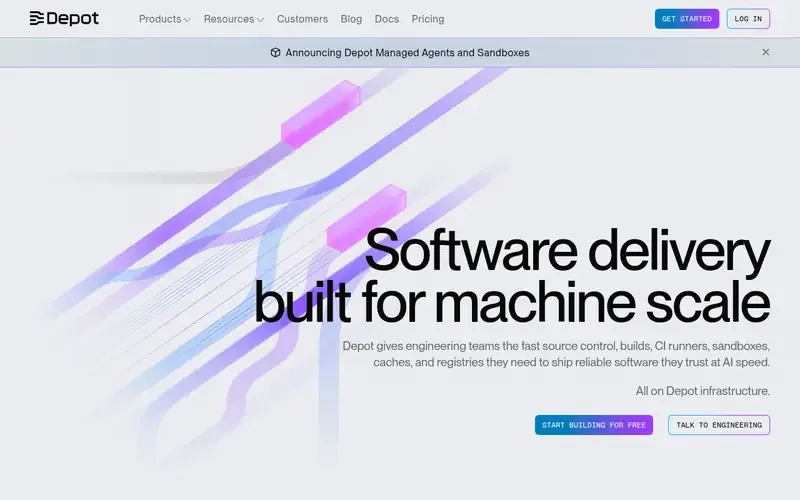
Depot provides source control, builds, CI runners, sandboxes, caches and registries for software delivery. It is designed to integrate with existing CI providers.
Documented strengths
- Builds, CI runners, sandboxes, caches and registries
- Depot CI runs GitHub Actions workflows without needing GitHub
- Custom sandbox images can have dependencies pre-installed
- Steps can run in parallel within one job
- Compute and data planes can be deployed into the customer's own AWS account
Documented limits
Documented as a suite of delivery primitives; teams should check the vendor documentation for how container image build caching is configured. It is SOC 2 Type 2 compliant, per the vendor.
- Who it is for
- Teams wanting builds, caches and runners from one provider
- Platforms
- Integrates with existing CI providers; deployable into a customer's own AWS account
- Pricing
- See the vendor's own pricing page for current plans and costs. depot.dev
- Facts checked
- 21 November 2026
Why it is placed here: It sits first because builds, caches and CI runners are core parts of its documented product set, and each job runs in a fresh, isolated sandbox.
#2 · Buildkite
Buildkite
Platform teams scaling agents on their own infrastructure

Buildkite is a CI orchestration platform with a cloud control plane and agents that run on customer infrastructure.
Documented strengths
- Cloud control plane with agents on customer infrastructure
- Hosted or self-hosted agents
- Test splitting, performance insights and flaky test isolation
- Isolation with containers, VMs or ephemeral agents
- Dynamic pipeline steps, plus API and webhook triggers
Documented limits
Documented as a CI orchestration platform; teams should check the vendor documentation for container image caching specifics. Agent infrastructure is run by the customer.
- Who it is for
- Platform teams scaling agents on their own infrastructure
- Platforms
- Hosted on Amazon Web Services; agents on customer infrastructure
- Pricing
- See the vendor's own pricing page for current plans and costs. buildkite.com
- Facts checked
- 21 November 2026
Why it is placed here: It comes second because its hybrid model lets teams scale agents on their own infrastructure, and it documents test splitting and flaky test isolation for faster feedback.
#3 · CircleCI
CircleCI
Teams wanting autoscaling and selective test runs

CircleCI is a CI/CD platform that helps teams validate, test and ship code changes with automation.
Documented strengths
- Execution environments, build images and autoscaling
- Smarter Testing runs only relevant tests to speed up feedback
- Cloud-hosted, self-hosted runners or a fully self-run instance
- Integrations with GitHub, GitLab, Bitbucket, AWS, GCP and Kubernetes
- Job-level OpenID Connect authentication
Documented limits
Documented as a general CI/CD platform; teams should check the vendor documentation for how Docker layer caching is handled.
- Who it is for
- Teams wanting autoscaling and selective test runs
- Platforms
- Cloud-hosted, self-hosted runners or a self-run instance
- Pricing
- See the vendor's own pricing page for current plans and costs. circleci.com
- Facts checked
- 21 November 2026
Why it is placed here: It sits third because it documents autoscaling, build images and Smarter Testing, which runs only relevant tests, though it is a general CI/CD platform rather than a build-focused one.
#4 · Semaphore
Semaphore
Teams wanting caching and a choice of managed or self-hosted setups
semaphoreci.comSemaphore is a CI/CD platform available as Cloud, Community Edition and Enterprise Edition. The vendor describes it as fast, easy to use and scalable.
Documented strengths
- Caching and a container registry to speed up workflows
- Change detection for monorepo workflows
- Self-hosted agents in the customer's own infrastructure
- Cloud, open-source Community Edition and Enterprise Edition
- Migration guides for users coming from Jenkins or CircleCI
Documented limits
Documented for general CI/CD workflows; teams that need detailed Docker build tuning should check the vendor documentation.
- Who it is for
- Teams wanting caching and a choice of managed or self-hosted setups
- Platforms
- Cloud, self-hosted Community Edition, and Enterprise Edition behind a firewall; GitHub and Bitbucket repositories
- Pricing
- See the vendor's own pricing page for current plans and costs. semaphoreci.com
- Facts checked
- 21 November 2026
Why it is placed here: It sits fourth because caching and a container registry are documented as ways it speeds up workflows, along with change detection for monorepos.
#5 · GitHub
GitHub Actions
Teams already hosting code on GitHub
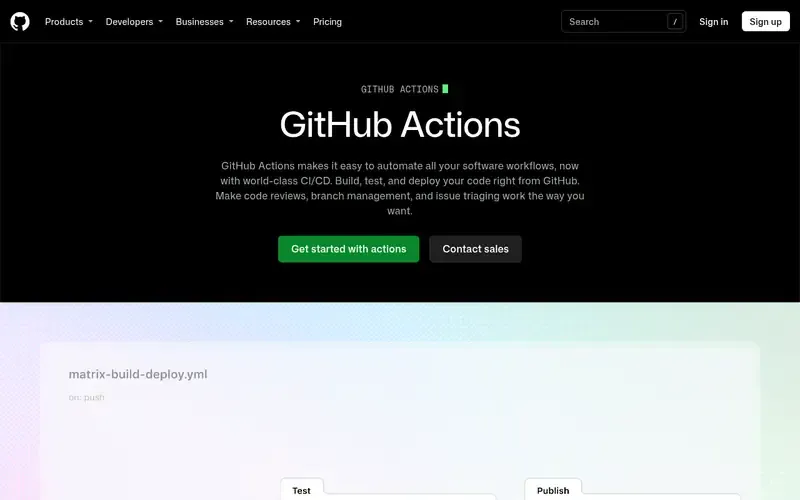
GitHub Actions is GitHub's workflow automation and CI/CD feature for building, testing and deploying code directly from GitHub.
Documented strengths
- Hosted environments covering multiple operating systems, ARM, GPU and containers
- Self-managed runners in the cloud or on-premises
- Matrix workflows across operating systems and runtime versions
- Marketplace of actions, including for building containers
- Workflow results can act as required checks before merge
Documented limits
Documented as a general workflow platform; teams should check the vendor documentation for caching of container image builds.
- Who it is for
- Teams already hosting code on GitHub
- Platforms
- Hosted runners on multiple operating systems, ARM and GPU; self-managed runners
- Pricing
- See the vendor's own pricing page for current plans and costs. github.com
- Facts checked
- 21 November 2026
Why it is placed here: It sits fifth because hosted environments, your own runners and a marketplace with container-building actions are documented, though its pitch is workflow automation more than build speed.
#6 · Buddy
Buddy
Teams wanting UI or YAML pipelines with cache-optimized builds
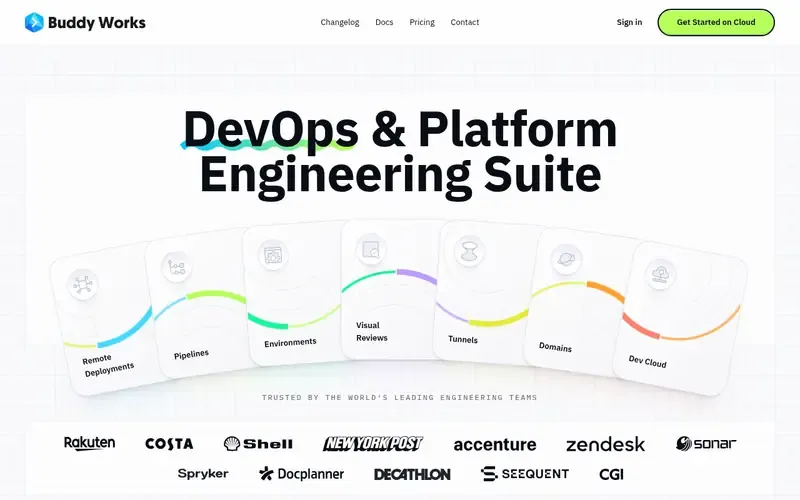
Buddy is a DevOps and platform engineering suite for building pipelines and deploying to many kinds of targets, with UI or YAML configuration.
Documented strengths
- Cache-optimized pipelines, designed in UI or YAML
- Actions run in containers across multiple CPU architectures and operating systems
- Steps can run in a matrix, in parallel or sequentially
- Environments on the customer's own infrastructure or on Buddy's
- REST API described by an OpenAPI 3 specification
Documented limits
Documented with a strong focus on deployment and environments; teams that need detailed container image build tuning should check the vendor documentation.
- Who it is for
- Teams wanting UI or YAML pipelines with cache-optimized builds
- Platforms
- Customer infrastructure (BYOC) or Buddy's infrastructure; multiple CPU architectures and operating systems
- Pricing
- See the vendor's own pricing page for current plans and costs. buddy.works
- Facts checked
- 21 November 2026
Why it is placed here: It closes the list because its cache-optimized pipelines and container-based actions are relevant, but its documentation puts more weight on deployment than on image build speed.
Sources
- Depot: depot.dev, depot.dev/about, depot.dev/security (21 Nov 2026)
- Buildkite: buildkite.com/home, buildkite.com/about/company, buildkite.com/about/security (21 Nov 2026)
- CircleCI: circleci.com, circleci.com/about, circleci.com/product (21 Nov 2026)
- Semaphore: docs.semaphore.io, docs.semaphore.io/getting-started/about-semaphore, support.semaphore.io (21 Nov 2026)
- GitHub Actions: github.com/features/actions, github.com/about, github.com/features (21 Nov 2026)
- Buddy: buddy.works, buddy.works/about, buddy.works/docs/api/getting-started/overview (21 Nov 2026)
Related guides
How we compiled this
We looked at how closely each tool's documentation matches the use case: speeding up container image builds with caching and scalable runners. We checked documented capabilities such as build and cache primitives, autoscaling, parallelism, self-hosted runners and isolation. We also checked the deployment and platform options the vendors describe. We dropped Codefresh from the planned seven because its official page describes a product in transition for existing customers rather than documented build-speed features.
All facts come from official vendor pages, with check dates recorded on our side. The order reflects editorial fit for this use case: tools whose documentation puts more weight on builds, caching and scalable compute come first. It does not mean one tool is better overall. The list is built from documentation, not from product trials, and the vendor pages do not publish Docker-specific build timings, so teams should verify image build behavior in the vendor documentation.
Order used: Ordered by emphasis on build speed, caching and scalable runners, strongest first.
Common questions
How can CI speed up Docker image builds?
The vendors on this list document caching, parallel steps and scalable runners. For example, Depot lists caches and builds as core products, Semaphore documents caching and a container registry, and Buddy offers cache-optimized pipelines.
Can I run my own build agents or runners?
Yes, several tools document this. Buildkite agents run on customer infrastructure, CircleCI supports self-hosted runners, Semaphore supports self-hosted agents, and GitHub Actions lets you run your own runners in the cloud or on-premises.
Can I keep my existing GitHub Actions workflows?
Depot documents that Depot CI runs GitHub Actions workflows without needing GitHub and that existing workflows can be migrated with one command. GitHub Actions itself runs them natively.
Which tools reduce the time spent running tests?
CircleCI documents Smarter Testing, which runs only relevant tests. Buildkite documents test splitting and flaky test isolation, and Semaphore documents change detection for monorepo workflows.
Why is Codefresh not on this list?
Its official page describes Codefresh CI as developed and supported within the Octopus Deploy portfolio for existing customers. It does not document build-speed or caching features for this use case, so we left it out.
The editorial order is unpaid. A vendor can buy one labelled featured slot per guide, but it gets the same fact check as everyone else and cannot alter or remove a competitor's entry. Guidehurst is independent. Product names and logos belong to their respective owners.