This shortlist starts with Okta Adaptive MFA, Duo Security and Ping Identity PingID, followed by Silverfort, Hypr and SecureAuth. It is written for security and IT teams hardening employee access with context-aware, risk-based policies and passwordless sign-in options.
The shortlist
Side-by-side comparison
| Tool | Who it is for | Platforms | Pricing |
|---|---|---|---|
 Okta Adaptive MFAOkta | Teams that want detailed contextual policies and device checks | Not stated on official pages | Pricing on okta.com |
 Duo SecurityCisco | Teams that want risk-based MFA and passwordless login in one stack | Passwordless login from any device | Pricing on duo.com |
 Ping Identity PingIDPing Identity | Teams that want step-up MFA with broad integrations and no on-premise infrastructure | SaaS service with iOS and Android mobile app; containers alongside PingFederate | Pricing on pingidentity.com |
 SilverfortSilverfort | Teams that need MFA on legacy apps, command-line tools and OT | On-prem, OT, hybrid, cloud and multi-cloud environments | Pricing on silverfort.com |
 HyprHYPR | Teams moving employees to passkeys and phishing-resistant sign-in | Windows and Mac workstations, mobile devices and web apps | Pricing on hypr.com |
 SecureAuthSecureAuth | Teams that want continuous authentication alongside an existing identity provider | Cloud, hybrid, private SaaS or air-gapped infrastructure | Pricing on secureauth.com |
Quick verdict by need
- Okta Adaptive MFA if you need teams that want detailed contextual policies and device checks.
- Duo Security if you need teams that want risk-based MFA and passwordless login in one stack.
- Ping Identity PingID if you need teams that want step-up MFA with broad integrations and no on-premise infrastructure.
- Silverfort if you need teams that need MFA on legacy apps, command-line tools and OT.
- Hypr if you need teams moving employees to passkeys and phishing-resistant sign-in.
- SecureAuth if you need teams that want continuous authentication alongside an existing identity provider.
Tool details
#1 · Okta
Okta Adaptive MFA
Teams that want detailed contextual policies and device checks
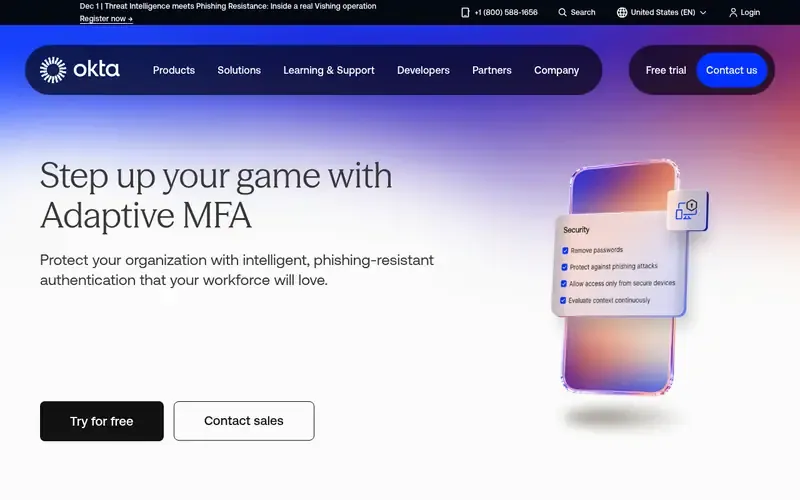
Okta Adaptive MFA is a risk-based multi-factor authentication solution that decides when to challenge users for additional verification.
Documented strengths
- Contextual policies assess devices, networks, locations, user behavior and IP addresses
- Aggregates device posture data and can deny access when device conditions fail
- Re-evaluates device state after the SSO session starts to mitigate session hijacking
- Suspicious logins such as impossible travel can be blocked or met with a high-assurance challenge
- Biometric factors including Okta FastPass, Face ID and Touch ID
Documented limits
Documented as a risk-based MFA product; teams that want a full directory or privileged access features should check the vendor documentation. Platform support is not stated on the page we used.
- Who it is for
- Teams that want detailed contextual policies and device checks
- Platforms
- Not stated on official pages
- Pricing
- See the vendor's own pricing page for current plans and costs. okta.com
- Facts checked
- 22 November 2026
Why it is placed here: It sits first because its documentation covers the widest set of contextual signals and responses for workforce logins, including device posture, impossible travel and re-evaluation after sign-in.
#2 · Cisco
Duo Security
Teams that want risk-based MFA and passwordless login in one stack
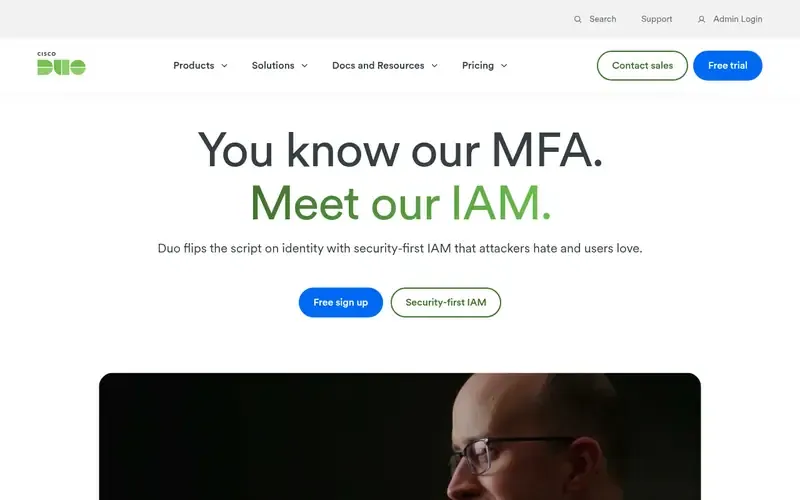
Cisco Duo is an identity security and IAM platform that combines phishing-resistant MFA, SSO, passwordless login, a directory and device trust.
Documented strengths
- Risk-based authentication that adapts to users in real time
- Passwordless login from any device
- Session theft protection, device verification and risk-based authentication combined
- Can be a full IAM solution or broker access from existing identity sources
- Duo Passport reduces repeated authentication prompts
Documented limits
Some capabilities, such as device trust with endpoint protection checks and remote access without a VPN, are documented for the top edition. Teams should check which edition includes the features they need.
- Who it is for
- Teams that want risk-based MFA and passwordless login in one stack
- Platforms
- Passwordless login from any device
- Pricing
- See the vendor's own pricing page for current plans and costs. duo.com
- Facts checked
- 21 November 2026
Why it is placed here: It is second because it documents risk-based authentication together with passwordless login from any device and session theft protection, and it can sit in front of identity sources you already use.
#3 · Ping Identity
Ping Identity PingID
Teams that want step-up MFA with broad integrations and no on-premise infrastructure
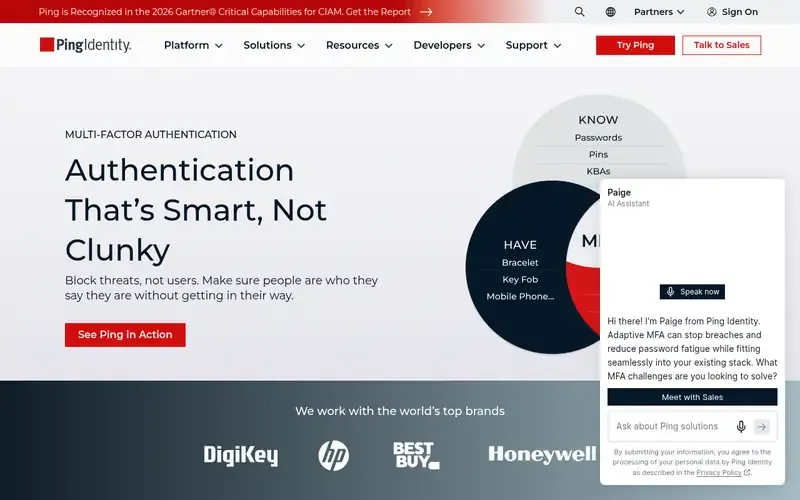
PingID is Ping Identity's cloud MFA solution for workforce and partners, delivered as a SaaS service plus a mobile app.
Documented strengths
- Adaptive authentication using device posture, geolocation, IP and time since last authentication
- Start users on lenient methods and step up for high-risk assets
- Methods include push, OTPs, QR codes, magic links, FIDO2 biometrics and security keys
- Integrates with Azure AD, AD FS, Windows login, Mac login and SSH
- Offline MFA mode and admin dashboards showing rollout progress
Documented limits
Machine-learning threat detection is documented through PingOne Protect used alongside PingID. Teams that want it should check the vendor documentation.
- Who it is for
- Teams that want step-up MFA with broad integrations and no on-premise infrastructure
- Platforms
- SaaS service with iOS and Android mobile app; containers alongside PingFederate
- Pricing
- See the vendor's own pricing page for current plans and costs. pingidentity.com
- Facts checked
- 22 November 2026
Why it is placed here: It is third because adaptive signals and step-up methods are clearly documented and it integrates with common workforce systems, though its passwordless coverage is described mainly through FIDO2 and biometric factors.
#4 · Silverfort
Silverfort
Teams that need MFA on legacy apps, command-line tools and OT
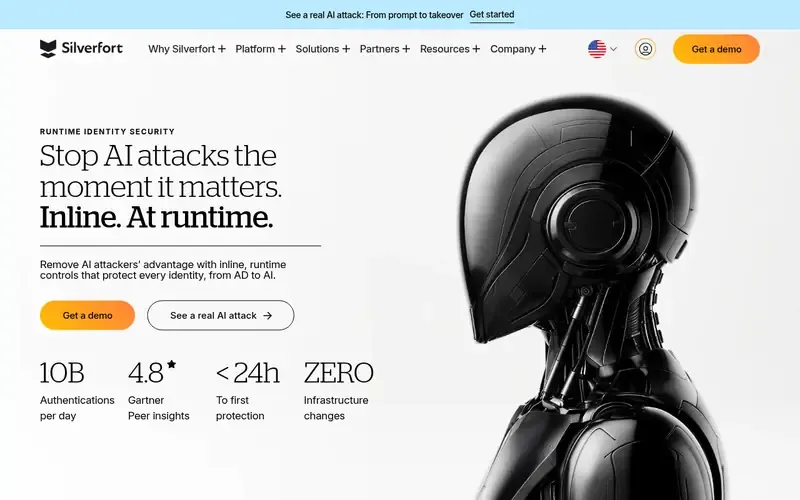
Silverfort is a runtime identity security platform that provides inline protection for human, machine and AI agent identities across Active Directory, cloud, SaaS, legacy systems and OT.
Documented strengths
- Analyzes context for each access request and can allow, challenge or block
- Extends MFA to legacy apps, command-line tools and OT with no agents or code changes
- Integrates with Active Directory, cloud IdPs, SaaS, legacy systems and OT
- Privileged access controls without a vault, including least privilege and JIT access
- Includes ITDR, ISPM and an Authentication Firewall
Documented limits
Documented for inline risk enforcement across existing infrastructure; teams that want passwordless sign-in should check the vendor documentation. Its audience is identity and security teams at enterprises.
- Who it is for
- Teams that need MFA on legacy apps, command-line tools and OT
- Platforms
- On-prem, OT, hybrid, cloud and multi-cloud environments
- Pricing
- See the vendor's own pricing page for current plans and costs. silverfort.com
- Facts checked
- 22 November 2026
Why it is placed here: It sits fourth because it applies allow, challenge or block decisions at authentication time and extends MFA to legacy systems, but its documentation is centred on integrating with your existing IAM rather than on passwordless login.
#5 · HYPR
Hypr
Teams moving employees to passkeys and phishing-resistant sign-in
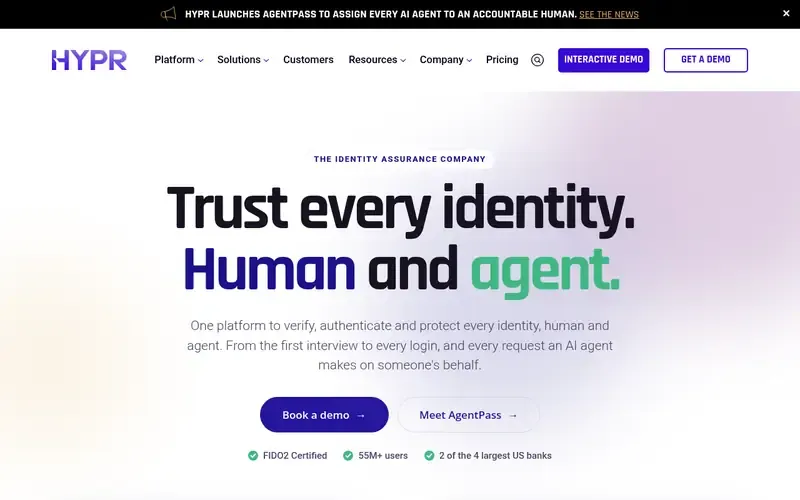
HYPR is an identity assurance platform offering phishing-resistant passwordless authentication, identity verification, risk detection and AI agent governance.
Documented strengths
- HYPR Authenticate provides passwordless MFA with passkeys, PIV and security keys
- HYPR Adapt is a real-time risk engine that drives step-up or block decisions
- Phishing-resistant sign-in to Windows and Mac workstations
- Works with existing identity providers such as Entra, Okta and Ping
- Integrates with CrowdStrike to verify device trust
Documented limits
The vendor lists consumer login and financial services among its audiences, so workforce-only teams should check which components apply to them.
- Who it is for
- Teams moving employees to passkeys and phishing-resistant sign-in
- Platforms
- Windows and Mac workstations, mobile devices and web apps
- Pricing
- See the vendor's own pricing page for current plans and costs. hypr.com
- Facts checked
- 22 November 2026
Why it is placed here: It is fifth because its passwordless and passkey coverage is strong and it has a real-time risk engine, while its documentation also targets consumer login and high-trust sectors beyond workforce use.
#6 · SecureAuth
SecureAuth
Teams that want continuous authentication alongside an existing identity provider
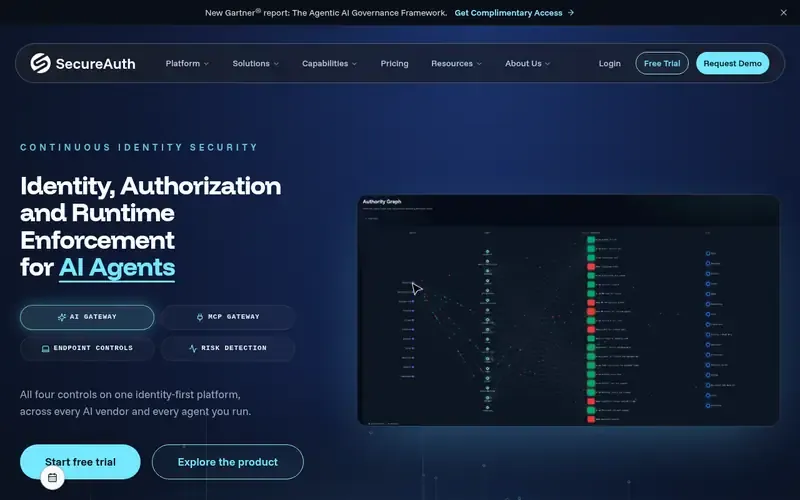
SecureAuth is an identity security platform covering workforce, customer, partner and AI agent access, with continuous authentication, per-action authorization and agent governance.
Documented strengths
- Sessions are not trusted by default; risk is reassessed with step-up when needed
- Per-action authorization decisions rather than only login decisions
- Token binding and DPoP bind tokens to the requesting device
- Deploys on cloud, hybrid, private SaaS or air-gapped infrastructure
- Records every authentication, authorization and policy decision
Documented limits
Documented passwordless options are not described on the pages we used. Teams that need them should check the vendor documentation.
- Who it is for
- Teams that want continuous authentication alongside an existing identity provider
- Platforms
- Cloud, hybrid, private SaaS or air-gapped infrastructure
- Pricing
- See the vendor's own pricing page for current plans and costs. secureauth.com
- Facts checked
- 22 November 2026
Why it is placed here: It closes the list because continuous, risk-reassessed authentication and token binding are documented, but its emphasis is on AI agent governance and partner or customer identity more than on passwordless employee login.
Sources
- Okta Adaptive MFA: okta.com/products/adaptive-multi-factor-authentication, okta.com/solutions, okta.com/solutions/secure-ai (22 Nov 2026)
- Duo Security: duo.com, duo.com/about, duo.com/product (21 Nov 2026)
- Ping Identity PingID: pingidentity.com/en/capability/multi-factor-authentication.html, pingidentity.com/en/platform.html, pingidentity.com/en/product/pingid.html (22 Nov 2026)
- Silverfort: silverfort.com, silverfort.com/company/#about-us, silverfort.com/platform (22 Nov 2026)
- Hypr: hypr.com, hypr.com/platform, hypr.com/for-product-teams (22 Nov 2026)
- SecureAuth: secureauth.com, secureauth.com/platform, secureauth.com/products/b2b (22 Nov 2026)
Related guides
How we compiled this
We looked at how well each tool fits employee login hardening: documented risk-based or contextual policies, passwordless and phishing-resistant options, and the deployment and integration details each vendor publishes. Tools that cover wider identity areas, such as AI agents or customer login, are included where the documentation also covers workforce authentication.
All facts come from official vendor pages, with check dates recorded. The order reflects editorial fit for this use case, explained in the short note under each tool, and it is not a statement that one product is better overall. The list is built from documentation, not product trials, so teams should confirm details with each vendor before choosing.
Because the products differ in scope, the notes under each tool describe what the vendor documents and where its focus lies.
Order used: Ordered by strength of context-aware, risk-based policy and passwordless options, strongest first.
Common questions
What is adaptive MFA?
Adaptive MFA decides when to ask for extra verification based on context. Okta Adaptive MFA, for example, uses risk-based analysis, and PingID uses signals such as device posture, geolocation and IP.
Which tools here offer passwordless login for employees?
Duo documents passwordless login from any device, and HYPR Authenticate provides passwordless MFA with passkeys, PIV and security keys. PingID supports FIDO2 biometrics and security keys.
Can adaptive MFA protect legacy applications?
Silverfort states it can extend MFA to legacy apps, command-line tools and OT infrastructure with no agents or code changes. Okta Adaptive MFA can secure on-premises apps without source code changes.
Do these tools replace my existing identity provider?
Not necessarily. Duo can broker access from existing identity sources, HYPR works with providers such as Entra, Okta and Ping, and SecureAuth is positioned to work alongside an existing identity provider.
Can access be blocked automatically for risky logins?
Yes, in several tools. Okta can block suspicious logins such as impossible travel, HYPR Adapt drives step-up or block decisions, and Silverfort can allow, challenge or block each access request.
The editorial order is unpaid. A vendor can buy one labelled featured slot per guide, but it gets the same fact check as everyone else and cannot alter or remove a competitor's entry. Guidehurst is independent. Product names and logos belong to their respective owners.