Matrix, Element and SimpleX Chat open this shortlist of messaging tools that do not depend on a single central server or provider. It is written for communities and organizations that want federated or decentralized chat, and it also covers Session and Briar for different privacy and connectivity needs.
The shortlist
Side-by-side comparison
| Tool | Who it is for | Platforms | Pricing |
|---|---|---|---|
 MatrixMatrix.org Foundation | Communities and organizations that want to choose their own host | Not stated on official pages | Pricing on matrix.org |
 ElementElement | Organizations that want to self-host group collaboration | Not stated on official pages | Pricing on element.io |
 SimpleX ChatSimpleX Chat Ltd | Users who want messaging without any user identifiers | Not stated on official pages | Pricing on simplex.chat |
 SessionSession Technology Foundation | Individuals wanting private, anonymous messaging | Android, iOS, Windows, Mac and Linux | Pricing on getsession.org |
 BriarBriar Project | Activists, journalists and anyone needing resilient communication | Android; Briar Desktop for non-Android platforms | Pricing on briarproject.org |
Quick verdict by need
- Matrix if you need communities and organizations that want to choose their own host.
- Element if you need organizations that want to self-host group collaboration.
- SimpleX Chat if you need users who want messaging without any user identifiers.
- Session if you need individuals wanting private, anonymous messaging.
- Briar if you need activists, journalists and anyone needing resilient communication.
Tool details
#1 · Matrix.org Foundation
Matrix
Communities and organizations that want to choose their own host
Matrix is an open protocol and network for secure, decentralised communication, stewarded by the non-profit Matrix.org Foundation. The public network is federated, so users on one homeserver can talk to users on another.
Documented strengths
- Federated public network across homeservers
- Open source with a public specification
- Clients, servers, bots and application services
- Bridges to external systems
- Open governance by a non-profit foundation
Documented limits
Matrix is a protocol and network, so everyday use happens through a client such as Element. The official facts do not list specific platforms.
- Who it is for
- Communities and organizations that want to choose their own host
- Platforms
- Not stated on official pages
- Pricing
- See the vendor's own pricing page for current plans and costs. matrix.org
- Facts checked
- 21 November 2026
Why it is placed here: It comes first because federation is its core design, with a public specification and open governance that suit communities choosing their own hosting.
#2 · Element
Element
Organizations that want to self-host group collaboration
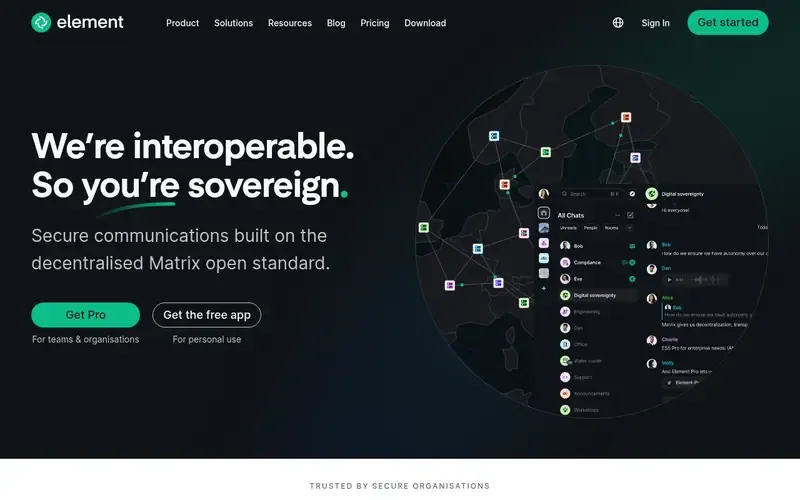
Element is a Matrix-based, end-to-end encrypted messaging and collaboration app that can be self-hosted. It is led by the creators of the Matrix open standard.
Documented strengths
- End-to-end encryption by default
- Self-hosting, including air-gapped and isolated environments
- Group rooms with access permissions
- Unlimited voice and video calls, one-to-one and group
- Device verification to guard against imposters
Documented limits
Documented as Matrix-based, so it depends on the Matrix network. Server hosting for organizations is a separate product (Element Server Suite Pro); check vendor documentation for platform details.
- Who it is for
- Organizations that want to self-host group collaboration
- Platforms
- Not stated on official pages
- Pricing
- See the vendor's own pricing page for current plans and costs. element.io
- Facts checked
- 21 November 2026
Why it is placed here: It is second because it turns Matrix federation into a ready-to-use app for groups, with self-hosting and access permissions for teams.
#3 · SimpleX Chat Ltd
SimpleX Chat
Users who want messaging without any user identifiers

SimpleX Chat is a private, encrypted, open-source messenger that uses no user identifiers on a decentralized network. Contacts and groups are stored on the user's device.
Documented strengths
- No phone numbers, usernames, accounts or user identities
- Connect through a link or QR code
- Servers cannot see who users talk to
- Anyone can run servers
- Directory to find channels and communities
Documented limits
Documented as its own network; the official facts do not list supported platforms. Security assessments by Trail of Bits are dated November 2022 (implementation) and July 2024 (protocol design).
- Who it is for
- Users who want messaging without any user identifiers
- Platforms
- Not stated on official pages
- Pricing
- See the vendor's own pricing page for current plans and costs. simplex.chat
- Facts checked
- 21 November 2026
Why it is placed here: It is third because its network is decentralized and anyone can run servers, with groups and channels, but it is a single network rather than a federation of interoperating servers.
#4 · Session Technology Foundation
Session
Individuals wanting private, anonymous messaging
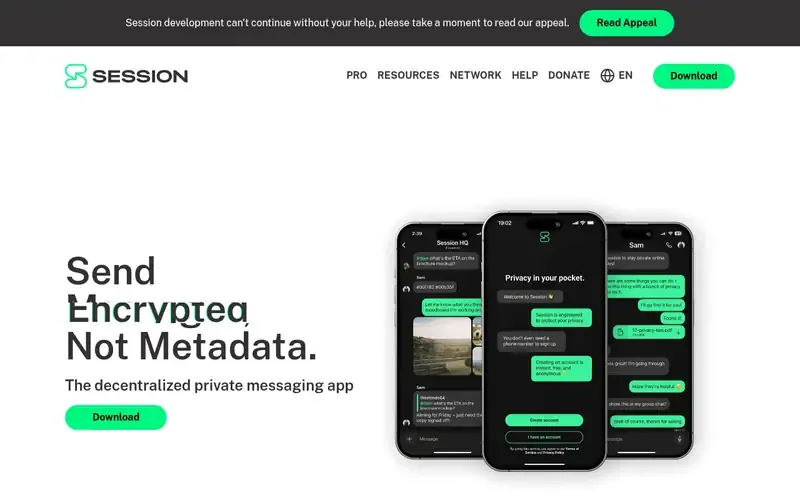
Session is a decentralized, end-to-end encrypted messenger that routes messages through an onion routing network. It needs no phone number or email to sign up.
Documented strengths
- Onion routing with decentralized message storage
- Accounts use Account IDs, with no phone number or email
- Group chats and larger Community chats
- Disappearing messages and end-to-end encrypted attachments
- Network run by a global community of node operators
Documented limits
Onion-routed voice and video calls are listed as upcoming, and Session Protocol V2 is in development. Documented mainly for individual use.
- Who it is for
- Individuals wanting private, anonymous messaging
- Platforms
- Android, iOS, Windows, Mac and Linux
- Pricing
- See the vendor's own pricing page for current plans and costs. getsession.org
- Facts checked
- 21 November 2026
Why it is placed here: It is fourth because it is decentralized and supports groups and larger Community chats, but it is aimed mainly at individuals seeking anonymous messaging.
#5 · Briar Project
Briar
Activists, journalists and anyone needing resilient communication
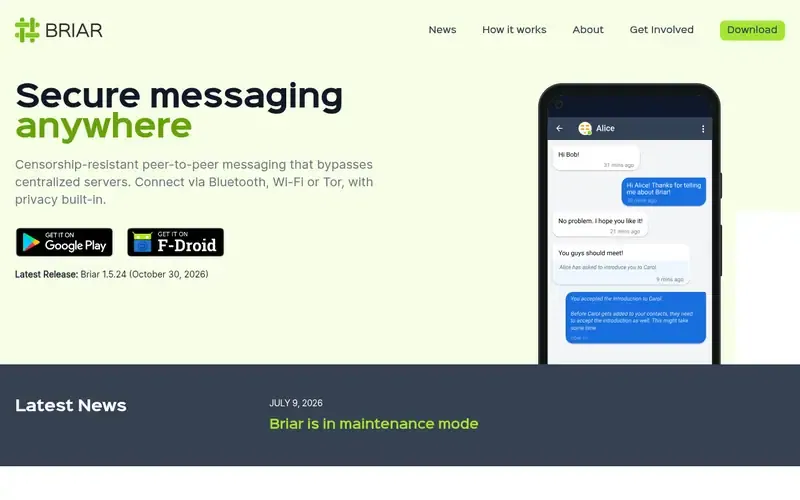
Briar is a free, open-source, peer-to-peer encrypted messenger that syncs directly between devices over Bluetooth, Wi-Fi or Tor. It has no central server.
Documented strengths
- No central server; messages sync directly between devices
- Bluetooth, Wi-Fi or memory cards without Internet
- Tor when online to prevent metadata surveillance
- Private messaging, public forums and blogs
- Briar Mailbox for users online at different times
Documented limits
Briar Desktop was started to bring Briar to non-Android platforms; check the project documentation for current platform support. The official facts do not describe federation across servers.
- Who it is for
- Activists, journalists and anyone needing resilient communication
- Platforms
- Android; Briar Desktop for non-Android platforms
- Pricing
- See the vendor's own pricing page for current plans and costs. briarproject.org
- Facts checked
- 21 November 2026
Why it is placed here: It is last because its peer-to-peer design suits censorship-resistant and offline scenarios more than large, always-on community chat.
Sources
- Matrix: matrix.org, matrix.org/foundation/about, matrix.org/homeserver/about (21 Nov 2026)
- Element: element.io/en, element.io/en/about, element.io/en/features (21 Nov 2026)
- SimpleX Chat: simplex.chat, simplex.chat/why, simplex.chat/about (21 Nov 2026)
- Session: getsession.org, docs.getsession.org, docs.getsession.org/readme/advanced-features (21 Nov 2026)
- Briar: briarproject.org, briarproject.org/about, briarproject.org/how-it-works (21 Nov 2026)
Related guides
How we compiled this
We looked at fit with the use case of chatting without a single central provider, the capabilities each project documents, and the deployment and platform information on its official pages. That meant checking how each tool is decentralized or federated, what is said about groups and communities, and where the documentation names supported platforms.
All facts come from official vendor or project pages, with check dates recorded. The order reflects editorial fit for this use case, with federated architectures that suit groups first, and does not say any tool is better overall. The list is built from documentation, not from product trials, so where a page is silent we say so.
Order used: Ordered by maturity of the federated or decentralized architecture and usability for groups.
Common questions
What is the difference between federated and decentralized messaging?
In a federated network such as Matrix, users on different homeservers can talk to each other. Decentralized tools such as SimpleX Chat, Session and Briar avoid a single central provider by other means, such as user-run servers, node operators or direct device sync.
Can I host my own server?
Element can be self-hosted, and SimpleX Chat documents that anyone can run servers. Matrix is designed so users can choose who hosts their communication.
Which tool works without an Internet connection?
Briar documents syncing over Bluetooth, Wi-Fi or memory cards when there is no Internet. Element documents installation in air-gapped and isolated environments.
Do I need a phone number to sign up?
Session needs no phone number or email, and SimpleX Chat has no phone numbers, usernames or accounts. Check each vendor's documentation for the other tools.
Which tools suit large communities?
Matrix and Element document group rooms and communities, SimpleX Chat has a directory of channels and communities, and Session supports larger Community chats.
The editorial order is unpaid. A vendor can buy one labelled featured slot per guide, but it gets the same fact check as everyone else and cannot alter or remove a competitor's entry. Guidehurst is independent. Product names and logos belong to their respective owners.