For business users who want to ask data questions in plain language and get automated insights, ThoughtSpot, Tellius and Sigma Computing are the first tools to look at, followed by Domo, Qlik Sense and Tableau. This shortlist is for business users and the analytics teams who enable self-service for them.
The shortlist
Side-by-side comparison
| Tool | Who it is for | Platforms | Pricing |
|---|---|---|---|
 ThoughtSpotThoughtSpot | Business teams asking questions directly of governed data | Not stated on official pages | Pricing on thoughtspot.com |
 TelliusTellius | Pharma, finance, procurement and supply chain teams with recurring analytical work | Not stated on official pages | Pricing on tellius.com |
 Sigma ComputingSigma Computing | Business teams working on live warehouse data under IT governance | Not stated on official pages | Pricing on sigmacomputing.com |
 DomoDomo | Business teams that want connectors, dashboards and alerts on one platform | Cloud platform | Pricing on domo.com |
 Qlik SenseQlik | Organisations wanting exploration and no-code predictive analysis for people at all skill levels | On-premises, cloud or hybrid deployments for data movement; hybrid and multi-cloud data | Pricing on qlik.com |
 TableauSalesforce | Teams that want visual analytics with a natural-language assistant, including self-managed deployment | Tableau Cloud, or Tableau Server on own infrastructure, any cloud or hybrid | Pricing on tableau.com |
Quick verdict by need
- ThoughtSpot if you need business teams asking questions directly of governed data.
- Tellius if you need pharma, finance, procurement and supply chain teams with recurring analytical work.
- Sigma Computing if you need business teams working on live warehouse data under IT governance.
- Domo if you need business teams that want connectors, dashboards and alerts on one platform.
- Qlik Sense if you need organisations wanting exploration and no-code predictive analysis for people at all skill levels.
- Tableau if you need teams that want visual analytics with a natural-language assistant, including self-managed deployment.
Tool details
#1 · ThoughtSpot
ThoughtSpot
Business teams asking questions directly of governed data
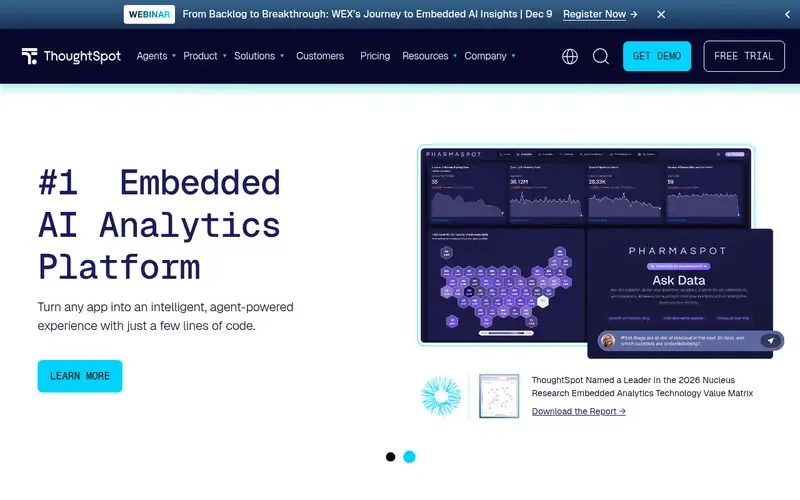
ThoughtSpot is an agentic analytics platform that provides AI agents, natural-language answers, dashboards and embedded analytics on governed data.
Documented strengths
- Natural-language questions with answers grounded in verified business definitions
- Spotter, an always-on analytics agent
- Anomalies, drivers and trends surfaced across governed data models
- SpotterViz generates dashboards from natural language
- Direct query to Snowflake, Databricks and BigQuery without a second data copy
Documented limits
Documented for governed data models and warehouse connections; teams with other data sources should check the vendor documentation. Defining shared KPIs through Spotter Semantics is a setup task for the data team.
- Who it is for
- Business teams asking questions directly of governed data
- Platforms
- Not stated on official pages
- Pricing
- See the vendor's own pricing page for current plans and costs. thoughtspot.com
- Facts checked
- 21 November 2026
Why it is placed here: It comes first because asking questions in natural language and getting answers grounded in verified business definitions is the core of how the vendor describes the product.
#2 · Tellius
Tellius
Pharma, finance, procurement and supply chain teams with recurring analytical work
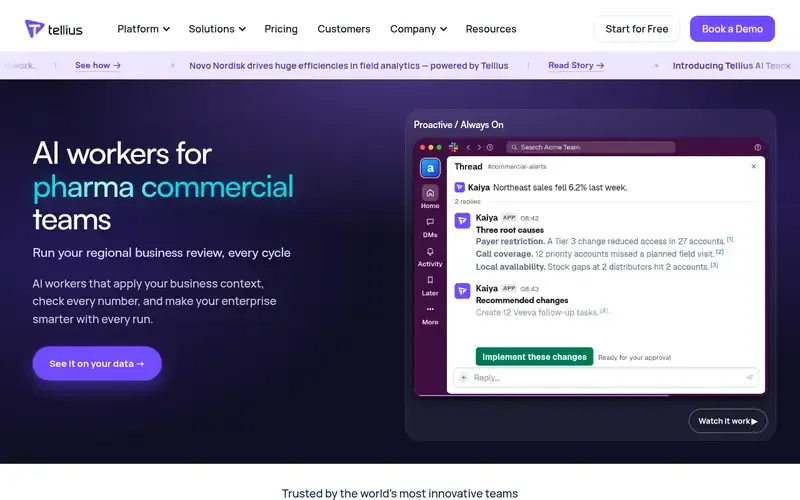
Tellius is a Decision AI platform that provides enterprise AI agents (AI workers) which run recurring analytics jobs on a company's data and check every number.
Documented strengths
- AI agents for recurring work such as business reviews and month-end close
- Figures checked against the customer's rules and traceable to rows
- Methods for variance, driver, gross-to-net and contract analysis
- Outputs delivered in the customer's template
- Reads structured, syndicated and unstructured data together
Documented limits
Documented for commercial, pharma and life sciences, finance, procurement, manufacturing and supply chain teams; other teams should check the vendor documentation. Setup follows a staged process rather than open-ended self-service exploration.
- Who it is for
- Pharma, finance, procurement and supply chain teams with recurring analytical work
- Platforms
- Not stated on official pages
- Pricing
- See the vendor's own pricing page for current plans and costs. tellius.com
- Facts checked
- 21 November 2026
Why it is placed here: It sits second because the product is described as conversational and always-on, with agents that run recurring analyses, though it is aimed at specific industries and functions.
#3 · Sigma Computing
Sigma Computing
Business teams working on live warehouse data under IT governance
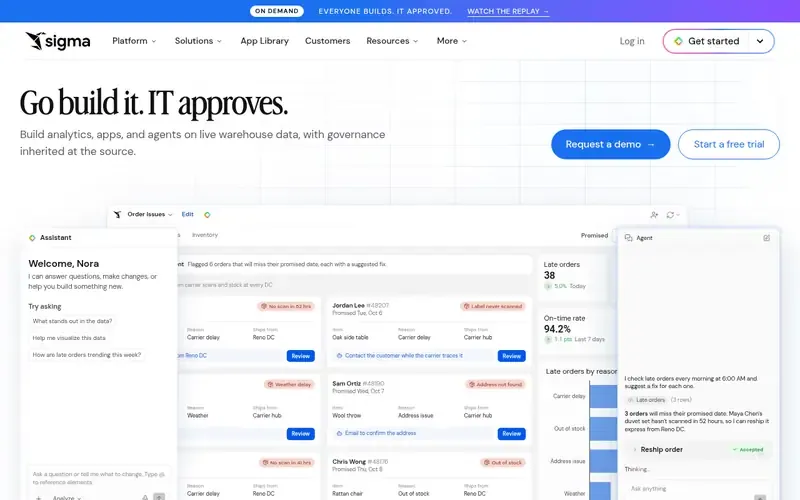
Sigma is a warehouse-first analytics platform for building dashboards, AI apps and agents on governed live warehouse data.
Documented strengths
- Plain-language questions answered from live warehouse data
- Apps and agents inherit warehouse permissions down to the row
- Audit logs that include AI conversations
- Data models that define metrics once for reuse
- Queries the warehouse in place without copying data out
Documented limits
Documented as warehouse-first, so teams without a data warehouse should check the vendor documentation. Writeback features are described only with approval and existing permissions.
- Who it is for
- Business teams working on live warehouse data under IT governance
- Platforms
- Not stated on official pages
- Pricing
- See the vendor's own pricing page for current plans and costs. sigmacomputing.com
- Facts checked
- 21 November 2026
Why it is placed here: It sits third because users can ask plain-language questions of live warehouse data, with the product built around dashboards and apps as well as AI.
#4 · Domo
Domo
Business teams that want connectors, dashboards and alerts on one platform
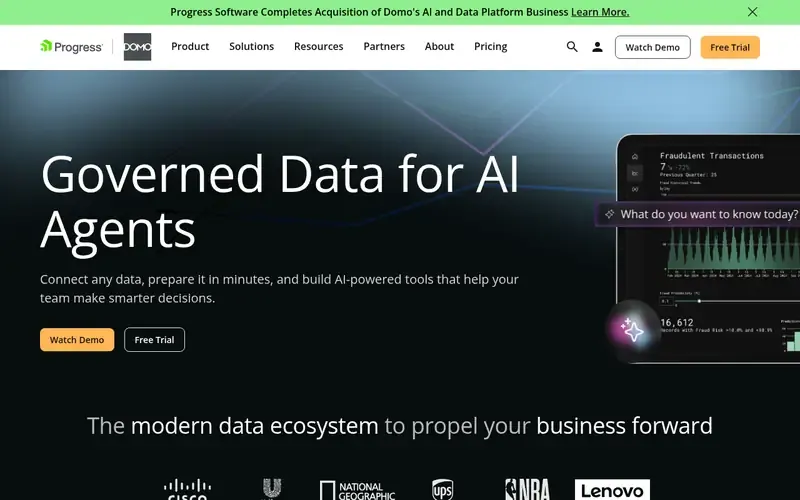
Domo is a cloud platform that connects data from many sources and provides BI dashboards, AI agents and automation to support business decisions.
Documented strengths
- More than 1,000 pre-built connectors
- Natural-language questions about data
- Over 150 chart types
- Threshold-based alerts when metrics change
- Built-in governance with permissions, roles and audit trails
Documented limits
The natural-language capability is described briefly in the vendor's pages, so teams focused on conversational analysis should check the vendor documentation for depth.
- Who it is for
- Business teams that want connectors, dashboards and alerts on one platform
- Platforms
- Cloud platform
- Pricing
- See the vendor's own pricing page for current plans and costs. domo.com
- Facts checked
- 21 November 2026
Why it is placed here: It sits fourth because natural-language questions are one feature among a wide platform of connectors, dashboards, pipelines and automation.
#5 · Qlik
Qlik Sense
Organisations wanting exploration and no-code predictive analysis for people at all skill levels
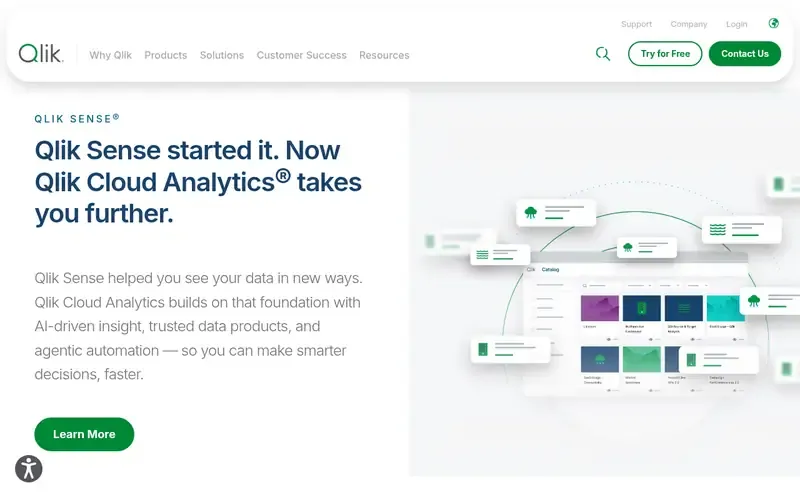
Qlik Sense is Qlik's analytics product, now presented as Qlik Cloud Analytics, offering AI-driven insight, data products and automation to support decisions.
Documented strengths
- Plain-language questions through an agentic experience
- Engine that indexes relationships between values for free exploration
- Qlik Predict for no-code machine learning
- No-code automations that act on data
- Security controls down to the row and object level
Documented limits
The vendor now presents the product as Qlik Cloud Analytics, so teams on earlier Qlik Sense deployments should check the vendor documentation for how features map across.
- Who it is for
- Organisations wanting exploration and no-code predictive analysis for people at all skill levels
- Platforms
- On-premises, cloud or hybrid deployments for data movement; hybrid and multi-cloud data
- Pricing
- See the vendor's own pricing page for current plans and costs. qlik.com
- Facts checked
- 21 November 2026
Why it is placed here: It sits fifth because plain-language questions are offered through an agentic experience, alongside an analytics engine built for free exploration of associations in the data.
#6 · Salesforce
Tableau
Teams that want visual analytics with a natural-language assistant, including self-managed deployment
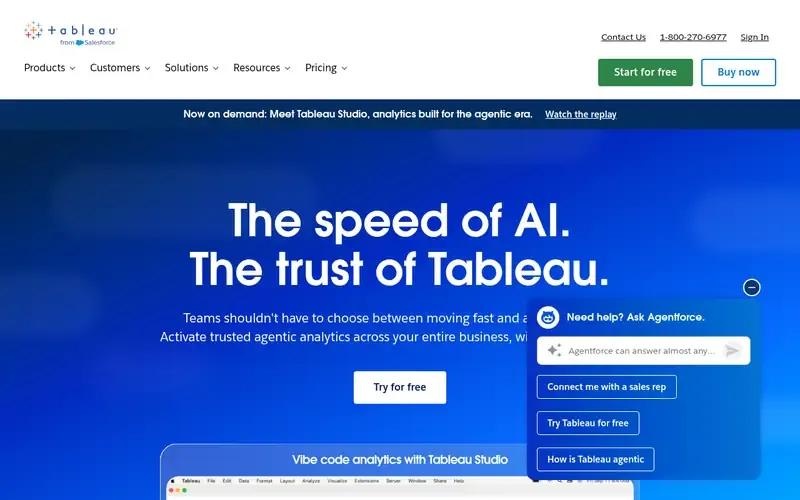
Tableau is a business intelligence and analytics platform for connecting to data, building visualizations and sharing insights, with agentic AI capabilities.
Documented strengths
- Tableau Agent uses natural language across prep, visualization and exploration
- Tableau Studio, an agentic workspace for building analytics conversationally
- Semantic layer for consistent metrics
- Tableau Server for self-managed deployment
- Embedding in products, applications and web portals
Documented limits
Documented as a visualization-first platform; teams that mainly want plain-language questions should check the vendor documentation. Using a customer's own OpenAI model is documented for Tableau Server.
- Who it is for
- Teams that want visual analytics with a natural-language assistant, including self-managed deployment
- Platforms
- Tableau Cloud, or Tableau Server on own infrastructure, any cloud or hybrid
- Pricing
- See the vendor's own pricing page for current plans and costs. tableau.com
- Facts checked
- 21 November 2026
Why it is placed here: It comes last because the product is centred on visualization and sharing, with natural-language use arriving through Tableau Agent and Tableau Studio.
Sources
- ThoughtSpot: thoughtspot.com, thoughtspot.com/solutions, thoughtspot.com/new-features (21 Nov 2026)
- Tellius: tellius.com, tellius.com/about-us (21 Nov 2026)
- Sigma Computing: sigmacomputing.com, sigmacomputing.com/product/ai, sigmacomputing.com/product/vdp (21 Nov 2026)
- Domo: domo.com, domo.com/features, domo.com/platform (21 Nov 2026)
- Qlik Sense: qlik.com/us/da/products/qlik-sense, qlik.com/us/why-qlik, qlik.com/us/all-products (21 Nov 2026)
- Tableau: tableau.com, tableau.com/solutions, tableau.com/products/trial (21 Nov 2026)
Related guides
How we compiled this
We looked at how central natural-language questions and AI-assisted analysis are to each product's documented capabilities. We also weighed governance and security controls, how each tool connects to data, and the deployment and platform details the vendor publishes. Tools whose official pages put search or conversational answers at the core of the product are placed ahead of broader business intelligence platforms that add those features alongside other capabilities.
Every fact comes from the vendor's official pages and was checked against them. The order reflects editorial fit for this use case, explained in the "why here" line for each tool. It does not say any product is better overall. The list is built from documentation, not product trials, so teams should confirm current details with each vendor before choosing.
Order used: Ordered by how central search-driven and AI-assisted analysis is to each product.
Common questions
Which analytics tools let non-technical users ask questions in natural language?
ThoughtSpot, Sigma, Domo and Qlik all document plain-language or natural-language questions. Tableau offers Tableau Agent, which uses natural language across prep, visualization and exploration. Tellius is described as conversational.
Can natural-language analytics query data without copying it?
ThoughtSpot documents direct query to Snowflake, Databricks and BigQuery without a second data copy. Sigma queries the warehouse in place and does not copy data out. Domo can also query data in place in warehouses without duplication.
How do these tools keep natural-language answers consistent?
ThoughtSpot's Spotter Semantics lets teams define KPIs once and reuse them. Sigma data models define metrics once for reuse everywhere. Tableau uses a semantic layer for consistent metrics.
Which tools offer row-level security for self-service analytics?
ThoughtSpot enforces row-level and column-level security. Sigma applies row- and column-level security to reads and writes, and Qlik documents controls down to the row and object level.
Can I run natural-language analytics on my own infrastructure?
Tableau Server can be deployed on own infrastructure, in any cloud, or in hybrid environments. Qlik supports on-premises, cloud or hybrid deployments for data movement. Check each vendor's documentation for the exact options.
The editorial order is unpaid. A vendor can buy one labelled featured slot per guide, but it gets the same fact check as everyone else and cannot alter or remove a competitor's entry. Guidehurst is independent. Product names and logos belong to their respective owners.